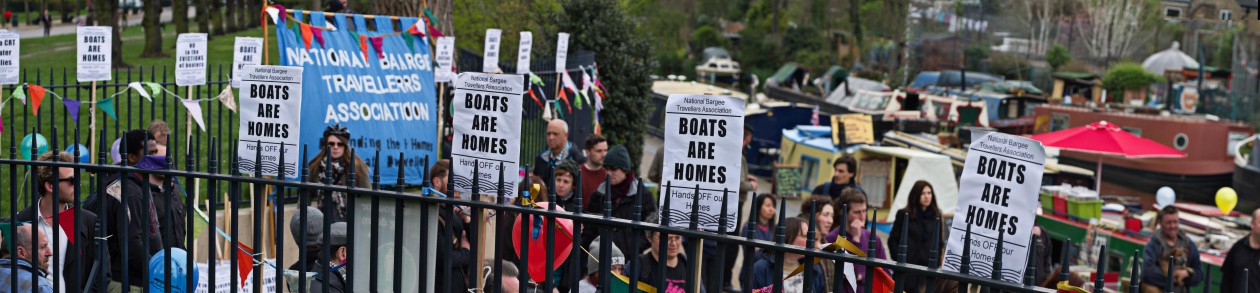
Canal River and Trust (CRT) here have rolled out a survey into managing boat numbers on London Waterways.
This consultation is obviously framed with a set of leading questions to encourage people to say negative things about our community.
https://wh.snapsurveys.com/s.asp?k=160260143288
So we at NBTA suggest to remedy this the response should be of a positive kind, such as:
Question 1: What would the impact be on you / or those you represent if boat numbers in already busy areas continue to grow significantly? (answer needs to be a choice from 1-10, 0 = no impact; 10 = significant impact)
5
Question 2: In your own words tell us what the impact would be on you/those you represent:
More boats means more neighbours, which particulary in urban areas means more eyes on each others’ boats, leading to significantly less crime.
A proportion of boaters feel anxiety walking home alone, particularly in the winter months, and more neighbours means more people to walk with and call on for support.
More neighbours also means more people to interact and make friends with.
More boats can mean more people to share locks with and travel with, which many boaters feel enhances their experience.
Also, a wider range of varied boats and boat dwellers would increase the diversity, vibrancy and therefore value of the waterways for both boaters and members of the wider community to enjoy these areas.
Question 3: In your own words what would you want the Trust to do to manage boat numbers in busy areas?
(Consider the way this question is framed; this is a leading question. CRT have already decided that more boats is a problem. We suggest you might answer this instead with postive improvements to the waterways, such as:)
The trust should improve facilities, increase the number of facilities, increase mooring rings, dredging the channel and up to the bank, improve the structure of banks which are eroding / falling apart, keep on top of maintenance of things such as locks.
Question 4: How could you help contribute to managing boat numbers in busy areas?
(Here’s another hugely leading question. We suggest this could be turned on its head).
I can contribute by helping implement positive improvements on the waterways including the things mentioned above (facilities and mooring rings outside of ‘busier’ areas).
Question 5: If you have any other comments or suggestions, please write them here:
I would like to see the improvements as mentioned above whether or not numbers of boats increase, decrease or stay the same.
Also I would like to challenge the idea of the survey on the base of these points below:
1. The data provided is too coarse and could be misleading. The narrative of the survey is that the London Mooring Strategy (LMS), “acknowledged that if boat numbers continued to rise [since 2018] then additional measures…would need to be investigated” and states that numbers “show no sign of reducing”. This is supported by a single statistic, which compares boat numbers in 2010 with 2019.
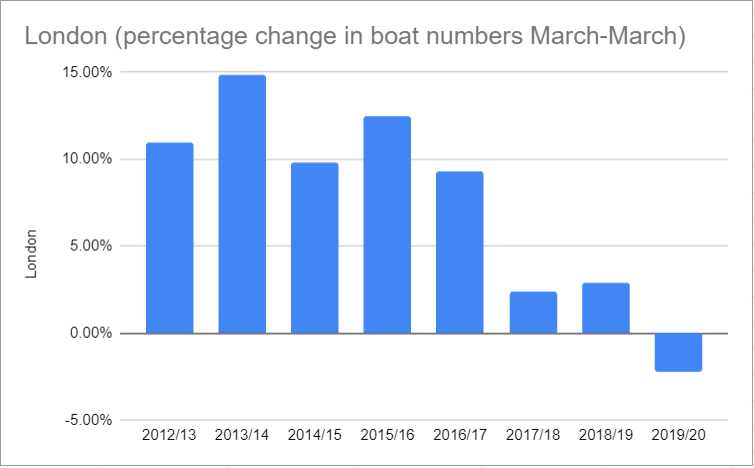
However, the 2020 National Boat Count showed a reduction of 2.2% in boat numbers in the London and SE area. Between 2012 and 2017, boat numbers increased by an average of 11.5% a year, but in the last three years the average has been under 1.5%. This trend (see chart below) tells a very different story to the narrative presented by CRT of unsustainably large increases with no signs of reduction, and so the framing of the whole survey is highly questionable.
2. The first 4 questions in the survey are very particularly framed by CRT, leading down a preordained path, and are therefore likely to lead to unreliable responses. The survey only has a few questions, so each one is very important. The main question looking to gather evidence is question 2: ‘What would be the impact on you/those you represent if boat numbers in already busy areas continue to grow significantly?’ The survey, on the opening page, frames the changes with the point that boat numbers have doubled in the last decade. Without any more detailed data (such as the trends set out above) and with phrases like ‘already busy’, the survey encourages repondants to think that numbers are continuing to rise at the same rate as they have been over the last decade and to imagine an unrealistic and imprecise hypothetical situation and give an assessment of what impact this would have. Responses to this are likely to be alarmist, with respondents imagining the worst (regardless of whether that is likely), and any results from this will be unreliable. The lack of definition around the meaning of ‘busy areas’ or their location is also problematic.
3. The London Mooring Strategy (LMS) proposals have not been implemented or assessed. It is less than two years since CRT completed its comprehensive strategy around London. This took over two years to run, taking in views from a very wide range of stakeholders on the issue of managing London’s waterways. The LMS highlighted potential for 1800m of off-side moorings, the need for new facilities and mooring rings to ‘help spread mooring more evenly across the waterway’ (this more nuanced notion of distribution across London has been replaced with the crude notion of all of London being busy), and creating new short stay visitor moorings and bookable moorings to make London more accessible to visitors. Surely, having spent two years coming up with these proposals which are targeted at the specific issues being considered, it would make sense to complete the implementation of the LMS and assess its impact once completed. It’s great to think outside the box, but only once the good ideas in the box have been fully tested. If those ideas haven’t worked, then there needs to be an explanation of why they haven’t worked published up front to enable a full discussion of what new ideas are needed.
4. The timeline explicitly preempts the outcome of the consultation. While the purpose of this engagement is to generate novel ideas, the timetable published alongside it states ‘July 2021: Implement mooring zone proposals’. It’s a clichéd, hackneyed idea that consultations start with the organisation involved already knowing what the outcome is, but in this case the timeline literally sets out what the conclusion will be. This completely undermines the purpose of the survey, namely reaching out for novel ideas, and deeply erodes trust. This damage is being done right now.
5. The Covid context is missing. Covid is changing everything, as well as creating a huge level of anxiety and insecurity which, as a ‘wellbeing’ charity, CRT should be well aware of. The increase in online working, together with major changes to the job market, could easily lead to a reduction of people moving to London (and increase in people moving away). This is one of the biggest shocks in a generation, one whose impact should be assessed before considering novel, untested ideas for a situation whose form is very likely to change in the future.



 National Bargee Travellers Association - London Branch