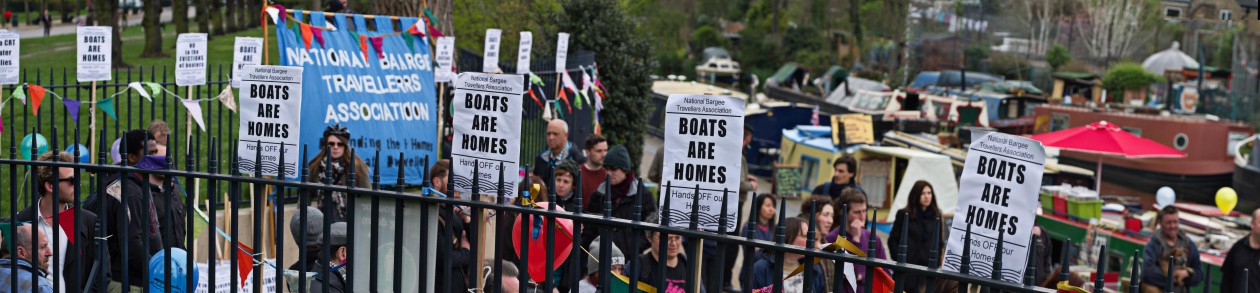
In the recent infamous Zoom meeting in which Canal and River Trust (CRT) attempted to manage the discontent of boaters with the River Lee “safety” zones, Ros Daniels, regional director for London and the South East, referred to those of us who were resistant to their attempts to justify their proposals as “these people”.
It is perhaps tempting to regard the “these people” comment as a slip of the tongue, but it is nearer to the truth that in fact it is merely reflective of how CRT truly regards boaters without a home mooring who cruise the London waterways (and other locations). To CRT, and its predecessor British Waterways (BW), we have always been “these people”. And further more, there has always been too many of us.
In 2011, claiming that boat numbers on the Lee and Stort was too high, BW attempted to impose 6 neighbourhoods covering the whole of the Lee and Stort (4 on the Lee, 2 on the Stort). Boaters would be allowed to stay in a neighbourhood for only 14 days (7 on the Stort and Hertford Union) before moving to the next. Like the CRT’s safety zones, BW’s
proposals were founded on wafer thin evidence, which Sally Ash, BW’s head of boating, said was collected “informally” And like CRT’s “safety zones”, there was no consultation.
Later, in 2014, Sally Ash, now working for CRT and once described as the most hated person in CRT, blamed boaters without a home mooring for spoiling everybody’s enjoyment of the waterways.
The Lee & Stort mooring strategy led to the formation of London Boaters as a campaigning group to defend the rights of boaters in London, and resulted in an humiliating retraction at their hands.
But “neighbourhoods” were not dead. Failing to learn from BW’s mistake, CRT picked up the idea in 2014 and trialled them on the Kennet and Avon. Despite struggling to form anything approaching a legal proposal. Predictably, the trial crashed and burned…until the
next time CRT looked at trying them on parts of the K&A, which along with London, is CRT’s main target for new “policies”, in 2016.
The executives at CRT pay lip service to supporting liveaboard boaters and the benefits of having them on the water; but the examples of how CRT’s continual attempts to justify its existence target boaters without a home mooring could fill a book.
Whether it is mooring plans, boating strategies, number management or “safety” zones, the fact remains that it is we who are affected disproportionately negatively.
That is the price of being “these people”.
 National Bargee Travellers Association - London Branch