CRT have been putting up our license fees over the last two years and they plan to further increase this over the next five years.
Our licenses went up 8% in 2022, 9% in 2023, and they now plan to put them up another 6% on that already vastly inflated figure in 2024 – an increase 23% in just three years, with further increases planned.
On top of this CRT are introducing a ‘surcharge’ for boats without a home mooring from April 1st 2024. This differential pricing based on your mooring status is part of a thinly veiled objective to price itinerant boaters off the water.
CRT claims that this differential licence proposal is the ‘fairest’ way to reduce their current financial problems and maintain the crumbling waterways infrastructure. But those financial problems and the precarious nature of the waterways are due to their mismanagement. Whether it’s spending money on vanity projects such as a new logo or paying subcontractors hundreds of thousands of pounds to enforce their ill-conceived mooring schemes, CRT’s finances are in tatters because of their own negligence.
When it comes to claims of ‘fairness’ it doesn’t take long to see that for CRT, ‘fairness’ is just a deceptive term they use to hide their real agenda – marginalising, penalising and eliminating boaters without a home mooring. Whenever they talk about ‘fairness’ it is always a preamble to making our lives more difficult.
CRT have proved that they cannot be trusted; they cannot be trusted with their finances, they cannot be trusted with keeping the waterways system maintained and they cannot be trusted with our wellbeing.
We believe this to be the largest orchestrated attack on our way of life in years and we are going to stand strong and oppose it vociferously. We want you to stand with us.
Join the NBTA to have your say. Tell us if you oppose CRT’s latest proposal and if so, what you are prepared to do to fight it.
Get involved in the licence campaign working groups
After the great efforts of the National Bargee Travellers Association (NBTA) and others campaigning for the Government’s energy grant, many itinerant boat dwellers on Canal & River Trust (CRT) waterways are now entitled to £600 each. However, a large proportion of the boating community is still being ignored.
On 17th August 2023, the Department for Energy and Net Zero (ESNZ) and CRT announced that 7,000 liveaboard boaters without a home mooring would receive a £600 voucher redeemable for cash.
The NBTA were the first to get in touch with the Government to highlight the fact that many boaters were missing out on the energy grant that was meant to be available to all households in the UK. They went on to work together with the National Association of Boat Owners (NABO), Friends, Families and Travellers, Derbyshire Gypsy Liaison Group, London Gypsies and Travellers, and the Canal & River Trust in campaigning for the grant which includes £400 for Energy Bills Support Scheme – Alternative Funding and £200 for Alternative Fuels Payment – Alternative Funding. CRT only started talking to the Government about this issue months after the NBTA began their campaign, and that was only after NBTA and other boaters put pressure on CRT to do so.
To be entitled to the voucher, you must have held a licence as a “continuous cruiser” for a minimum of one day between 27th February 2023 and 31st May 2023 on Canal & River Trust waterways. If you sold your boat during this period then you will still get the grant retrospectively. No receipts will be necessary.
ESNZ have informed the NBTA that vouchers will be sent (in order of preference) to:
– An email address; – If no email address, then by SMS to the registered phone number; – If no email or phone number, by post to the registered postal address.
There is no fourth option.
Many have now received an email with the voucher that pays the money directly into their bank accounts. The money can also be withdrawn as cash at a PayPoint retailer.
This win was the result of a concerted effort by dedicated people who took up the fight for inclusion and their efforts are hailed by the wider community. “Together, boaters have fought hard for our community and won a victory here,” says a spokesperson for NBTA. “This grant is not a gift from the government, but the result of concerted action and pressure to hold them to their word. The NBTA celebrates that effort and demonstrates what communities like ours can do when we come together and organise for recognition and protection of our way of life.”
Earlier this year, a group of boater activists led a flotilla of boats from Braunston to London on a 15-day journey south to draw attention to the issue and pressurise the Government to follow through on their promise to provide financial support during the spiralling cost-of-living and fuel crises in the UK. The boats moored in Paddington Basin around 1pm on Saturday June 10th and were greeted by a group of supportive boaters in the area, many of whom had also been campaigning.
On 19th June 2023, the boaters handed a petition into Downing Street calling on the government to reverse the exclusion of itinerant boat dwellers and others without a fixed address from receiving the energy grant. The petition was started by the NBTA and gathered just short of 5,500 signatures.
Flotilla boater Kim Marshall handing in the petition at Number 10
The flotilla and petition hand-in were supported by the NBTA, who have been campaigning for the inclusion of itinerant and off-grid communities since the beginning. NBTA Chair Pamela Smith said: “The fact that boaters travelled half-way across the country to deliver the petition shows the strength of feeling that continues to animate our community on this issue. The government may think that by ignoring us we’ll simply go away, but they’re wrong.” She continued, “Not only has the failure to include boaters and others without a fixed address led to immense hardship this winter gone, it’s contributed to a real and enduring loss of boaters’ trust in the government to deliver for them on a basic level. Boaters will continue to make their anger about this rank unfairness known to their representatives, whether via legal proceedings, continuing to lobby their MPs or when they next have the opportunity to go to the polls.”
Ministers first announced on 26th May 2022 that “every household” would receive at least £400 off their energy bills. But it turned out that only households with a domestic electricity meter qualified. No provisions were made for the many thousands of people in the UK who live off-grid for whom the increased cost of living has placed an immense financial burden, just like many others in this country.
Many itinerant liveaboard boaters are on low incomes or pensions, with 48% earning less than £20k per year. With rampant inflation, stagnating wages and the cost of fuel and food skyrocketing, many are struggling to make ends meet. Most rely on diesel engines to navigate, bottled LPG gas to cook and heat water, and other forms of fuel to heat and light their boats. Many boaters have found their finances dramatically impacted by the cost of fuel to stay warm during the colder months and with no government assistance until now, some are still struggling to recover from last winter.
This win follows on from NBTA’s success in late 2022, when they forced the Government to agree to include residential boaters with home moorings in the grant scheme. Now, over a year after the Government’s initial announcement, another group of boaters have finally received money off their energy costs.
However, while the extension of the voucher scheme is a step in the right direction, it only helps itinerant liveaboard boaters who were licensed as itinerants on CRT water in February, March, April or May 2023: 7,000 people out of a liveaboard boater population many thousands more.
So, this is not the end of our fight. Many people – including itinerant boaters on non-Canal & River Trust waters, some live-aboards with a home mooring, and those living itinerantly on land – remain excluded, despite the grant being promised to every household in the UK. Of 900,000 people thought to be eligible for the grant, around 700,000 are still in limbo. The NBTA will continue to communicate with the government in support of and in solidarity with these communities to ensure that the government truly delivers on that promise.
Boaters have been asked to make sure their contact details are up-to-date on the CRT database by 21st September 2023 *new date* as the Department for Energy and Net Zero would be using CRT’s database to determine who should receive the funds. Vouchers will then be received in week commencing 25th September. Payments will be made until 23rd November 2023.
If you miss out because you were not licensed by CRT during this period, or for any other reason, and you think you are eligible for Legal Aid, please contact the NBTA by e-mail or phone.
The Canal & River Trust’s (CRT) failing ’Water Safety Zones’ scheme on the River Lee has been dealt another blow after a risk assessment confirmed that the expensive and unpopular zones are ‘not necessary’.
Once referred to by CRT as ‘Water Sports Zones’, these designated areas on both the Lower and Upper Lee – close to the Lea Rowing Club in Hackney and Broxbourne Rowing Club in Hertfordshire – are a part of CRT’s strategy to remove the number of places where boaters can moor, and to force the itinerant liveaboard community off the water.
Initially CRT had plans to get rid of 550 mooring spaces along the River Lea, where boaters have the right to moor for up to 14 days at a time. Following a sustained campaign of resistance from the boating community (many of whom have continued to moor on the sites despite harassment and failed attempts at enforcement) CRT relented on the full threatened 550 mooring spaces. However, they continue to try and eliminate 295 mooring spaces.
CRT have been unable to provide a clear reason for these ‘No Mooring’ Zones, and despite constant requests have not released any assessment that explains why these sites should be ‘No Mooring’. The National Bargee Travellers Association (NBTA) finally ran out of patience and commissioned an independent risk assessment at three of these ‘No Mooring’ Zones themselves. This assessment, carried out by a qualified and experienced IOSH and IIRSM Risk Assessment professional at three of the ‘No Mooring’ Zones, concludes the following:
‘Boats moored in this area cannot be considered an additional risk as they comply with national standard practice(…) Mooring restrictions at these sites are not necessary’.
The resulting verdict goes on to suggest that it is more important for craft – including row boats – to manage their speed effectively to avoid any potential incidents.
The ‘No Mooring’ Zones policy is designed to make life difficult for many boaters, and could ultimately drive them off the water and out of their homes.
Daniel Prada is an itinerant liveaboard boater who has been moored on and off on the ‘No Mooring Zones’ this year, including on one of the sites the risk assessment covers. He said:
“It’s clear to me that this has never been about safety. The Lower Lee is one of the widest waterways in the whole of CRT’s South East waterway region and I’ve never seen any issues with the navigation at all because of moored boats. Honestly, this just feels like another way for the CRT to put pressure on boaters and make our life more difficult. This is my home – it’s where I’m raising my daughter. To have CRT try and force me out of it just makes me more resolved to defend it so that the waterways can remain a place for everyone.”
CRT has recently put out a series of announcements regarding their money issues, blaming everyone but themselves for the holes in their finances. However, a Freedom of Information request shows that as of 31 May 2023, the Trust has wasted anything up to £249,680.09* on the Water Safety Zones – much of it spent on outsourced enforcement contracts with companies like District Enforcement.
Marcus Trower, of NBTA London
Marcus Trower, of the London branch of the National Bargee Travellers Association (NBTA), has also been continuing to defy the ‘No Mooring’ Zones. He said:
“The NBTA has continuously tried to engage with the CRT to address legitimate safety concerns, but this risk assessment confirms what we knew all along – that the so-called ‘water safety zones’ have never been about safety, and have always been about trying to erase our community from our homes, impoverishing the waterways as a result. Boaters have mounted an incredible resistance to this dishonest, wasteful and fundamentally doomed policy for years, ever since it was first announced. The news that CRT has been lying about their intentions all along, and wasting hundreds of thousands of pounds – which we provide through our licence fees – in the process will only galvanise our community further. CRT needs to stop mismanaging both their finances and the waterways in general, and get their house in order. We will continue to resist, protest and push back at any and all further attacks on the boater community with all means at our disposal.”
No Mooring Sign in the ‘Safety Zones’ covered by boaters with a bin bag
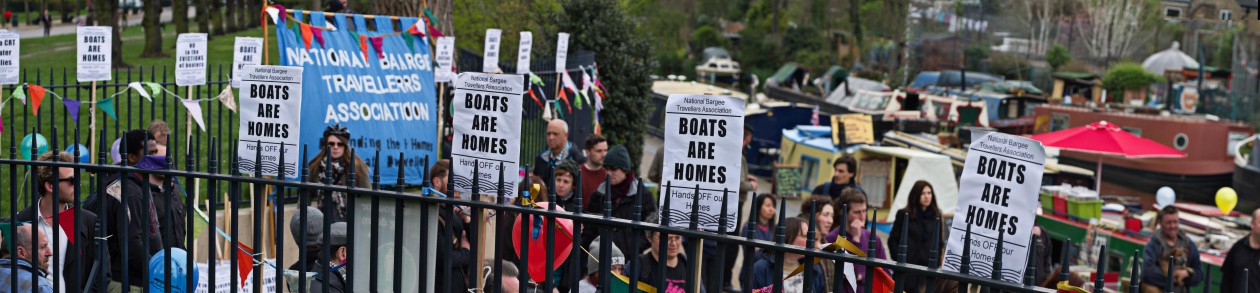
The campaign of resistance against the ‘Water Safety Zones’ continues in full swing. Many boats continue to ignore the ‘no mooring’ signs and resist CRT’s campaign of harassment, and in May of this year hundreds attended the NBTA Spring Fayre – a celebration of the boater community held at one of the key sites that the CRT is trying to erase boaters from in Hackney.
*CRT caveats this figure, saying it is the total spend in the ‘Water Safety’ Zones, and so may cover costs relating to other Trust activities. However, after the recent spate of new ‘No Mooring’ signs erected in both areas, this number will certainly have risen since May already.
NBTA London needs your support to carry on our work. Please get in touch here if you would like to volunteer with us. Alternatively your donations are vital to us supporting boaters with their legal case work, campaign banners and other printed material as well as events. You can help us with your donations online here
A volunteer organisation formed in 2009 campaigning and providing advice for itinerant boat dwellers on Britain’s inland and coastal waterways




 National Bargee Travellers Association - London Branch