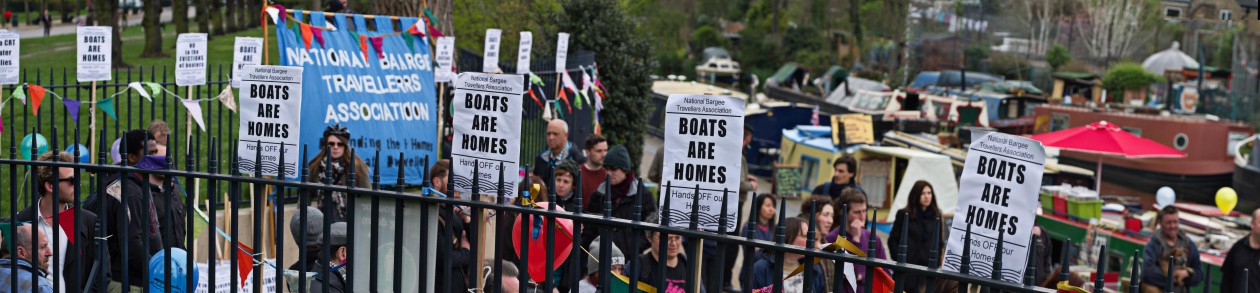
‘Safety Zones’ Update

It has been 3 years since CRT installed a new set of ‘No Mooring Zones’ on the River Lee. These ‘No Mooring Zones’ were exclusionary and unpopular at their outset – leaving the boating and wider community confused why it was so necessary to push boaters out of such a vital community area – without any evidence of a safety issue in the first place.

For 3 years boaters have continued to moor in protest at these ‘No Mooring Zones’ – yet the river has remained safe, with no significant, or even noticeable spike in safety incidents. The Itinerant Boating Community is full of diversity. Boat dwellers are also canoeists, paddle boarders and rowers, and NBTA are keen to encourage and celebrate this diversity, so we have approached CRT to suggest a different approach. An approach based on mutual initiatives – rather than exclusionary ‘No Mooring Zones’ – where different aspects of the boating community work together to ensure the river is accessible to all. 

It is early days yet, and we hope that discussion will have began in earnest by the end of July – but early signs are good, with CRT and key boating orgs along the River Lee showing interest in a different and more collaborative approach.

A further benefit to this collaborative approach is it can be ‘grassroots’, growing within the community – saving CRT the cost of needless and ineffective micro-management and policing during this time of financial need.

Licence Strike Imminent


CRT have introduced their discriminatory surcharge against boats without a home moorings.  As every day passes, more boaters realise that their licences are spiralling upwards while services continue to degrade.  As more boaters realise that they are been priced off the water, urgent action is required.   CRT claim it’s about money.  But is it really? 

There is no money to be made by the surcharge.  Rather it is about making an alternative way of life impossible.


The surcharge has been justified by CRT following a consultation that they presented to their board of trustees.  CRT claimed that the consultation revealed that boaters were overall in favour of a surcharge.  However multiple FOI’s have shown that CRT doctored the consultation, removing the slides that demonstrate that 97% of boats without a home mooring and 60% of all boaters were against the surcharge.  The doctored consultation was used to mislead the board of trustees and push through this discriminatory surcharge.
Recent contact with Richard Parry by NBTA members has shown that CRT has no interest in discussing how the surcharge will negatively impact our way of life.  He has stated that there will be no reopening of negotiations regarding the surcharge.  But CRT once claimed similar regarding the ‘saftey zones’ and following community pressure, they have been forced back to the table. 

So what does pressure look like this time around? A licence strike: Strikers will refuse to pay CRT’s new class of licence fee in protest against the ever increasing additional charges for boaters who
do not want, cannot afford, or cannot find a home mooring.
Currently the Stop the Surcharge Campaign are looking to sign up 500 boaters to go on a full licence strike.  They are rapidly approaching that threshold and strike action is imminent.  Why do they need to wait until 500 are ready to go on strike before acting? First, we are stronger as a collective in the face of CRT’s enforcement.  Such a number would overwhelm CRT’s enforcement capabilities thereby minimising the risk to you and your home.  Secondly, it would deny CRT over half a million pounds (the same amount as the combined salaries of Richard Parry, Chief Executive, and Stuart Mills, Chief Investment Officer).  Such amounts would begin to exert the pressure require from CRT to reopen discussions.  

To sign up to the strike go to  tinyurl.com/licencestrike . We are also looking for volunteers to deliver leaflets and picket CRT stalls, thereby damaging their public image.  If you feel that you would be able to please email:  CRTlicencestrike@gmail.com .

Where have all the boats gone?

In March, the Canal and River Trust (CRT) announced that they will be introducing 800 meters of new pre-bookable moorings at 6 sites across London: Kings Cross, Camden, Victoria Park, Broadway Market, Kensal Green and Cowley North. This is in addition to existing chargeable moorings at Islington, Little Venice and Paddington.

Since then, members of NBTA London have been working together to campaign against the loss of these free mooring spaces, and to tackle the CRT’s assertions that boaters struggle to find somewhere to moor in London and therefore these pre-bookable moorings are justifiable.

These pre-bookable moorings are now live but if you have been anywhere near these moorings, you’ll be wondering who are the boaters that so desperately want to moor in these spots, because they’re not in London. These moorings, which used to be full of bustling boater life, are now empty and quiet. Locals have already started to comment that they do not feel safe walking these strips of towpath at night again. In response to this, an outreach program targeted at locals and boaters, called “Where have all the boats gone?”, is about to be launched to find out how the lack of boats in these areas is negatively impacting their use of the canal and towpath.

To make matters worse, more chargeable moorings now seem to be popping up, almost over night, with little or no warning. Embarrassingly for CRT, these pre-bookable moorings are clearly already failing. Based on the lack of uptake, the CRT have been sent several FOIs regarding the use of these moorings, but unfortunately they have not been very forthcoming with their responses so far.

Chargeable Mooring Sign in London, subverted by local boaters to read, “No Charges apply”

As many boaters have expressed an interest in continuing to use these moorings as standard, 14 day mooring. Here is guidance regarding the possible implications of mooring in these spots: https://nbtalondon.co.uk/2024/07/12/should-i-moor-on-the-payable-moorings-some-brief-guidance-and-advice/

Let CRT know that you don’t agree with this new change by using their contact form here: https://canalrivertrust.org.uk/contact-us/ways-to-contact-us

Is really about money?

As many of you know, the main reason CRT has given for charging more for boaters that don’t have a home mooring is that they need more money. CRT says this is due to two things; 1) inflation, and 2) cuts to the funding they get from the government. 

However, inflation increases are accounted for with an increase in the standard boat licence. In 2022, a CRT standard boat licence was increased by 8%, while inflation that year was 9%. Then CRT increased the standard boat licence once again in 2023 by 9%, while the inflation the same year was just 7%. In 2024, they continued to increase the standard boat licence by another 6% at a time that inflation has decreased to 2%. So as you can see, with boat licences CRT more than compensated for inflation. Therefore, CRT can’t seriously argue that they need to increase licences on boats without home moorings due to inflation.

Now onto the cuts to funding from the government that CRT receives. It is possible to counter this argument with the following argument:

When CRT was set up in 2012 the plan set out by the government was always to cut CRT funding over time until CRT no longer received government funding, and CRT’s job was to find other ways to fund the waterways they managed. For some years, CRT got more funding from the government than British Waterways before them. However, instead of succeeding in the plan to fund the waterways without the government, CRT spent the time wasting money on things like new logos and the ‘safety zones’, plus selling off assets such as most of the marinas, dredging equipment and most other things necessary for managing the waterways; it subsequently costs them much more to hire the equipment back. So either CRT leadership is to blame for mismanagement, or the CRT project was set to fail from the beginning. Or a bit of both. Therefore, it can easily be argued that we as boaters shouldn’t foot the bill for the failure of CRT.

However, the real question should be – can the extra money raised by the surcharge on boats without home moorings cover the decreases in funding from the government?

We worked out that CRT would raise roughly an extra £4.27 million with the surcharge on boats without home moorings over the next 5 years. Which is a drop in the ocean compared to more £320m CRT claims will be cut from its government funding. Also CRT hasn’t put forward any serious plans to raise the hundreds of millions needed to cover the loss of government grants, and charging boaters more will never fill that gap. Therefore, we maintain that CRT isn’t charging a surcharge because they need the money, it is simply a way to make our way of life harder, in an effort to rid the waterways of our community.