New daily mooring fees which are now being charged in a number of locations in London have had a devastating impact on London’s boating community in 2024.
Once-busy sections of towpath have emptied, thanks to discriminatory fee policies from the Canal and River Trust (CRT).
A campaign by NBTA saw a small reversal in policy from the CRT. In November 2024 it agreed to drop prices from the ‘punishingly expensive’ daily charge of between £25 and £35 a night to £20 a night over winter. By continuing to charge a nightly fee, the CRT has created a two-tier system, where those with discretionary spending money for whom an extra £140 a week is nothing at all, can moor safely in central London and everyone else is pushed out.
CRT also agreed to stop charging to moor in Camden, but has remained committed to charging boaters to be able to moor in Little Venice, Paddington Basin, Kings Cross and Angel. These moorings spots — all time-limited at 7 days — are generally considered safe places to moor as long as there are other boaters around, as they are close to public transport and other amenities.
However, the fight to protect London’s canals from de facto privatisation and CRT’s stated ambition to “manage the number of boats in Lonon” is not over.
If you DON’T want London’s thriving boat community to be pushed off the waterways, we call on you to take action before it is TOO LATE.
1. Share your thoughts on London’s boating community in an increasingly hostile environment via social media tagging @CanalRiverTrust and @NBTAlondon
2. Write to the Mayor of Londonmayor@london.gov.uk to tell him how London’s canals and boating community benefits you, your family, your friends, your community, or your business — and why you believe he needs to help protect it.
Here is an opinion of a boater about a licence strike:
My boat is my home. Over a five year period CRT want to raise my licence by around £600. That’s an additional half on top of the fee I already pay. I want to make a stand and I want to refuse to pay such an excessive rise but I’m nervous about a participating in the proposed licence strike. I don’t want to jeopardise my home.
I feel a powerful need to do something to stop CRT getting away with this punitive and destructive surcharge, particularly in the face of reduced services and fat salaries at the top of their organisation. What they’re doing with moorings is what was called embourgoisement when old terraced houses in towns got bought up by the middle classes and working people were priced out of those areas. The same when council houses were sold off. The CRT is looking, by design or by default, to price a whole section of society off the water. Where those people go, CRT don’t seem to care. What they’re doing by running services down is impoverishing the lives of all canal users, not just boaters. Their justifications and their figures are, at best, questionable. What’s their motivation?
Over many years, and in completely different situations from this one, I have had involvement in strikes and coordinated actions. The empowering factor in those activities for the people involved has always been numbers. To stand side by side with people seeking to achieve the same aim is powerful, reassuring and, even if the purpose of the action isn’t fully realised, provides future security in knowing you have each other’s interests at heart. The ripple effects create change somewhere else along the way. It changes the people who are involved and it makes those seeking to squash individuals and force them out of, or into compromised positions, realise that they have to rethink , because together, individual voices form a potent mass, a force to be reckoned with.
Organisations hit by strike action have to rethink their strategies. They have to sit down and negotiate with the people their proposals will adversely affect. They have to back down or compromise. I doubt the CRT would be able to continue to press such punitive payment proposals into action if enough people say “no”. The negative publicity of forcing numbers of people out of their homes would likely be counterproductive if they’re publicly shown to be making life worse by water.
I’ve been on strike as a warehouseman and as a teacher. I’ve been on mass demonstrations, squatted empty buildings, blocked machinery from digging roads across peoples beloved landscapes. Those things have had an effect. I can look back and see that some of the efforts haven’t been successful in the long term but have caused a slowing down of the process, a rethink of the necessity of a scheme and have always cost the organisations and corporations money, something they hate not having control over.
I’ve also seen things conclude with some success. A pay rise, better working conditions, an ear bent to listen in a more understanding way, negotiation of future plans with those who will be adversely affected. I’ve rarely been involved in the process of organising. I’m more a person who stands arm in arm with others who are struggling with the same imposition of stringent and ill advised policies. Standing with people is powerful. If we don’t do it, if we give in to the insecurities it raises for us, if we roll over, we don’t stand a chance of being heard or of winning our case.
The CRT isn’t a massive organisation, it’s not a multinational corporation, it’s not government. It’s a trust, a charity. It has a set of principles it ought to be adhering to. It has a broad remit and it needs to fulfil that remit in all aspects of its work. As Ccers, and it now seems, as long term moorers, they have engaged with us offering unfavourable terms. We need to take those terms back to them and say no. If we try that individually, they’ll pick us off and deny the justness of each case, as if to suggest each individual effort was pure wilfulness or criminality. If a mass of boaters coordinate to say a loud and reverberating NO, they’ll be forced to sit up and take note, to look at their strategy, to test it against a mass of adverse opinion.
How we achieve this it’s not my intention to state here. I just want to reassure myself and others that it’s possible to stop this surcharge being imposed or at least to negotiate something far more reasonable. And I want to hear enough other voices say a simple YES to decisive action so that I feel secure in taking that necessary action myself.
If you would like to ask questions about going on licence strike or agree with having a licence strike please contact Licence Strike campaign group. Licence Strike campaign group are planning to organising the licence strike, their email address is here:
It’s been over a year since Canal and River Trust (CRT) started introducing chargeable moorings as part of their plan to bring down boat numbers in London. So far, only part of the plan to bring in 1.1km of chargeable moorings has been implemented and already these have had a great impact on the boaters that use these areas. Added to the chargeable moorings that were bought in with CRT’s London Mooring Strategy, the length of chargeable moorings in London will do up to 1.5km.
The pretence was that these moorings would allow those from other parts of the country to visit the capital more freely, with assured availability in the most popular destinations. CRT supposedly carried out a consultation on whether boaters wanted such moorings in 2022, however they have so far been unable to provide us with the results of this consultation upon request. Meantime in the “Issues & Challenges Report” published as a result of their 2022 survey, the issue of a lack of moorings in central London is nowhere to be seen: unsurprisingly, a lack of facilities and the waterways falling into disrepair are much higher on boaters’ list of concerns.
Anyhow, availability there now certainly is. According to a Freedom Of Information (FOI) request submitted to the Canal and River Trust (CRT) in June this year and NBTA’s calculations, 1,203 one-night paid bookings were made between 31st October 2023 and 31st May 2024, where the total availability would have been 7,224. This demonstrates that pre-bookable moorings are being used at approximately 17% of their full potential. Chargeable moorings have existed since 2019, with a few available for £10-£12 a night. Why the need to double or triple the price and create more, when these already sat empty?
Paddington visitor moorings after they were made chargeable, 2023
In the aforementioned FOI response, CRT declared a total gross income from these booked moorings of £36,532, averaging an income of just over £30 for each night of each booking. To be clear, this is £30 per night to live in your own home, potentially double-moored, with the wonderful view of central London replaced by that of your neighbour’s curtains. Unfortunately, instead of opening up the capital to those living outside it, it has merely priced those of us already living there out. Instead of opening up new moorings and maintaining those available to us now, we find ourselves crammed into smaller spaces, while the most desirable parts of the city sit empty. This leaves the towpaths increasingly susceptible to crime and violence, particularly as the nights draw in earlier, and commuters walk home after dark. These once thriving community mooring spaces have been left empty and abandoned because CRT has made them financially exclusive – a strange no-person’s land throughout central London.
For those of us crossing the capital and unwilling or unable to pay, we now have an obligatory full day’s cruise ahead of us. And what’s to stop CRT extending these expensive moorings further, leaving us no choice but to stop in them and pay a fee or risk a fine? Alternatively, more London boaters will remain on a River Only licence and cruise solely on the Lee and Stort, therefore reducing CRT’s income further. Boaters from outside London will likely do what most Londoners do all year-round: moor up on the outskirts and travel in.
In an FOI request submitted in October 2023, CRT explained that three Mooring Rangers manage the pre-bookable moorings alongside other tasks, at a cost to them of £104k a year. This doesn’t cover software, IT, admin support, management of that team, or any other associated costs. Considering the gross income from these moorings of £36,532 over six months, so approximately £73k a year, it’s hard to see how CRT could be making much profit, if any. It is in fact more likely they would be making a loss.
So here we are again. Another scheme started by CRT under false pretences, which is not only detrimental to London boaters, but those all along the network, who aren’t seeing any of the supposed income reinvested into CRT waterways and facilities to meet boaters’ day to day needs.
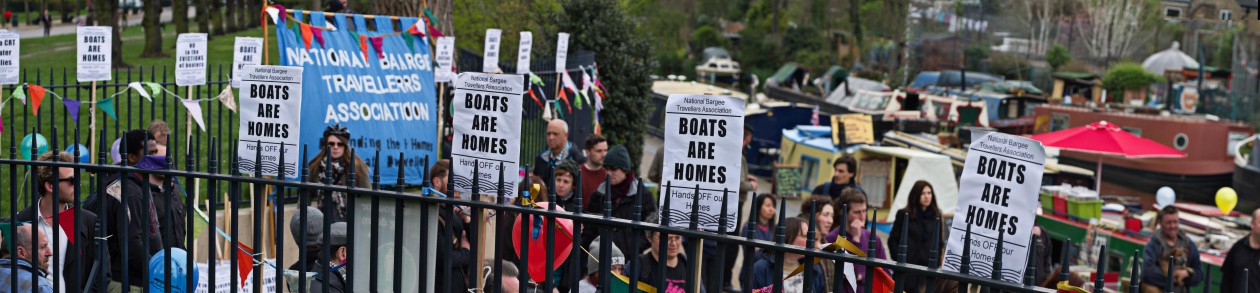
Boats moored in protest against chargeable moorings at Little Venice, late 2023
A volunteer organisation formed in 2009 campaigning and providing advice for itinerant boat dwellers on Britain’s inland and coastal waterways


 National Bargee Travellers Association - London Branch