With the option to change boater legislation on the table for CRT, we need to get more MP allies to help stop any law change. We have put together an easy-to-use online form for you to write to an MP and to collect information on what MPs have said about boaters to help us direct how we lobby them. Here is the form: https://docs.google.com/forms/d/e/1FAIpQLSewVyrdHRYXE9WA0HYlkB_rgPNVDcFWOLHP779xmUF0QD7XRg/viewform
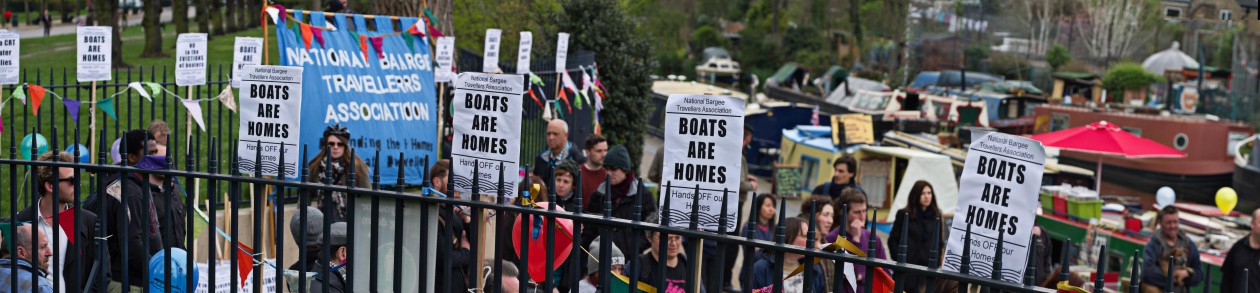
If the UK is a country of villages, then its canal network is the longest village of them all. Our 250-year-old itinerant boating community stretches all the way from Bristol to York. And the community spirit of our shifting village is stronger now than ever. The world’s longest village got together on the 14th June to celebrate life on the water at the Boaters’ Big Bash, held on the Paddington Arm in West London. In what can best be described as a village fair, the Boaters’ Big Bash brought together live music from boater musicians; rousing speeches; a raffle; arts, crafts, and entertainment for boating families; and, of course, a classic tea and cake stall.
Big Boater’s Bash Summer 2025
It took two four-banners stitched together to display the “Welcome to the Longest Village in the World” poster. Land-dwelling local residents came to join the celebration of life on the water, with many telling boaters how glad they were to see the once-abandoned waterways brimming with life again.
The NBTA continues to protest against CRT at boating events around the country. Get in touch if you’d like to join in.
We from the NBTA believe events like this are great to bring people together, increase feelings of community, and public support. If you helped with the event or just attended it, thank you.
If you would like to get involved to help make the next event a success, let us know by emailing nbtalondon@gmail.com.
Following Richard Parry’s announcement that he would be leaving his role as CEO, Canal and River Trust have selected serial charity CEO Campbell Robb as his replacement. Previously CEO of housing charity Shelter and currently criminal justice, housing and education charity Nacro, Robb has long experience of running organisations attempting to paper over the cracks of a failing British state. Perhaps that why he was chosen.
Canal and River Trust’s previous CEO Richard Parry as previously featured on NBTA London
As when Parry took up the role shortly after the foundation of CRT, a certain amount of optimism was expressed at the announcement. Robb’s experience in the “social justice” third sector has been cited as evidence that boaters without a home mooring could get better treatment from the Trust. That would be nice, but given the stuff coming out of the licence review, even if that were his intention – and there is no evidence that it is – such a change in the well entrenched culture of CRT seems unlikely.
In law, there is no designated authority responsible for providing sanitation facilities for boaters. Unfortunately, our community has experienced first-hand that the CRT cannot be trusted to support us in this way, with poorly maintained boater facilities falling into ongoing disrepair or disappearing entirely. Wanting to avoid the weekly chore of lugging a cassette up the towpath—only to find the elsan broken—or taking a long detour to a pump-out, many boaters have turned to separating (composting) on-board loos for both ecological and convenience reasons.
Boater’s compost toilet – Image: Facebook Group/”Compost Toilets for Boats and Off-Grid Living”
Circular Revolution was born in 2021 with the aim of providing boaters with a reliable and sustainable solution to manage their separating loo ‘waste’. C.R. believes that, with the right resources, we boaters want to care for our shared environment and that, with our knowledge of the community and the waterways, we are best placed to do so. The core C.R. service collects dry material from separating loos on boats across London on a monthly or fortnightly basis by e-cargo bike and processes the amassed material into soil conditioner—transforming ‘waste’ into a valuable resource.
C.R. became a Co-operative Community Interest Company (CIC) in 2023, meaning the business is owned and controlled by its members to meet their shared needs. Their aim is to showcase to the UK that a successful, grassroots alternative to the broken-by-design traditional sanitation industry is possible—and that we boaters can be at the forefront of leading this shift.
They are also working hard to make their service accessible to all who want to use it, including introducing sliding-scale drop-off points and running a volunteer scheme where people can contribute a small amount of their time in return for a monthly subscription.
At the Big Boaters Bash we organised in summer the NBTA London Chair, Ian McDowell did a speech and here it is below:
‘When Canal & River Trust (CRT) come up with a new policy or strategy, they have a favourite word to cover up the subtext: fairness. Safety Zones – fairness; extortionate pre-bookable moorings – fairness; converting casual moorings into restricted time visitor moorings – fairness; the licence surcharge for itinerant boaters – fairness. But who loses out each time? Who is targeted? Which part of the boating community is further marginalised whenever CRT talks about fairness? It is, of course, boaters without a home mooring.
But the subtext doesn’t stop with CRT. NBTA members & volunteers speak to a lot of people; members of other boating organisations, boaters and the public on the towpath when we are leafleting and newsletters, people at our public events and of course at events like Cavalcade where we engage with the public and aim to undermine CRT’s spin that they are some kind of beneficent society. And sometimes we are asked “what is your solution?”
What are we supposed to do to come up with this “solution”? Stop campaigning against the “Safety” Zones? Stop campaigning against the removal and monetisation of casual moorings? Stop campaigning against the license surcharge? Stop campaigning for the interests of parents who need to send their children to school, or people with physical and mental health issues who need adjustments to their expected cruising plans?
The fact is that these “what is your solution” questions are very rarely made in good faith. They are an attempt to deflect away from CRT’s attacks on our community and down a cul de sac where they can blame us for not coming up with the answers, framed within an acceptance of CRT’s claims that we are the problem. For these people, when they talk about a solution, they mean a solution to us, itinerant boaters.
So what could our reply be when we are asked about solutions? CRT need to stop blaming us; to stop marginalising us; to stop discriminating against us, and then, and only then, can we talk about the bigger picture.’
A volunteer organisation formed in 2009 campaigning and providing advice for itinerant boat dwellers on Britain’s inland and coastal waterways


 National Bargee Travellers Association - London Branch