A spell of dry weather with very little rain has exposed cracks in CRTs maintenance planning.
This summer, many boaters experienced low water levels and changing plans due to drought. Even at the time of writing, Oxford still has restrictions in place. People heading north had to hold their nerve or turn back. Holiday boaters were restricted to boatyards and marinas. The Leeds canal completely drained, and could easily have been confused with a rubbish tip. Emails advising people to move into pounds with water points were not entirely unexpected as partial closures and timed restrictions in early August quickly became complete lockdowns to retain water on higher ground from August 15th. 20% of the network was closed on Tuesday 26th, the day storm Erin hit.
Despite allowances for the drought, the condition of the canals and locks does seem to be deteriorating over time. A ‘if it ain’t broke, don’t fix it’ attitude combined with lack of routine maintenance and the outsourcing of works to contractors raises the question; Were CRT tasked with maintaining the infrastructure or overseeing its managed decline? We can’t forget that the selling off of plant infrastructure and deskilling their own work force were policy decisions.
An FOI request by NBTA has revealed that dredging, a statutory duty to maintain navigation on the inland waterways, started to be phased out in the 1990s. It has now been completely been outsourced to third parties with ‘old equipment phased out and resources re-allocated to other work’. What other work? If they’re not dredging the canals and maintaining the network, what other work is there? These are the basics.
And while CRT claim ‘a surcharge on boaters without home moorings is necessary for those who make most use of the ‘utility’, it turns out that ‘utility’ is rain! An element that belongs to no-one and affects us all equally. Perhaps they rely a little too much on bad weather?
NBTA helps any boater without a home mooring facing CRT enforcement or other issues that can arise from living on a boat without a home mooring, such as accessing benefits or registering with a GP. We are not a charity; we are boaters not too different from you, and we do this out of solidarity with our fellow boaters.
The reason NBTA puts effort into casework to support individual boaters is our foundational belief that we are stronger together. We shouldn’t allow authorities to target us one by one.
Most boaters on CRT waterways who seek help from us with enforcement issues find themselves in this situation because they have travelled less than 20 miles in a year, turned around a bit too much, or are facing health issues or engine problems that prevent them from moving as frequently or as far. A small number of those who come to us have not moved for quite some time, sometimes even years. Often there are valid reasons for not moving, such as health problems.
Without prejudice, we will do everything we can to stop a boater from being evicted; however, what we can do is limited by what is in existing Acts (of Parliament). On CRT waterways, the main Act for us is the British Waterways Act 1995. This Act states that CRT cannot refuse a licence to someone who has insurance, a boat safety certificate, and either a permanent mooring or who uses their boat for navigation, provided they do not stay longer than 14 days in one place unless reasonable.
So, stopping evictions on CRT waterways hinges on the boater’s ability to demonstrate an intention to use their boat for navigation or to obtain a home mooring.
To demonstrate that intention, the boater may require help in challenging CRT’s decision or more time to get a boat safety certificate, or to get their engine fixed. We use our collective resources as caseworkers to help the boater get licensed.
Another Act that significantly impacts our casework is the Equalities Act 2010, which both BW and CRT ignored until 2014, when a successful campaign by the NBTA brought the issue into the press and thus caused wider pushback. Under this Act, people who are unable to move as often as others or who need to overstay due to a disability or chronic illness can be allowed to stay longer than 14 days or to not have to travel as far in a year. Completing forms or dealing with CRT can be challenging, so we can also assist people with that aspect. Nevertheless, boaters needing reasonable adjustments still must use their boat for navigation if they don’t have a home mooring.
The NBTA believes that as a community, we need to stick together and support one another in sharing the waterways and protecting the travelling way of life.
If you want help from a caseworker, email: nbta.london.caseworker@gmail.com or ring 01615431945. If you are interested in becoming an NBTA caseworker, let us know by emailing us on NBTALondon@gmail.com
When Canal & River Trust (CRT) come up with a new policy or strategy, they have a favourite word to cover up the subtext: fairness. Safety Zones – fairness; extortionate pre-bookable moorings – fairness; converting casual moorings into restricted time visitor moorings – fairness; the licence surcharge for itinerant boaters – fairness. But who loses out each time? Who is targeted? Which part of the boating community is further marginalised whenever CRT talks about fairness? It is, of course, boaters without a home mooring.
But the subtext doesn’t stop with CRT. NBTA members & volunteers speak to a lot of people; members of other boating organisations, boaters and the public on the towpath when we are leafleting and delivering newsletters, people at our public events and of course at events like Cavalcade where we engage with the public and aim to undermine CRT’s spin that they are some kind of beneficent society. And sometimes we are asked “what is your solution?”.
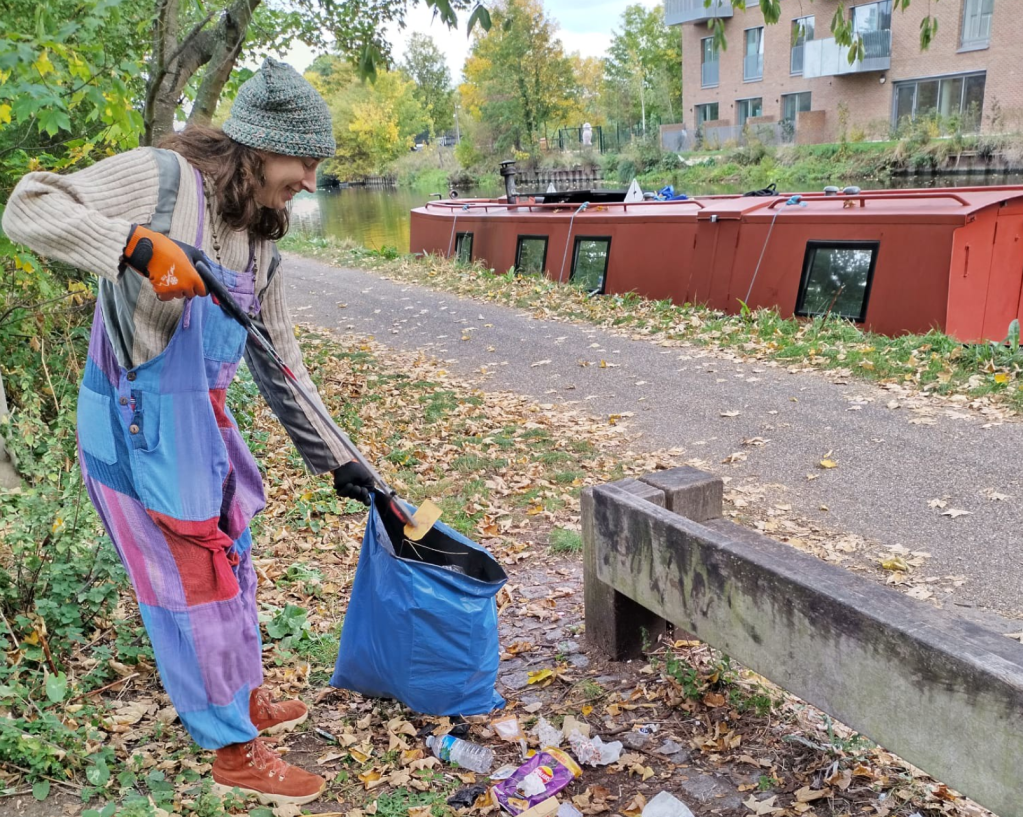
Boaters recently got together to clear up litter in Tottenham
What are we supposed to do to come up with this “solution”? Stop campaigning against the “Safety” Zones? Stop campaigning against the removal and monetisation of casual moorings? Stop campaigning against the licence surcharge?
Stop campaigning for the interests of parents who need to send their children to school, or people with physical and mental health issues who need adjustments to their expected cruising plans?
The fact is that these “what is your solution” questions are very rarely made in good faith. They are an attempt to deflect away from CRT’s attacks on our community and down a cul de sac where they can blame us for not coming up with the answers, framed within an acceptance of CRT’s claims that we are the problem. For these people, when they talk about a solution, they mean a solution to us, itinerant boaters.
So what could our reply be when we are asked about solutions? CRT need to stop blaming us; to stop marginalising us; to stop discriminating against us, and then, and only then, can we talk about the bigger picture.
If the UK is a country of villages, then its canal network is the longest village of them all. Our 250-year-old itinerant boating community stretches all the way from Bristol to York. And the community spirit of our shifting village is stronger now than ever. The world’s longest village got together on the 14th June to celebrate life on the water at the Boaters’ Big Bash, held on the Paddington Arm in West London. In what can best be described as a village fair, the Boaters’ Big Bash brought together live music from boater musicians; rousing speeches; a raffle; arts, crafts, and entertainment for boating families; and, of course, a classic tea and cake stall.
Big Boater’s Bash Summer 2025
It took two four-banners stitched together to display the “Welcome to the Longest Village in the World” poster. Land-dwelling local residents came to join the celebration of life on the water, with many telling boaters how glad they were to see the once-abandoned waterways brimming with life again.
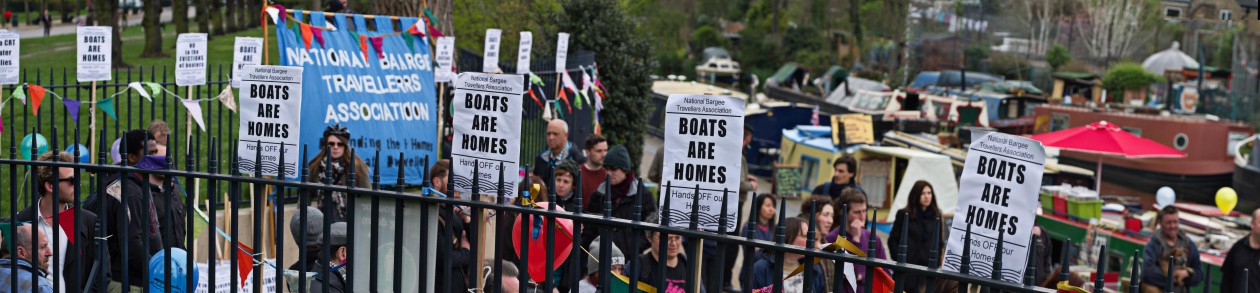
The NBTA continues to protest against CRT at boating events around the country. Get in touch if you’d like to join in.
We from the NBTA believe events like this are great to bring people together, increase feelings of community, and public support. If you helped with the event or just attended it, thank you.
If you would like to get involved to help make the next event a success, let us know by emailing nbtalondon@gmail.com.
Following Richard Parry’s announcement that he would be leaving his role as CEO, Canal and River Trust have selected serial charity CEO Campbell Robb as his replacement. Previously CEO of housing charity Shelter and currently criminal justice, housing and education charity Nacro, Robb has long experience of running organisations attempting to paper over the cracks of a failing British state. Perhaps that why he was chosen.
Canal and River Trust’s previous CEO Richard Parry as previously featured on NBTA London
As when Parry took up the role shortly after the foundation of CRT, a certain amount of optimism was expressed at the announcement. Robb’s experience in the “social justice” third sector has been cited as evidence that boaters without a home mooring could get better treatment from the Trust. That would be nice, but given the stuff coming out of the licence review, even if that were his intention – and there is no evidence that it is – such a change in the well entrenched culture of CRT seems unlikely.
In law, there is no designated authority responsible for providing sanitation facilities for boaters. Unfortunately, our community has experienced first-hand that the CRT cannot be trusted to support us in this way, with poorly maintained boater facilities falling into ongoing disrepair or disappearing entirely. Wanting to avoid the weekly chore of lugging a cassette up the towpath—only to find the elsan broken—or taking a long detour to a pump-out, many boaters have turned to separating (composting) on-board loos for both ecological and convenience reasons.
Boater’s compost toilet – Image: Facebook Group/”Compost Toilets for Boats and Off-Grid Living”
Circular Revolution was born in 2021 with the aim of providing boaters with a reliable and sustainable solution to manage their separating loo ‘waste’. C.R. believes that, with the right resources, we boaters want to care for our shared environment and that, with our knowledge of the community and the waterways, we are best placed to do so. The core C.R. service collects dry material from separating loos on boats across London on a monthly or fortnightly basis by e-cargo bike and processes the amassed material into soil conditioner—transforming ‘waste’ into a valuable resource.
C.R. became a Co-operative Community Interest Company (CIC) in 2023, meaning the business is owned and controlled by its members to meet their shared needs. Their aim is to showcase to the UK that a successful, grassroots alternative to the broken-by-design traditional sanitation industry is possible—and that we boaters can be at the forefront of leading this shift.
They are also working hard to make their service accessible to all who want to use it, including introducing sliding-scale drop-off points and running a volunteer scheme where people can contribute a small amount of their time in return for a monthly subscription.
While CRT complains about the reduction in government funding and uses it as an excuse to increase our licence fees, we must remind ourselves that the reason given by the Tory government for the creation of CRT was so that the waterways could eventually be self-sustaining and not need any government funding. Putting aside the fact that the only way the waterways can continue is at least in part via government funding, the question is: how could the waterways be self-funded?
The only way that the waterways could be self-sustaining is by the waterways authority managing its profitable assets properly. However, CRT, which got the government contract in the first place on the proviso that it would eventually be self-sustaining, has been selling off its profitable assets. Back in 2018, for example, CRT put up for sale its marina subsidiary, BWML. Why did they do this? Was it because the marinas were unprofitable? No. In the words of Stuart Mills, Chief Investment Officer at CRT at the time, “BWML is performing well and we believe its prospects for future growth are good.” In 2018, the turnover at BWML was £8,502,000. This level of turnover continued to grow even after BWML became Aquavista. In 2021, turnover was £10,064,021. But unlike when it was BWML, CRT doesn’t receive that profit from Aquavista.
Limehouse Waterside and Marina is also part of Aquavista owned by BWML
Now that CRT has sold off BWML, who gets that profit? While there are many strands to this, simply put, the profits go primarily to the private equity company Lloyds Development Capital (LDC), which is part of Lloyds Bank. In 2018, CRT sold all its shares in BWML for £2,116 (yes! We found it difficult to believe too, but this is what the financial reports suggest) to a limited company called Project Belize Limited. You would think that the 18 marinas, including the Crick Marina, caravan sites, etc., would sell for millions, but the amount isn’t reported in the press, nor is it in the financial reports of CRT, Project Belize, or Aquavista. So, BWML became Aquavista, and Project Belize borrowed roughly £35 million from Lloyds Development Capital for infrastructure (no more detail is given than that). Aquavista now has 29 marinas in its growing portfolio. A lot of the profits from the marinas go to paying off the debt and, of course, paying shareholders.
CRT sold off this whole road (Dock Road) in 2024
So why did CRT sell off these very profitable assets like marinas, particularly when they weren’t facing a large funding shortfall from the government? There appears to be no good business reason. Even if they sold them off for £35 million, with the level of profit the assets were making, they would get that back in a few years. What better way to bring in money for a water authority than moorings? As well as profits from moorings, BWML generated income from caravan sites, boat brokerage, property rents, and other sources. Now that profit is being gobbled up by shareholders and bankers rather than going back into reinvestment in the waterways, which serve the wider public good.
Sadly, this is not an isolated case. CRT and British Waterways before them have been selling off anything bolted down or otherwise. From lock houses and dredging equipment to even towpaths, assets have been sold off and are being sold off, and this isn’t to the benefit of the waterways. It’s only to the benefit of the people and businesses that own them now. So it is CRT’s remarkable mismanagement (read: selling off) of its assets that has led to huge holes in its funding. We shouldn’t allow CRT to lump us with the bill for this with ever increasing licence fees. We say to CRT: fund our waterways and stop selling our assets!
NBTA London needs your support to carry on our work. Please get in touch here if you would like to volunteer with us. Alternatively your donations are vital to us supporting boaters with their legal case work, campaign banners and other printed material as well as events. You can help us with your donations online here
As itinerant boaters face the double threat of license surcharges and extortionate ‘pre-bookable paid towpath moorings’, it is worth reminding ourselves that when we faced similar challenges in the past, our protests were successful.
In 2010, British Waterways (who were later succeeded by CRT), introduced ‘local mooring strategies’ in London and the West end of the Kennet and Avon. They claimed that ‘more boats are moored along the river Lea than desirable’ and tried to implement a set of rules that would make it near impossible for most itinerant boaters to live in these areas.
British Waterways, in an attempt to make the river Lea less popular for boaters, tried to define the word ‘place’ in the following statute: the vessel ‘will be used bona fide for navigation throughout the [license period] without remaining continuously in any one place for more than 14 days or such longer period as is reasonable in the circumstances.’ (BW Act 1995, Section 17)
They claimed that a ‘place’ is the same as a neighbourhood and then defined enormous stretches of the waterways as one neighbourhood. In London, the entire length of the river Stort became two ‘neighbourhoods’ (and almost entirely seven day mooring only); all waterways in London south of the North Circular became one neighbourhood, including Limehouse cut and the Hertford Union; the Lea north of the north circular was split into three neighbourhoods.
Having redefined the meaning of the word ‘place’, British Waterways declared that itinerant boaters had to move to a new neighbourhood each 14 days and would have tospend an equal amount of time in each neighbourhood across the licence period.
Against this unfair attempt to cleanse the river Lea of itinerant boaters, hundreds of boaters protested. It was at this time that London Boaters, originally a protest group, formed. They got information about the changes out to residents, rowers, canoers, cyclists and surveyed boaters and towpath users. They encouraged responses to the consultation and demonstrated that, far from being unwanted on the Lea, itinerant boats were welcome.
London Boaters also challenged the legality of BW’s proposals and worked with other boating organisations such as NABO (National Association of Boat Owners) and RBOA (Residential Boat Owners’ Association). They conducted their own research which challenged BW’s unsupported claims about congestion and examined the likely impact of the proposals, which would increase homelessness and put pressure on local housing waiting lists. They showed that the changes would prevent boaters accessing education, employment and health care.
Eventually, in September 2011, British Waterways realised the game was up and announced that it was dropping its plans for London. But, they were implemented by the newly formed Canal and River Trust in a 12 month trial in 2014 on the K&A.
On the K&A, similar to the ‘neighbourhoods’ idea, they set a maximum length of time that could be stayed on each stretch of the canal. They also planned to implement a charge of £25 a day for staying longer than stated on a less-than-14 day visitor mooring and introduced a 20 mile minimum distance. If boaters couldn’t abide by these draconian rules, CRT offered ‘roving mooring permits’ (£800 a year for a 60ft boat) which enabled the boater to move every 14 or 28 days. While CRT eventually conceded that the ‘roving mooring permits’ were illegal , many of these requirements will be familiar to itinerant boaters across the country as they have since been rolled out in guidance to all boaters. The parallels between the new ‘constant-cruiser’ surcharge and the ‘roving mooring permits’ might also be noted. BW backed down in London because boaters dedicated a huge amount of time and energy to fighting their cause, but CRT re-used the same ideas on the K&A some years later and are re-using them again now in the introduction of the itinerant boater surcharge and the pre-payable visitor moorings in London. We must stick together and stay united in our opposition to their incessant attacks on our way of life – attacks which have been defended against before and can be defended against again.
NBTA London needs your support to carry on our work. Please get in touch here if you would like to volunteer with us. Alternatively your donations are vital to us supporting boaters with their legal case work, campaign banners and other printed material as well as events. You can help us with your donations online here
As we head into winter, the cost of living on a boat increases massively for many of us, with paying for coal, gas, or diesel to heat our homes. Some of us may forage for free wood to burn. However, this option is now threatened when moored within ‘clean air zones’ due to bans on burning foraged wood.
In the last few years the cost of fuels to heat our homes has dramatically risen. In some cases costs have doubled. But it hasn’t just been boat dwellers that have felt the cost of heating homes exponentially rise. The whole of the UK has seen a great increase in the cost of heating and energy in general. In 2022 in response to this crisis, the government decided to pay £400 towards energy costs for most homeowners. At first however, many households, including boat dwellers, were left out.
Along with non-NBTA members, and other Traveller organisations, we lobbied different MPs across the country. We also lobbied CRT to get them to put pressure on the government. NBTA also met several times with the civil servants, responsible for the Energy Bills Support scheme, including with the deputy director-general of the Department for Business, Energy, and Industrial Strategy.
Many of us sent emails to CRT demanding they do something as well. Then CRT started to talk to the government and made at least one press release stating that boats without home moorings should also get the grant.
Into the summer of 2023 we continued with our campaign including boats with banners and also handing a petition into 10 Downing St. Along with all this, a few boaters without home moorings on CRT waterways started legal action for discrimination against the government on the basis of being left out of the scheme. Two weeks after the solicitor put the papers into court, the government announced that they would pay both energy grants worth £600 to each boat licenced on CRT waterways without a home mooring.
Although we should have got the grant from the beginning, with a campaign, political and legal pressure, we won. This shows that whilst it’s never guaranteed, sometimes our collective effort can have a huge payoff.
NBTA London needs your support to carry on our work. Please get in touch here if you would like to volunteer with us. Alternatively your donations are vital to us supporting boaters with their legal case work, campaign banners and other printed material as well as events. You can help us with your donations online here
It’s been over a year since Canal and River Trust (CRT) started introducing chargeable moorings as part of their plan to bring down boat numbers in London.
So far only part of the plan to bring in 1.1km of chargeable moorings to London has been implemented but already these changes have had a great impact on boaters who move through these areas of London.
In the CRT’s London Mooring Strategy, the length of chargeable moorings in London could go up to 1.5km in the next year.
CRT claimed to have consulted boaters in 2022 on the need for such moorings but it has not provided the results of this consultation. Notably, their 2022 “Issues & Challenges Report” did not mention a shortage of moorings, instead it highlighted boaters concerns about disrepair and lack of facilities.
Little Venice chargeable moorings in August 2024. Once brimming with life, now desolate.
Chargeable moorings were first introduced here in 2019, but they were priced at £10 to £12 a night. Despite low demand at that price, CRT has significantly raised the price, leading to even more space in central London being wasted, empty of boaters.
According to a Freedom of Information (FOI) request submitted in June 2024, only 1,203 bookings were made between October 2023 and May 2024 (out of a possible 7,224 bookings), indicating that the moorings were used at just 17% capacity.
The FOI revealed that CRT earned a gross income of £36,532 from these bookings on an average of just over £30 per night. We believe this is barely enough to cover the cost of administering prebookable moorings.
The rationale for them is to enable people to book a berth without having to find somewhere to moor on their own in central London. However, the data tells us that the demand is simply not there: only 16.5% of the availability has been utilised.
Rather than improving access to the capital, the charges have effectively priced many existing boaters out of central London, leaving prime locations empty. As a result, many boaters must now cruise for a full day to find a mooring, or risk being fined.
There is a knock-on effect of leaving these locations empty too: those who cannot afford to pay are forced to moor in now even more crowded areas, making a trip through London even more precarious for boaters with or without a home mooring.
Vandalised chargeable mooring sign in London
The situation has also worsened safety concerns for boaters and local residents, as these once-bustling sections of towpath have been deserted, leaving them more vulnerable to crime.
Others may opt for a River Only license, staying on the Lee and Stort as London’s main canal network becomes too expensive, a move that will reduce CRT’s revenue further.
The decimation of London’s boating community and the safety that it brings to the canal here means those boaters from outside London whom CRT are trying to entice with their pricey prebookable moorings are likely to avoid the capital altogether.
A subsequent FOI in October 2024 revealed that three Mooring Rangers, tasked with managing these moorings, cost CRT £104k annually, far exceeding the (assumed) £73k annual income from the moorings. This suggests CRT may even be operating this policy at a loss. It is an illogical policy that is costing boaters and CRT, with no clear benefit to either.
In November 2024, CRT decided to reduce the price of these chargeable moorings – from between £25 and £35 per night to £20 per night – as a result of NBTA London’s campaigning.
We look forward to seeing whether the reduced price has any positive uptick in the number of bookings made, or if there is in fact NO case for charging per night for mooring on the public towpath at all.
Due NBTA London campaigning CRT has also agreed to stop charging to moor in Camden and says they no longer plans to roll out more chargable moorings across London including Uxbridge, Kensal, Broadway Market and Victoria Park. However, CRT has remained committed to charging boaters to be able to moor in Little Venice, Paddington Basin, Kings Cross and Angel.
NBTA believe these mooring spots should be open for anyone boating through London, as is the norm across the entire canal network, and that the privatisation of public spaces should continue to be resisted.
NBTA London needs your support to carry on our work. Please get in touch here if you would like to volunteer with us. Alternatively your donations are vital to us supporting boaters with their legal case work, campaign banners and other printed material as well as events. You can help us with your donations online here
A volunteer organisation formed in 2009 campaigning and providing advice for itinerant boat dwellers on Britain’s inland and coastal waterways




 National Bargee Travellers Association - London Branch