Oh look, an (allegedly senior) member of Lea Rowing Club (LRC) taking an angle grinder to the grab bars which can help people who have fallen into the river get out safely.
LRC has been unapologetic in pushing for CRT’s implementation of the “safety zones” – in fact they were the ones who came up with the deranged scheme in the first place.
But actually useful pieces of safety infrastructure there to help everyone don’t seem to matter to these overly entitled hypocrites. Could it be that their interest in “safety” has more to do with their desire to not share the river with other users?
Canal and River Trust (CRT) are attempting to bring in yet another restriction to all boaters, including boat dwellers without a home mooring, which will prohibit mooring nationwide on any bends or near bridges, regardless of whether it blocks navigation or not.
This proposal has not gone through any consultation process, but has been underhandedly tagged on to CRT’s “No Mooring” strategy that we are currently experiencing predominantly on the River Lee. The new restriction of no mooring on bends or near bridges refuses to take in to account the safe mooring on the bends of wide waterways such as the River Lee and parts of the Grand Union Canal.
It is the view of NBTA London that if safe navigation is not impeded by mooring on a bend or near a bridge, then to restrict mooring is simply reducing the possibility of liveaboard and leisure boaters alike from stopping in an available and perfectly feasible mooring.
Banning boaters from perfectly safe casual moorings on the bends of wide waterways begs the question of whether already existing, online long term moorings, located on bends or under bridges, and from which CRT derives income, will be removed.
Of course this won’t happen.
Just another example of CRT’s hypocrisy when it comes to attacking our community.
The Canal and River Trust (CRT) is preparing to launch an assault on the rights of boaters. Specifically, their rights to moor on large stretches of the historic River Lea, a river which has been populated by boat owners of all flavours dating back to the Bronze Age.
They are pursuing this strategy in the name of safety: they claim moored boats are a hazard to the users of the waterway. We do not agree. In fact, it is CRT themselves who are allowing the River Lea to become a dangerous place. They are allowing it to become dangerous through a lack of care, a lack of investment and a lack of sense. There are too many places which are too shallow, which make it impossible to moor close to the bank or even moor at all, in some places it even makes it hard to navigate.
The Lea has not been properly dredged for many years, 11 to be precise – and that was just the Lower Lea. Waltham Town Lock to Kings Weir hasn’t been done since 2009 and doesn’t even have a record of when above Waltham Town Lock has been done last.
And why, 11 years ago was the cost of dredging the Lower Lea deemed acceptable? The answer is simple, the City of London and by extension British Waterways did not want important, international visitors to the Olympic park to have to contend with the putrid smells and depressing sights of the nearby river which had been neglected. At the time, Simon Bamford, General Manager of British Waterways (BW) in London, is quoted as saying ‘[water] quality on the River Lee Navigation has been an issue of concern for many years, affecting local residents, wildlife, boaters and other waterway users’.
The reason for the poor quality? To put it quite simply, a deluge of raw sewage overflows brought down from Deephams Sewage Works in north London. 11 years later and that issue has not gone away! Together with the 2018 Lower Lea river oil spill, the Lower Lea is fast becoming a toxic mess that is hazardous not only to the humans that spend time within its proximity, but also the animals that call it home.
If safety was a real issue for CRT, rather than removing places where we can moor, they should be looking at positive actions which would get wide support, like dredging.
Canal and River Trust (CRT) are planning to change visitor moorings in central London into paid, pre-bookable moorings.
They are proposing ten locations, totalling 1.1 kilometres of towpath between Kensal and Viccy Park, where moorings that are currently free 7 or 14 day moorings will become 7 day moorings costing £10 to £12 per night. The fees that are being asked for would equal between £70 and £84 per week with no mention of how CRT will manage late arrivals, cancelled bookings, or over-stayers.
The proposals would mean for many boaters who cannot afford these significant fees a very long run from Kings Cross to Willesden that may well cause a lot of stress. It is another attempt by CRT to push out poorer boaters from central London. This is nothing less than social cleansing of the waterways.
CRT are also planning to make it an ‘improper mooring’ offence to moor a widebeam and a narrowbeam next to each other, no matter how wide the river or canal is. While we understand that this may be sensible where the waterway is narrow, such a blanket rule is unnecessary and unfair, especially given their plans to further reduce free mooring spaces in London.
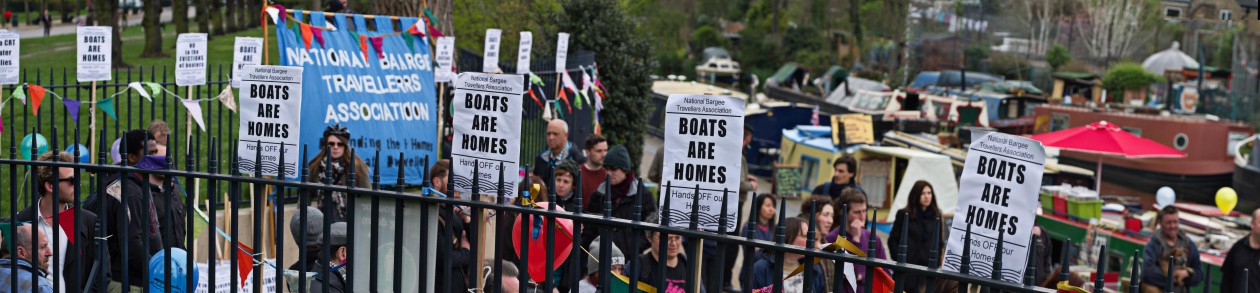
On Saturday 26 March 2022, hundreds of boaters marched on Canal & River Trust’s (CRT) main London office to protest the Trust’s continued attack on the capital’s liveaboard boating community.
Starting in Regents Park, the protest marched to CRT’s offices in Little Venice where they were addressed by speakers from the boating community and land based supporters and engaged with the public to explain how these discriminatory policy changes are threatening people’s livelihoods.
The protest was hailed as a great success by Ian McDowell, Chair of the London branch of the National Bargee Travellers Association, which has helped organize boaters’ opposition to CRT’s attacks.
Since London’s boaters forced CRT into a consultation on their plan to remove up to 550 mooring places on the River Lea in 2021, the Trust has doubled down on their plans to cull boats from London’s waterways including:
• Bringing in more reduced mooring times on the Grand Union; • Implementing banning boats from 295 ‘no mooring’ spaces in ‘safety zones’ despite indicating they wouldn’t; • Turning a blind eye to criminal damage of safety features of the River Lea inside a so-called ‘safety zone’; • Proposing 1.1km of new chargeable moorings and further mooring restrictions in Central London; • Revealing that the Trust no longer takes complaints about their policies.
The National Bargee Travellers Association (NBTA) believe this is further evidence of CRT’s plans to prioritise leisure over living on Britain’s waterways. Early in 2021, CRT announced that they would be restricting moorings along 10km of the river Lea, claiming that mooring in these ‘Water Safety Zones’ was unsafe. The NBTA, together with the London boating community, fought back by organising two flotillas involving over 70 boats and 1000+ people. CRT was forced to engage boaters in consultation, the result of which showed boaters are concerned about safety, but the ‘Water Safety Zones’ would not make the river safer. The ‘River Lea Forum’ was established with representatives from all interested user groups to discuss what would make the waterways safer. However, CRT ignored boaters’ voices by imposing many of the ‘Safety Zones’ before the first Forum even took place.
In October 2021, ‘no mooring’ signs started appearing on the River Lea and boaters moored in these areas were told they would have enforcement action taken against them under the new ‘Improper Mooring Process’. CRT claims that these sites come under its existing rules on where boats are permitted to moor, but these are the exact same stretches that they’d planned to designate as no mooring as part of their ‘Water Safety Zones’, making these new rules for areas where boaters have lawfully moored without any penalty for many years.
On 10 January 2022, enforcement started on the ‘no mooring’ sites and since then, CRT has continued to try and intimidate boaters by giving notices threatening to terminate licences and thereby forcing boaters out of their homes. CRT has also employed a third party car parking ‘enforcement’ agency at huge cost to hand out these notices.
Tyrone Halligan, Amelia Friend and their two year old son Isaac.
London houseboat dwellers stage a protest against what they believe is a drive by the Canal & River Trust to force them out, as part of a gentrification process of the UK (particularly London’s) waterways.
Amelia and Tyrone have lived on a boat travelling the London waterways for seven years. Together with their two-year-old son, they spend up to 6 months a year staying in one place to the next along the stretch of the River Lea from Tottenham to Stratford where the ‘no mooring’ signs have gone up. They are currently expecting their second child and worry that they may have to leave the water, and perhaps London, altogether. “This area is our home. My son attends a nursery here and we’re registered with doctors, dentists, and my midwife appointments are in Homerton Hospital. We have built a life within this area and not being able to moor here truly feels as if we are being forced out,” Amelia says. “The stress of receiving abrupt emails, notices and knocks at the door, about where we are moored, in areas we have allowed to be for years previous, is causing us a great deal of stress at a time when, as a young and growing family, we already have a lot going on. No consideration is being given for people who have set up their lives, careers and families in these areas.”
Days before Christmas 2021, CRT made a fresh attempt at trying to take away mooring spaces in the capital by sneaking out another consultation with proposals for paid-for bookable short term moorings of less than 14 days. This, despite their own figures showing that the two ‘test sites’ for these new chargeable moorings have had less than 25% occupancy – most of the year they were wasted moorings. They’re also proposing further areas of restrictions on triple mooring and narrowboat to widebeam mooring – regardless of how wide the navigation is. “This continued disregard for the people who live and work in these new ‘no mooring’ and proposed paid-for mooring areas drives boaters away from their livelihoods, and out of their homes,” argues Ian McDowell, chair of the London branch of NBTA. “By ignoring its responsibility to preserve the waterways for all communities, CRT is crossing a dangerous line that could see London Waterways and other waterways become usable only by those who can afford any extra costs CRT chooses to introduce in addition to the licence fee. Their actions only serve to show that while CRT markets themselves as a charity that promotes wellbeing, they repeatedly try to introduce policies which attack boaters’ wellbeing and way of life.”
NBTA London demands that CRT concentrates on its mandate to maintain the navigation with things like dredging, rather than persecuting boaters who moor on some of the widest waterways in the country. The Trust must stop destroying boating communities by favouring one kind of boater over another.
NBTA and London Boaters have fought and prevented unfair and destructive attempts like these before, and we will do so again. National Bargee Travellers Association London branch (NBTAL) is supporting boaters in their direct action to disobey the ‘no mooring’ signs through providing a template complaint letter if they do receive a notice and posters to display in windows declaring the boat is moored in protest. Hundreds of boaters have defied CRT’s unfair and unjustified restrictions so far and since we are unable to complain online, now we are marching on CRT’s offices to resist the displacement of boaters and to protect our homes.
Ali was moored at Daubeney Fields. She works for a food and farming charity which advocates for land redistribution and community grow projects. Ali has been on the water for three years. “I’ve been involved in the protest movement against the new CRT restrictions for about a year and a half now, since the safety zones campaign started. I consciously seek out places where the new no mooring locations are. I speak to my neighbours about the restrictions, so that everyone in the community knows about them. And I think it’s important to show up physically against CRT’s attempts to gentrify the waterways even more. These are perfectly great moorings and the idea that they could become paid for or private moorings is really shocking. It’s been a hard year for everyone and the fact that space and land access is going to be restricted is really disgusting.”
“We must take a stand to protect our way of life or they will do everything they can to get rid of it.”
Marcus
Dee, Michelle and their son Io were moored offside at Daubeney fields. They have been on the water for just over a year. Mychelle is a baker. Dee is a gardener and has been clearing up the bankside where they are moored to make a lovely space for their son and other children to play. “It is a good spot to moor and it doesn’t cause any obstruction to anybody; there’s no reason for it not to be moored on. It’s a good spot to be. “The fact that it is a no mooring spot hasn’t really changed our minds about mooring here to be honest. If there was a real reason, like if it felt dangerous, then we wouldn’t moor here, obviously. But there’s no reason. Usually, families moor along here and our son will hopefully start school locally too.”
Lud by his boat
Lud “I work in a cleaning and maintenance job on a dock restoration site by the river. I’ve been on the water since 2016 and I fell in love with boating life and its people. I’m resisting the ‘no mooring zones’ because I think they are not fair to boaters who live on their boats and there’s nothing to justify them.”
Ben and Pru were moored at Matchmaker’s Wharf. They have been on the water for about three years. “We got a notice from the enforcement guy saying that we are wrongfully moored – there are no signs to tell us that we shouldn’t moor here and we haven’t received an email updating us about where we can and can’t moor. “CRT tried to put a load of water safety zones in and then realised that they hadn’t consulted anyone apart from the rowing groups. In a few years it will be impossible to moor in London and it will become just a rich city for rich people. It’s a subtle cultural genocide. They want to take us away.”
Jade and Ted were moored by the Green Bridge (Mandeville St).
Jade & Ted “There is no logic to what CRT are trying to implement. What they say it is about and what it is actually about are two different things. Safety is important, but this is nothing to do with safety”
Matthew was moored on the bend just above the Princess of Wales. He is a musician and he fits out sailaways to sell on. “I love the river and I love the people on it. I think (the safety zones) are absolutely ridiculous really. Boaters made the canal and rivers habitable again, haven’t we? We have a lot to do with the regeneration of the canals in London. The rowers don’t own the river . This is our life, for them it’s just a hobby. It’s really backward thinking and there’s a definite disconnect between us and CRT.”
Jay was moored near a bridge on the Filter Beds. Jay works in theatre, but has just quit his job and is going to cruise to Bristol at some point soon. “I didn’t realise that I was on a no mooring section. I’ve not heard anything, and I’ve been here a week. I think its just CRT saying that boaters are creating a problem, but we’re not. It’s kind of bullshit isn’t it? I don’t think mooring here makes any difference compared to mooring there, or mooring there (pointing to mooring spaces nearby).”
“In a few years it will be impossible to moor in London and it will become just a rich city for rich people. It’s a subtle cultural genocide. They want to take us away.”
Ben & Pru
Amy was moored near a bridge on the filter beds. “I don’t think (the safety zones) are needed. I think it is an unnecessary crackdown on numbers of boats in some of the widest parts of the river. The restrictions are unnecessary and I plan to ignore them for as long as possible.”
Marcus and his son aboard their boat
Marcus was moored by the electricity bridge on the offside. He is home schooler and plumber and has lived on the water for 10 years. “Over the years Canal and River Trust has been taking places where it has been possible to moor away. We must take a stand to protect our way of life or they will do everything they can to get rid of it.”
Canal River and Trust (CRT) is trying to further marginalise us by bringing in more reduced mooring times on the Grand Union, attempting to ban boats from 295 no mooring spaces in ‘safety’ zones on the River Lee, and introducing more mooring restrictions and a total of 1.1 kilometres of new chargeable moorings in Central London.
With the Clean Air Act putting boats under the same clean air zone restrictions as houses, the Government has made it harder for many of us to heat our homes and has opened us up to more harassment from land based NIMBYs.
We must stand together and continue to defend our nomadic way of life. A way of life that has been on the firing line for some time. Some older members of the community will still remember when British Waterways (BW) put forward their Bill to government in 1989, they tried to make it a criminal offence to have a boat without a home mooring on most UK waterways.
Due to action by some great individuals that particular attack was defeated and the Bill was made into the British Waterways Act 1995, where the right for us to have a boat without a home mooring, as long as we use them for navigation and not stay continuously longer than 14 days in one place, unless reasonable, was enshrined in law.
We are in a different time from then and we need more than great individuals; we need collective action. The resistance to ‘safety’ zones on the River Lea is great example of how we can defend our way life.
Let’s come together to march on CRT Little Venice office on Saturday 26th March and using the press, make it heard that Boats are Homes!
The serene surroundings of Cheshunt’s Lea Valley were interrupted when a man employed by CRT to collect their rubbish began swearing violently at a bin that looked like it had exploded.
This new spot for a congregation of boaters, not because of their new-found love for Cheshunt, but as a result of CRT’s policy of forcing boats to ‘increase their range’ and with nowhere to dump their household rubbish the trash of a dozen boats was being crammed into a container the size of a large pedal bin. What was needed was something ten times the size. If a tap and an Elsan were located here the boaters in Cheshunt would have found themselves in canal heaven.
Facilities are scarce
CRT says it’s ‘committed to…improving facilities for boaters’. A Better Relationship Group (BRG) was formed for boaters to discuss concerns with CRT. Facilities are second on the group’s list of objectives (increased moorings being the first and increased enforcement being the last). The need for far more facilities cannot be denied, particularly west of Paddington. CRT’s own survey of ‘London’ facilities, from Bishops Stortford in the north to Cowley and Brentford in the south west (a lot of canal) revealed how poor facilities are; 9 Elsans, 15 taps, 5 pump outs, 9 rubbish points and 5 WCs, and some of these scarce facilities, such as the pump-out at Stonebridge lock are in poor working order, or are in complete disrepair, as is the case of the WC at Victoria Park which is now a distant memory.
More boaters = more facilities?
The increasing number of boats (14% in 2013 and 10% in 2014) means more revenue for CRT and should mean more facilities. CRT and BRG made some very modest proposals; 3 new pump outs, 2 new Elsans, 3 new water points and 4 oil collection points, but none of this work has been carried out.
CRT neglect
What is stopping CRT? They’ve admitted new facilities are necessary, they have the money, with a surplus of funds in 2014. If they were as pro-active about taps, bins and Elsans as they are about ‘enforcement’ there would be facilities at every other lock. Is it incompetence or some kind of ‘benign neglect?’ My own experience of their administration has convinced me they are incompetent. As someone once said, it’s like Kafka meets the Marx Brothers.
There is a hypocritical corporate mentality at work. Behind the marketing machine with its cuddly website, the pretty signs and volunteers strategically placed at Camden for the tourist, behind the image of a progressive organisation that cares about boaters and the environment, is an antagonism to an alternative lifestyle and utter indifference to recycling and issues around housing. At the same time individual boaters, who are paying a licence fee, are subjected to the kind of monitoring usually associated with a police state and denied the facilities that every household in the country has a legal right to; a water supply that is easily accessed and rubbish disposal that is not a health hazard.
CRT has said that it intends to, ‘educate boaters about cruising requirement’, but ‘continuous cruising’ requires actually facilities and not mere lip service to the idea of better facilities, in this respect it is CRT which is in need of education and not the boating community.
The London branch of the National Bargee Traveller Association (NBTAL) has launched a new case-worker group in a bid to help London boaters who are affected by enforcement and the new Canal and River Trust (CRT) policy on refusing licences.
How can they help?
The case worker group keeps up to date with pooled knowledge of the current implementation of the new enforcement policy and the legal framework under which the policy sits, and can give assistance on ‘how far is far enough’ questions, re-licensing, sighting data queries, benefits, disability allowances and adjustments and other related advice.
Enforcement policy & ‘restricted’ licences
After a trial period when the new policy only affected new boaters on their first licence, CRT has recently announced that the new enforcement policy came into action for all boaters on the 1st May. Anyone having their licence renewed after that will fall under the new policy. CRT have stated that if a licence is renewed after the 1st May, they will look back over the previous year and make a decision as to whether you fit their current definition of “moving far enough and often enough”. If the boater fails this test they will refuse to renew their licence and will tell the boater to take a home mooring or remove their boat from the waters. If the boat isn’t removed and
is a live-aboard, then the next step is they will likely take the boater to court for having no licence and to seize the boat and remove it from the canal.
For an unspecified trial period, CRT are offering temporary 3 or 6-month “restricted” licences to affected boaters so they can “mend their ways”. This offer of restricted licences is “while boaters get used to the new regime”.
Fears
The NBTAL fears that in the future, CRT will simply refuse to renew licences with no restricted trial period offered. At a recent Canal User Group meeting, an NBTAL member asked the London enforcement manager how long the trial period would last and what happens afterwards and was told that “boaters would always be warned before we refuse to renew their licence.”
After a request from the NBTA, CRT have stopped charging premium rates for these “restricted” licences and the cost is now pro-rata to the full licence.
Volunteer case workers
Case workers can be contacted by email and are also available for a chat through a special helpline on 07974 298 958
WHAT DO I DO IF CRT REFUSES TO RENEW MY 12 MONTH LICENCE?
Licences
CRT’s new enforcement policy has meant many boaters have had renewal of their 12 month licence refused and a 6 or 3 month license offered instead.
How far is ‘far enough’?
CRT stated on 6th March: “Whilst this means that we cannot set a universal minimum distance for compliance, we can advise that it is very unlikely that someone would be able to satisfy us that they have been genuinely cruising if their range of movement is less than 15-20 miles over the period of their license. In most cases we would expect it to be greater than this.
We will be advising those boaters without a home mooring whose range of movement falls short of this distance that their movement needs to increase or we may refuse to renew their licence.”
The policy is now three months old and hundreds of boaters have been affected.
Help!
If you are affected by this new enforcement policy, the first thing to do is:
Obtain your sighting data from CRT and check its accuracy. This is
the log they have of your movement during the previous licence period.
Subject Access Request
We’ve had recent reports that CRT will only provide your sighting data in response to a Subject Access Request under the Data Protection Act 1998. However, do try asking nicely for it as SAR’s can take up to 40 days. If CRT refuses to provide your data, email London Enforcement Manager Simon Cadek: Simon.Cadek@canalrivertrust.org.uk
Clearly mark the email as a ‘Subject Access Request’ and ask for your sighting data and any other information that CRT holds on you. CRT can lawfully charge you up to £10 for this.
Should I accept a restricted licence?
When faced with the ‘option’, you can either take the 6 or 3 month licence offered by CRT in time to get the prompt payment discount (if not paying by direct debit), or you can complain. If you are unhappy with being offered a restricted licence, we strongly advise you to make a formal complaint about the lack of warning and
opportunity given to remedy the situation and the retrospective application of this policy.
Make yourself heard
To lodge a Level 1 complaint, use the template provided on the Kanda website or contact the NBTA caseworkers for help.
Download the Canal and River Trust’s “MAKING A COMPLAINT” guide here.
Refusing a licence
We believe if you take the restricted licence, during that time CRT will expect you to travel in excess of a range of 15 to 20 miles or they won’t renew it without a home mooring. If you feel you will be unable to comply with this distance then DO NOT accept the license and seek legal help through nbtalondon@caseworker.com
It can be challenged through the courts. CRT’s new enforcement policy is highly unlikely to be considered lawful if you sit tight, are prepared for the stress of a court case and you have complied with the legislation and moved a reasonable amount at least every 14 days, as the the law (The 1995 British Waterways Act) does not specify a minimum distance that must be travelled to comply.










 National Bargee Travellers Association - London Branch