Category Archives: Housing

The Poop-volution: Boaters Do It Better

In law, there is no designated authority responsible for providing sanitation facilities for boaters. Unfortunately, our community has experienced first-hand that the CRT cannot be trusted to support us in this way, with poorly maintained boater facilities falling into ongoing disrepair or disappearing entirely. Wanting to avoid the weekly chore of lugging a cassette up the towpath—only to find the elsan broken—or taking a long detour to a pump-out, many boaters have turned to separating (composting) on-board loos for both ecological and convenience reasons.

Boater’s compost toilet – Image: Facebook Group/”Compost Toilets for Boats and Off-Grid Living”

Circular Revolution was born in 2021 with the aim of providing boaters with a reliable and sustainable solution to manage their separating loo ‘waste’. C.R. believes that, with the right resources, we boaters want to care for our shared environment and that, with our knowledge of the community and the waterways, we are best placed to do so. The core C.R. service collects dry material from separating loos on boats across London on a monthly or fortnightly basis by e-cargo bike and processes the amassed material into soil conditioner—transforming ‘waste’ into a valuable resource.

C.R. became a Co-operative Community Interest Company (CIC) in 2023, meaning the business is owned and controlled by its members to meet their shared needs. Their aim is to showcase to the UK that a successful, grassroots alternative to the broken-by-design traditional sanitation industry is possible—and that we boaters can be at the forefront of leading this shift.

They are also working hard to make their service accessible to all who want to use it, including introducing sliding-scale drop-off points and running a volunteer scheme where people can contribute a small amount of their time in return for a monthly subscription.

A history of the collective fight for our homes

The fight to defend our homes is far from new. For as long as land and water are privatised and our right to live on those lands and waters are restricted by private, often for-profit landlordism, people have always fought for our right to live.

In UK’s modern history, we saw this over a century ago when in 1915 the women of Glasgow resisted increases in rent prices. They formed a women’s housing association and in May 1915 some 25,000 Glaswegians joined a rent strike that eventually pressured the government to pass the Rent Restriction Act. 

Statue of 1915 Govan Rent Strike Organiser, Mary Barbour, in Glascow

Unfortunately, the rent controls were reversed and another major wave of rent strikes came in the 1930s, when the working classes of London, Birmingham, Huddersfield, Liverpool, Aberdeen, Sunderland, Oxford and Sheffield seized power into their own hands and took strike action, demanding rent reductions as well as overdue repairs. Some tenants fought against intimidation, evictions and violence from bailiffs and police for months. Rent controls were reintroduced with the outbreak of the Second World War, followed by the Rent Act of 1957.

But as the government began inflicting vicious austerity programmes and privatised public housing over the past few decades, the UK has further plunged into increasingly acute housing crises.

This may not be surprising to us, as many boaters may have chosen to live aboard because living on land simply became too expensive. But with much of our waterways remaining under the control of the Canal and River Trust who have unilateral power to set license fees, we are again seeing what happens when the cost to literally live in our homes become unbearable.

Govan 1915 Rent Strike, Glasgow

But if history tells us anything, it is that we the people have power. More recently, in 2022 we saw this in action with the #DontPay campaign where families across the country pledged to withhold paying unjustly high costs for energy, which contributed to the government’s decision to offer some – if still inadequate – controls and support for households.

While too many decisions impacting our lives are made by just a handful of individuals, we have the power to resist and push for change. Affordable living should be the bare minimum, and beyond that we must continue fighting towards a commons where we all have the voice and power over our homes, our lives and futures.


NBTA London needs your support to carry on our work. Please get in touch here if you would like to volunteer with us. Alternatively your donations are vital to us supporting boaters with their legal case work, campaign banners and other printed material as well as events. You can help us with your donations online here


Gentrification of London waterways: CRT’s chargeable moorings policy will price boaters out

CRT would like to start charging ‘extra’ for Towpath Moorings. Normally your licence includes the right to moor on any towpath without extra charge. CRT would like to turn 1.1km of London’s regular towpath into new ‘Chargeable’ Moorings that would cost an additional £84 extra a week. Why? Because CRT believes financially excluding people from these moorings will somehow make them ‘fairer’. Boaters who can afford it will be able to reserve themselves a guaranteed mooring space, at the expense of less wealthy Boaters who will find their mooring opportunities significantly reduced.

Proposed chargeable mooring sites along the London Canal Network

In reality this would financially exclude many residential boaters without a home mooring from 1.1km of the mooring space they rely on for their livelihood. Much like every other CRT Policy, this prioritises Leisure Boating over Residential Boating – CRT have no actual adjustments in any of their strategies that actively support itinerant, residential boating. Perhaps there is a question here – do CRT believe that holidays are more important than homes? Most worrying of all, evidence suggests that these new chargeable moorings will often remain empty and unused.

Paddington Basin, one of the chargeable mooring locations. Pic by Nick Sarebi, Flickr

CRT have conducted an online survey about their ‘Chargeable Mooring’ plans – unfortunately their survey is invalid for the following reasons:

CRT’s survey is invalid because it claims a Pilot Chargeable Mooring Scheme they ran was a great success. In fact, it was only used 25% of the time – the rest of the time it remained empty and unused.

CRT’s survey is invalid because it is based on CRT creating new regular towpath moorings – to replace the ones being annexed off for wealthier boaters. A Freedom Of Information Request revealed that CRT does not know where these ‘replacement’ regular moorings will be. Historically CRT have promised many new mooring spaces that have not materialised – so if CRT do not know where these ‘replacement’ moorings will be, effectively they do not exist.

Boaters in 2017 tried to stop the Gasworks offside mooring in Bethnal Green from becoming private ‘paid’ moorings

CRT’s survey is invalid because it initially misinformed participants that only 40 regular towpath moorings would be lost to this ‘Chargeable’ mooring scheme. Due to another Freedom Of Information request they later had to amend these false figures mid-survey to 1.1km. This could amount to 120 regular mooring spaces being lost, so this survey was initially based on a false premise.*

CRT’s survey is invalid because it is filled with coercive questions that force participants to suggestively agree to things they do not. The question ‘How many times a year should you be allowed to moor on a Chargeable Mooring?’ does not allow me to disagree with the whole concept in the first place – one can only hope that CRT does not ‘cherry-pick’ their data.

CRT’s survey is invalid because when it suggests introducing a ‘no widebeam double mooring’ policy it misrepresents the facts. London’s canals are some of the widest in the country. There are many places throughout London’s canals where you can double moor onto a widebeam and leave an enormous amount of space for navigation. The impact of removing this double mooring capacity will be vast. Yet again – the survey is based on a false premise.

Angel is another proposed site for chargeable moorings. Pic by Alan Firkser

So where does that leave us? A poorly constructed, invalid survey about a poorly conceived scheme, based on falsehoods and prejudice. No Equality Impact Assessment to demonstrate how this will affect family/residential/disabled/older/financially disadvantaged boaters (CRT have promised to conduct one – but only once the scheme is effectively a done deal). Then there is the strange assertion that making something financially prohibitive will somehow make it fairer (- for whom?).

It feels like history is repeating itself. Yet another policy aimed at debilitating the Itinerant Boating Community, founded on a swamp of misinformation, without any form of proper consultation – in particular, no consultation with those it will impact the most. Surely in any proposal worth its salt you would conduct an Equality Impact Assessment before presenting it to the general public – otherwise you risk promoting discrimination… unless, of course, that is exactly what you intend to do.

Regents Canal through Central London.

And let’s not lose sight of the door that is being opened – one where CRT can charge whatever it likes, for any towpath mooring, anywhere. This new CRT Policy could in fact be a step-by-step guide on how to make a public asset financially exclusive.

  • * This was calculation assumes boats are 60ft each. The number is higher if you assume boat smaller.

_______________________________________________________________________________

NBTA London needs your support to carry on our work. Please get in touch here if you would like to volunteer with us. Alternatively your donations are vital to us supporting boaters with their legal case work, campaign banners and other printed material as well as events. You can help us with your donations online here

Join us at our Community Summer event at the end of this month. We are having a picnic at the Walthamstow Marshes on Sunday 26th June 2022 – 12pm start. Click here for more details

NBTA General Meeting

This meeting is to decide what the NBTA does in general.

This will be on the Saturday 21 November at the Quaker Meeting House, 150 Church Rd, Watford WD17 4QB (near Watford
Junction Station). Registration starts at 9.30am, the General Meeting ends at 6pm. There are going to be breaks in-between, including lunch .

If you would like to come to the General Meeting, please book a place as soon as possible by emailing secretariat@bargee- traveller.org.uk or phoning 0118 321 4128. We need to keep the venue informed of the numbers so please let us know in advance if you wish to attend.

Further travel directions etc. will be sent out on booking.

Why localised agreements on distance and place are dangerous

Voluntary agreements between boating groups and  the Canal and River Trust can be legally significant to the detriment of all boaters, says London NBTA.

There have been cases in the past where the Canal and River Trust has put pressure on local boater community organisations and boaters representative meetings to ‘fix’ the definition of ‘place’ in the 14 day limit legislation and to define the amount of distance a boat needs to move to avoid enforcement. logo Currently the 14 day limit in the 1995 British Waterways Act should be the legal underpinning of any enforcement that CRT take against boats without a home mooring. The main legal powers available to CRT amount to Section 17 (ii) of the BW Act, which states that CRT must licence boaters with no home mooring as long  as they use it  “bona fide for navigation (for the period of the license) without remaining continuously in any one place for more than 14 days or such longer period as is reasonable in the circumstances.” In other words, boats without a home mooring have to move to a new place at least every 14 days.

However, CRT often act to undercut this basic rule. One of the ways they have done it in the past is by supplementing ‘guidance’ to the rule, by agreeing definitions of distance and place with both individual boaters and groups of boaters and, it appears, more recently by adding terms and conditions to the boat licence that are potentially beyond what the law says is required. Currently, in the London area, we have had the trial ‘place’ maps proposed and rejected by Boaters groups involved in CRT ‘Better Relationships Meetings’, and – more recently – by agreeing individual bespoke ‘cruising plans’ with boaters who are threatened with enforcement and having their license terminated. The problem is that such agreements and possibly long standing and unchallenged licence terms and conditions, – even though they may be localized and agreed by both parties – can have an knock on effect on legal cases and could affect all boaters.

The following hypothetical case study could illustrate why: Boaters on the river Ooze and CRT have a nice cup of tea together and a local voluntary agreement is made that boaters need to clock up at least 24 miles a year with no return to any given place more than twice a year. Places are voluntarily defined, marked on a map and are roughly about a mile long.

However, Boater A, on narrowboat ‘Kropotkin’, does not agree with voluntary agreements about distance, 24 miles is too far for her because she has no car, just a bicycle, and has to get her child to primary school and hold down a part time job anyway. she decides to ignore the voluntary agreement, she wasn’t invited to the meeting anyway, and follows her usual pattern. In one year, she moves 12 miles, moving at least every 14 days, logs her movements and returns to one place three times.  

Unfortunately, she gets enforced, and CRT applies to the County Court for confirmation that their section 8 powers to remove the boat may be exercised in the circumstances, to allow them to haul her boat out of the canal. Boater A (or their lawyer) argues that the guidance is voluntary and she chose to ignore it as she didn’t consider it to be a fair interpretation of the 1995 BW Act and would also have found it hard to get her kids to school. CRT’s lawyer argues to the judge that their interpretation of the BW 1995 Act Section 17 (3)(c)(ii), – AKA ‘the 14 day rule’ –  in this particular case, is an extremely reasonable one, is actually less than the act requires and is based on the voluntary agreement made between themselves and “reasonable” boaters on the River Ooze. Other “reasonable” boaters, they say, some of whom have kids, are abiding by this voluntary agreement with no problems, but boater A is a troublemaker and is abusing both the law and the goodwill of the other boaters, they say. If the judge does not grant the order, they say, he will be disregarding the wishes of the “reasonable” boaters and endangering CRT’s ability to manage the canal. (yes I know claimant goes first – but give me a narrative break!)

The judge considers the arguments and grants the order. Boater A can either appeal or loses her home. She may even be chased by CRT for costs. If she appeals and loses, then, depending on the wording of the judgement and the rank and self-importance of the judge, the guidance may even set legal precedent. This legal precedence can then ‘fix’ the interpretation of the legislation for County courts and be used by CRT lawyers as a very very strong steer in other appeal cases, and not just on the river Ooze, but nationally.

According to a senior lawyer experienced in boaty legal cases, this case study “illustrates the danger of the knock on effects of local voluntary agreements.” He added that: “A county court or high court decision is strictly speaking, not a precedent, albeit it may be ‘persuasive’. CRT like to try and rely on BWB v Davies (a previous court case that explored distance and place) even though that is only County Court and the judge specifically refused to pass comment on the continuous cruising guidance. ”

London NBTA is compiling research on bespoke individual agreements made with individual boaters under threat of non-licence renewal or other penalties. Please get in touch with us in confidence at NBTA London  nbtalondon@gmail.com if you are in this situation.
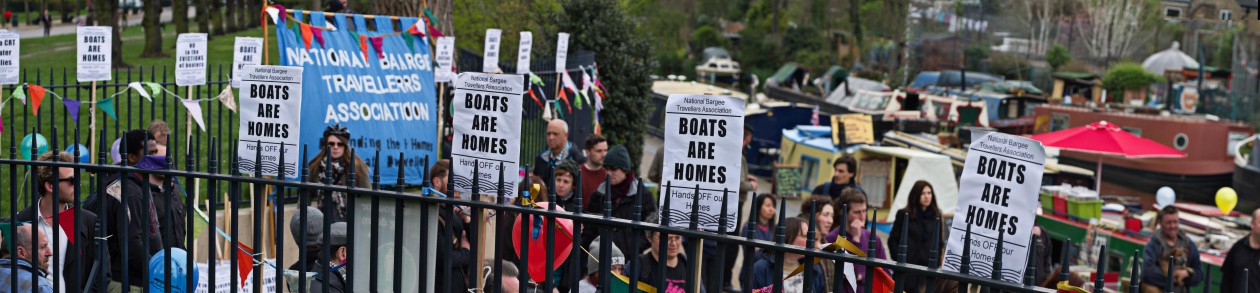
***THIS SATURDAY JOIN THE BOATERS BLOC!!***

Nbta London's photo.

Everywhere you go in London redevelopments are happening making the housing needs for people harder.

The waterways are not excluded from this. Around Central London there is pressure to move out boaters so that property prices are not negatively effected. However, we need more mooring rings.

The whole of the navigable waters of the Bow Back Rivers was taken from us for the Olympics. Now it is only open to some trip boats and with plans to turn it into just 24 hours moorings. This should be open again to all with 14 days moorings.

There has been great reduction of facilities across the waterways. In time where there is more boats, we need more facilities. Places like West London are lacking facilities. We demand more facilities now.

Let’s march on the City and alongside other housing campaigns let our demand be heard

More Mooring Spaces
Open the Bow Back Rivers
More Facilities

Saturday 31 January at 12 noon
St Mary’s Churchyard, Newington Butts, SE1 6SQ (Elephant and Castle tube/rail)
NBTA banner and boaters will be at the corner of St Mary’s Butts and Gun Street

***This SATURDAY join the BOATERS BLOC***

Nbta London's photo.

Everywhere you go in London redevelopments are happening making the housing needs for people harder.

The waterways are not excluded from this. Around Central London there is pressure to move out boaters so that property prices are not negatively effected. However, we need more mooring rings.

The whole of the navigable waters of the Bow Back Rivers was taken from us for the Olympics. Now it is only open to some trip boats and with plans to turn it into just 24 hours moorings. This should be open again to all with 14 days moorings.

There has been great reduction of facilities across the waterways. In time where there is more boats, we need more facilities. Places like West London are lacking facilities. We demand more facilities now.

Let’s march on the City and alongside other housing campaigns let our demand be heard

More Mooring Spaces
Open the Bow Back Rivers
More Facilities

Saturday 31 January at 12 noon
St Mary’s Churchyard, Newington Butts, SE1 6SQ (Elephant and Castle tube/rail)
NBTA banner and boaters will be at the corner of St Mary’s Butts and Gun Street

CRT Hands Off Our Homes! Public Meeting, 22nd January 2015, London

The Canal & River Trust (CRT) is on a mission to make the lives of live-aboards without home moorings harder. CRT has been meeting with some boaters’ groups to try to get an agreement to an unlawful definition of “place” and an unlawful minimum distance that continuous cruisers should travel to comply with Section 17 (3)(c)(ii) of the British Waterways Act 1995. This, together with recently concreted towpaths without mooring rings that are impossible to moor boats on, and the lack of facilities like water taps, threatens our homes. We must stop CRT making our lives harder. We need more mooring rings, more facilities and no further mooring restrictions.

The National Bargee Travellers Association London is hosting a public meeting about these attacks on boat dwellers and discussion about what we can do about it. We have also invited some speakers from the wider housing movement so we can get ideas about what can be done to defend our homes. Join us at this campaign meeting to plan what action to take.

Radical Housing Network

To many of us in the NBTA, it has become increasingly clear that the issues that we face as boaters are far from unique. The more we see of the problems facing people living on land, be they council tenants, private tenants or owner-occupiers, the more we realise how much we have in common.

Because of the common threats we face, we have become affiliated to the Radical Housing Network. This group brings together a wide range of groups campaigning to protect the right to be housed, as well as people exploring the possibilities of co-operative housing development and other alternative models.

We have seen the same issues time and time again, and these are issues that affect boaters too. The rapid development of luxury waterside apartments across London is accompanied by the creation of permanent moorings that reduce the space for continuous cruisers, who are forced to move further afield. This mirrors the regeneration happening on land, resulting in 45,000 families being moved out of their borough in the past five years.

We believe that our position is stronger if we can call upon the solidarity of all those groups engaged in similar campaigns to defend their rights and their homes. In the coming weeks and months, we will be posting articles here exploring the background to the challenges we all face, whether living on the land or on the water.