At the time of publication, itinerant boaters have still not received an energy grant from the Government, or been offered a user-friendly way in which to attain this grant. Most households across the UK are now into their sixth month of receiving help towards extortionate energy bills, yet the Government are still dragging their heels when it comes to itinerant boaters and other off grid communities.
All households in the UK were promised the £400 grant back in March last year, and an article published on the 1st April 2022 on the gov.uk website clearly states:
“If you live in a park home, houseboat or off the grid…The government has confirmed that further funding will be available to provide equivalent support of £400 for energy bills for the 1% of households who are not eligible for the discount. This includes households without a domestic electricity meter and a direct relationship with an electricity supplier, for example if you live in a park home, houseboat or you live off the grid.”
Depending on how the above is interpreted, itinerant boaters could be included under either the “houseboat” or living off grid examples. Either way, it seemed like we were included as we obviously do not have a domestic electricity meter or a direct relationship with an electricity supplier and therefore meet the criteria.
Since then, the Government have released several announcements regarding the EBSS, including an additional £200 Alternative Fuel Payment for those not using mains gas. However, none of their literature has directly referred to itinerant boaters, leaving us with a vague assumption that we will receive it at some stage in the future, via some unknown means.
In an attempt to find a good solution on how and when itinerant boaters will receive the EBSS, the National Bargee Travellers Association have been in talks with the relevant Government bodies for some time, and thanks to their efforts, a work around solution is now being trialled.
Unfortunately, the best solution the Government could offer was a perplexing arrangement whereby the applicant applied for the energy grant, knowing it would be rejected as it would not meet the criteria needed, then uses this rejection to apply for another grant from their Local Authority. This convoluted approach failed however, as Local Councils were neither informed nor consulted, with many simply replying as such, adding they had no budget for it
Therefore, we still do not have a definitive answer on how or when the majority of itinerant boaters will receive the energy grant. With many boaters spending upwards of £200 a month on heating this winter, the EBSS could relieve the difficult choice between heat or food that numerous folk may be facing.
As the winter months dwindle off into Spring, we are left wondering, will we ever get help to heat our homes?
NBTA London needs your support to carry on our work. Please get in touch here if you would like to volunteer with us. Alternatively your donations are vital to us supporting boaters with their legal case work, campaign banners and other printed material as well as events. You can help us with your donations online here
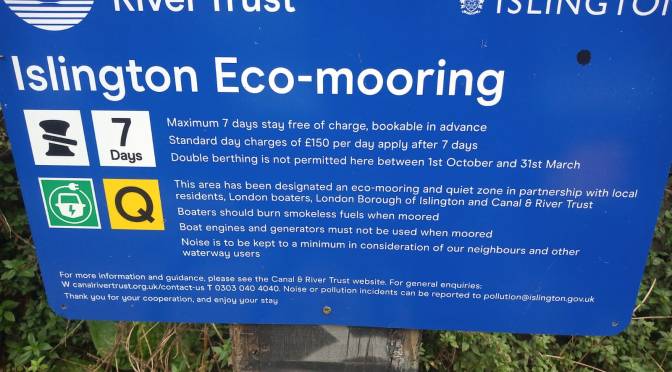
Westminster council have just held a consultation period for a new eco mooring zone in Paddington. If plans go ahead this will be the third eco zone in London. The other eco zones are either side of the Islington Tunnel and in Kings Cross in the borough of Camden.
In the Paddington eco mooring plans they contextualise the need for eco moorings and how it can benefit boaters and residents. They also mention pollution has caused the hospital ward near the canal to close on occasions. The council said they could not share any details about the cause of the pollution due to GDPR reasons. NBTA London is in the process of finding out more about the hospital ward closures and the reasons for them by means of a Freedom of Information request.
Paddington Basin, picture by Marc Barrot/Flickr
One particular aspect of the plan is appealing. They have presented the idea of giving grants to boaters to cover the costs of converting boats so they are able to use the electric points (total of £1445 per boat for wiring, fixtures, consumer unit, electrical appliance). However, this mock costing does not consider labour costs and is vague so we can’t be sure whether it’s suitable for all boats. How they would decide which boaters receive the funding is also not clear. As stated in the pamphlet, these conversion grants are not guaranteed. The council will have to apply for funding but there is a worry that the conversion grants idea is tokenistic.
NBTA London met with Westminster council to ask for more details about the eco zone plans. Present at the meeting were 2 members of K&A consultants, a member of Westminster council and a member of CRT. The Westminster council member played the politician and gave no real answers to our questions stating that the plan is dependent on the results of the consultation and available funding. It was clear the council didn’t want to commit to anything. However, we did propose some ideas on how they could make the eco moorings suitable for more boaters which were received positively:
Provide electrical heaters that can be borrowed by boaters.
This would mean boats with off-shore power hook-up wouldn’t need to adapt their boats and they could plug the heaters into their existing plugs.
Integrate a battery charger into the electrical point.
This would mean boats wouldn’t need to run their engines or diesel generators and they wouldn’t need to buy any extra appliances to fulfil their electrical needs. Especially as not all boats will be suitable for conversion.
King’s Cross, Regents Canal, picture by Diamond Geezer/Flickr
All London boroughs have clean air plans to meet clean air targets because illegal levels of air pollution are still being recorded in London, including in the city of Westminster (levels of nitrogen dioxide have been recorded up to 50% higher than legal levels in various areas across London). Despite the pollution from boats being negligible in comparison to the pollution caused by road transport and domestic/commercial heating systems, where we can, it’s good to reduce our emissions. However, in order to transition, boaters need time and support. Stoves and diesel engines are crucial to heat boats and to supply enough power during the Winter months, and are necessary for the majority of the waterways that are without electrical charging points. Then there is the issue of space and money to make boats suitable to use the electric points.
NBTA London needs your support to carry on our work. Please get in touch here if you would like to volunteer with us. Alternatively your donations are vital to us supporting boaters with their legal case work, campaign banners and other printed material as well as events. You can help us with your donations online here
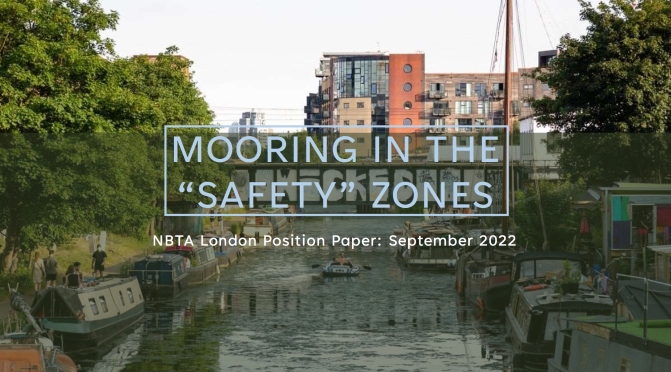
Have you ever wondered what the ‘no mooring’ sites in the ‘safety’ zones” are all about?
What are CRT trying to say to justify them, and which sites are NBTA London challenging and why?
In this document we answer these questions *and more*.
As well as hashing out the main arguments, we have throughly, concisely and clearly laid out each area which CRT are trying to ban boats from in the ‘safety’ zones.
The document states CRT’s position and shows NBTA London’s counter argument to each of the sites which we are challenging.
It’s very useful to help understand the ‘safety’ zones better. It’s not only very pretty, but also a must read!’ —> view pdf
NBTA Boats are homes protest outside CRT’s London offices
NBTA London needs your support to carry on our work. Please get in touch here if you would like to volunteer with us. Alternatively your donations are vital to us supporting boaters with their legal case work, campaign banners and other printed material as well as events. You can help us with your donations online here
CRT would like to start charging ‘extra’ for Towpath Moorings. Normally your licence includes the right to moor on any towpath without extra charge. CRT would like to turn 1.1km of London’s regular towpath into new ‘Chargeable’ Moorings that would cost an additional £84 extra a week. Why? Because CRT believes financially excluding people from these moorings will somehow make them ‘fairer’. Boaters who can afford it will be able to reserve themselves a guaranteed mooring space, at the expense of less wealthy Boaters who will find their mooring opportunities significantly reduced.
Proposed chargeable mooring sites along the London Canal Network
In reality this would financially exclude many residential boaters without a home mooring from 1.1km of the mooring space they rely on for their livelihood. Much like every other CRT Policy, this prioritises Leisure Boating over Residential Boating – CRT have no actual adjustments in any of their strategies that actively support itinerant, residential boating. Perhaps there is a question here – do CRT believe that holidays are more important than homes? Most worrying of all, evidence suggests that these new chargeable moorings will often remain empty and unused.
Paddington Basin, one of the chargeable mooring locations. Pic by Nick Sarebi, Flickr
CRT have conducted an online survey about their ‘Chargeable Mooring’ plans – unfortunately their survey is invalid for the following reasons:
CRT’s survey is invalid because it claims a Pilot Chargeable Mooring Scheme they ran was a great success. In fact, it was only used 25% of the time – the rest of the time it remained empty and unused.
CRT’s survey is invalid because it is based on CRT creating new regular towpath moorings – to replace the ones being annexed off for wealthier boaters. A Freedom Of Information Request revealed that CRT does not know where these ‘replacement’ regular moorings will be. Historically CRT have promised many new mooring spaces that have not materialised – so if CRT do not know where these ‘replacement’ moorings will be, effectively they do not exist.
Boaters in 2017 tried to stop the Gasworks offside mooring in Bethnal Green from becoming private ‘paid’ moorings
CRT’s survey is invalid because it initially misinformed participants that only 40 regular towpath moorings would be lost to this ‘Chargeable’ mooring scheme. Due to another Freedom Of Information request they later had to amend these false figures mid-survey to 1.1km. This could amount to 120 regular mooring spaces being lost, so this survey was initially based on a false premise.*
CRT’s survey is invalid because it is filled with coercive questions that force participants to suggestively agree to things they do not. The question ‘How many times a year should you be allowed to moor on a Chargeable Mooring?’ does not allow me to disagree with the whole concept in the first place – one can only hope that CRT does not ‘cherry-pick’ their data.
CRT’s survey is invalid because when it suggests introducing a ‘no widebeam double mooring’ policy it misrepresents the facts. London’s canals are some of the widest in the country. There are many places throughout London’s canals where you can double moor onto a widebeam and leave an enormous amount of space for navigation. The impact of removing this double mooring capacity will be vast. Yet again – the survey is based on a false premise.
Angel is another proposed site for chargeable moorings. Pic by Alan Firkser
So where does that leave us? A poorly constructed, invalid survey about a poorly conceived scheme, based on falsehoods and prejudice. No Equality Impact Assessment to demonstrate how this will affect family/residential/disabled/older/financially disadvantaged boaters (CRT have promised to conduct one – but only once the scheme is effectively a done deal). Then there is the strange assertion that making something financially prohibitive will somehow make it fairer (- for whom?).
It feels like history is repeating itself. Yet another policy aimed at debilitating the Itinerant Boating Community, founded on a swamp of misinformation, without any form of proper consultation – in particular, no consultation with those it will impact the most. Surely in any proposal worth its salt you would conduct an Equality Impact Assessment before presenting it to the general public – otherwise you risk promoting discrimination… unless, of course, that is exactly what you intend to do.
Regents Canal through Central London.
And let’s not lose sight of the door that is being opened – one where CRT can charge whatever it likes, for any towpath mooring, anywhere. This new CRT Policy could in fact be a step-by-step guide on how to make a public asset financially exclusive.
* This was calculation assumes boats are 60ft each. The number is higher if you assume boat smaller.
NBTA London needs your support to carry on our work. Please get in touch here if you would like to volunteer with us. Alternatively your donations are vital to us supporting boaters with their legal case work, campaign banners and other printed material as well as events. You can help us with your donations online here
Join us at our Community Summer event at the end of this month. We are having a picnic at the Walthamstow Marshes on Sunday 26th June 2022 – 12pm start. Click here for more details
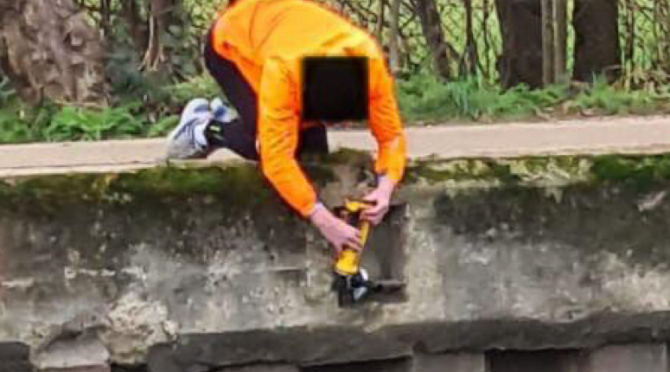
Oh look, an (allegedly senior) member of Lea Rowing Club (LRC) taking an angle grinder to the grab bars which can help people who have fallen into the river get out safely.
LRC has been unapologetic in pushing for CRT’s implementation of the “safety zones” – in fact they were the ones who came up with the deranged scheme in the first place.
But actually useful pieces of safety infrastructure there to help everyone don’t seem to matter to these overly entitled hypocrites. Could it be that their interest in “safety” has more to do with their desire to not share the river with other users?
The Canal and River Trust (CRT) is preparing to launch an assault on the rights of boaters. Specifically, their rights to moor on large stretches of the historic River Lea, a river which has been populated by boat owners of all flavours dating back to the Bronze Age.
They are pursuing this strategy in the name of safety: they claim moored boats are a hazard to the users of the waterway. We do not agree. In fact, it is CRT themselves who are allowing the River Lea to become a dangerous place. They are allowing it to become dangerous through a lack of care, a lack of investment and a lack of sense. There are too many places which are too shallow, which make it impossible to moor close to the bank or even moor at all, in some places it even makes it hard to navigate.
The Lea has not been properly dredged for many years, 11 to be precise – and that was just the Lower Lea. Waltham Town Lock to Kings Weir hasn’t been done since 2009 and doesn’t even have a record of when above Waltham Town Lock has been done last.
And why, 11 years ago was the cost of dredging the Lower Lea deemed acceptable? The answer is simple, the City of London and by extension British Waterways did not want important, international visitors to the Olympic park to have to contend with the putrid smells and depressing sights of the nearby river which had been neglected. At the time, Simon Bamford, General Manager of British Waterways (BW) in London, is quoted as saying ‘[water] quality on the River Lee Navigation has been an issue of concern for many years, affecting local residents, wildlife, boaters and other waterway users’.
The reason for the poor quality? To put it quite simply, a deluge of raw sewage overflows brought down from Deephams Sewage Works in north London. 11 years later and that issue has not gone away! Together with the 2018 Lower Lea river oil spill, the Lower Lea is fast becoming a toxic mess that is hazardous not only to the humans that spend time within its proximity, but also the animals that call it home.
If safety was a real issue for CRT, rather than removing places where we can moor, they should be looking at positive actions which would get wide support, like dredging.
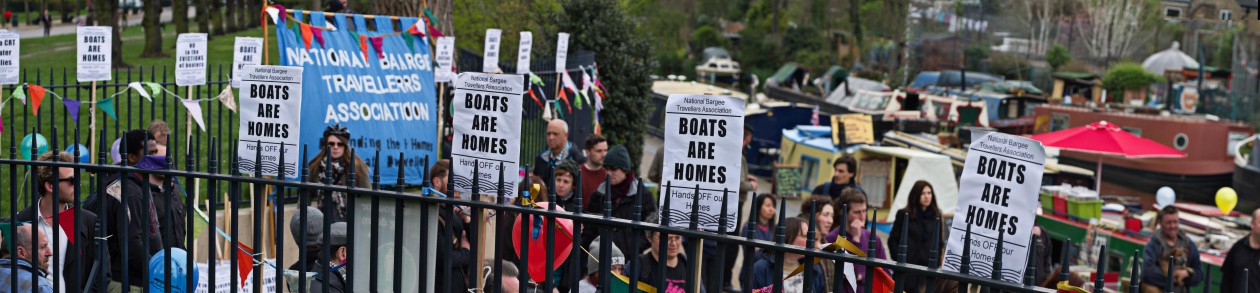
On Saturday 26 March 2022, hundreds of boaters marched on Canal & River Trust’s (CRT) main London office to protest the Trust’s continued attack on the capital’s liveaboard boating community.
Starting in Regents Park, the protest marched to CRT’s offices in Little Venice where they were addressed by speakers from the boating community and land based supporters and engaged with the public to explain how these discriminatory policy changes are threatening people’s livelihoods.
The protest was hailed as a great success by Ian McDowell, Chair of the London branch of the National Bargee Travellers Association, which has helped organize boaters’ opposition to CRT’s attacks.
Since London’s boaters forced CRT into a consultation on their plan to remove up to 550 mooring places on the River Lea in 2021, the Trust has doubled down on their plans to cull boats from London’s waterways including:
• Bringing in more reduced mooring times on the Grand Union; • Implementing banning boats from 295 ‘no mooring’ spaces in ‘safety zones’ despite indicating they wouldn’t; • Turning a blind eye to criminal damage of safety features of the River Lea inside a so-called ‘safety zone’; • Proposing 1.1km of new chargeable moorings and further mooring restrictions in Central London; • Revealing that the Trust no longer takes complaints about their policies.
The National Bargee Travellers Association (NBTA) believe this is further evidence of CRT’s plans to prioritise leisure over living on Britain’s waterways. Early in 2021, CRT announced that they would be restricting moorings along 10km of the river Lea, claiming that mooring in these ‘Water Safety Zones’ was unsafe. The NBTA, together with the London boating community, fought back by organising two flotillas involving over 70 boats and 1000+ people. CRT was forced to engage boaters in consultation, the result of which showed boaters are concerned about safety, but the ‘Water Safety Zones’ would not make the river safer. The ‘River Lea Forum’ was established with representatives from all interested user groups to discuss what would make the waterways safer. However, CRT ignored boaters’ voices by imposing many of the ‘Safety Zones’ before the first Forum even took place.
In October 2021, ‘no mooring’ signs started appearing on the River Lea and boaters moored in these areas were told they would have enforcement action taken against them under the new ‘Improper Mooring Process’. CRT claims that these sites come under its existing rules on where boats are permitted to moor, but these are the exact same stretches that they’d planned to designate as no mooring as part of their ‘Water Safety Zones’, making these new rules for areas where boaters have lawfully moored without any penalty for many years.
On 10 January 2022, enforcement started on the ‘no mooring’ sites and since then, CRT has continued to try and intimidate boaters by giving notices threatening to terminate licences and thereby forcing boaters out of their homes. CRT has also employed a third party car parking ‘enforcement’ agency at huge cost to hand out these notices.
Tyrone Halligan, Amelia Friend and their two year old son Isaac.
London houseboat dwellers stage a protest against what they believe is a drive by the Canal & River Trust to force them out, as part of a gentrification process of the UK (particularly London’s) waterways.
Amelia and Tyrone have lived on a boat travelling the London waterways for seven years. Together with their two-year-old son, they spend up to 6 months a year staying in one place to the next along the stretch of the River Lea from Tottenham to Stratford where the ‘no mooring’ signs have gone up. They are currently expecting their second child and worry that they may have to leave the water, and perhaps London, altogether. “This area is our home. My son attends a nursery here and we’re registered with doctors, dentists, and my midwife appointments are in Homerton Hospital. We have built a life within this area and not being able to moor here truly feels as if we are being forced out,” Amelia says. “The stress of receiving abrupt emails, notices and knocks at the door, about where we are moored, in areas we have allowed to be for years previous, is causing us a great deal of stress at a time when, as a young and growing family, we already have a lot going on. No consideration is being given for people who have set up their lives, careers and families in these areas.”
Days before Christmas 2021, CRT made a fresh attempt at trying to take away mooring spaces in the capital by sneaking out another consultation with proposals for paid-for bookable short term moorings of less than 14 days. This, despite their own figures showing that the two ‘test sites’ for these new chargeable moorings have had less than 25% occupancy – most of the year they were wasted moorings. They’re also proposing further areas of restrictions on triple mooring and narrowboat to widebeam mooring – regardless of how wide the navigation is. “This continued disregard for the people who live and work in these new ‘no mooring’ and proposed paid-for mooring areas drives boaters away from their livelihoods, and out of their homes,” argues Ian McDowell, chair of the London branch of NBTA. “By ignoring its responsibility to preserve the waterways for all communities, CRT is crossing a dangerous line that could see London Waterways and other waterways become usable only by those who can afford any extra costs CRT chooses to introduce in addition to the licence fee. Their actions only serve to show that while CRT markets themselves as a charity that promotes wellbeing, they repeatedly try to introduce policies which attack boaters’ wellbeing and way of life.”
NBTA London demands that CRT concentrates on its mandate to maintain the navigation with things like dredging, rather than persecuting boaters who moor on some of the widest waterways in the country. The Trust must stop destroying boating communities by favouring one kind of boater over another.
NBTA and London Boaters have fought and prevented unfair and destructive attempts like these before, and we will do so again. National Bargee Travellers Association London branch (NBTAL) is supporting boaters in their direct action to disobey the ‘no mooring’ signs through providing a template complaint letter if they do receive a notice and posters to display in windows declaring the boat is moored in protest. Hundreds of boaters have defied CRT’s unfair and unjustified restrictions so far and since we are unable to complain online, now we are marching on CRT’s offices to resist the displacement of boaters and to protect our homes.
In protest, the National Bargee Traveller Association London (NBTAL) organised a ‘Forage for Facilities’ event today to highlight the shortage of water, waste and rubbish disposal points on the London canals.
There were 8 boats in total, with about 40 attendees. The event took place in West London today starting at Old Oak common and involved an expedition of boats, decked out in banners and bunting, hunting the elusive facilities that have been promised by CRT since 2013. The flotilla travelled for five hours, with no facilities in sight. Between Little Venice and Bull’s Bridge there is only one water point for boaters without a home mooring to access.
A recent report by a group formed by CRT and some London boaters called the Better Relationships Group, has found that 4,000 boats, or approximately 8,000 boaters, are sharing 15 working taps and five toilet and rubbish points in the greater London area.
A spokesperson for the NBTA London said:
“After travelling five hours we didn’t find any water points, rubbish disposal facilities or anywhere to empty our toilets. The lack of facilities in this area means that we are unable to fulfill our basic needs without travelling unreasonable distances.
This forces us to live in a way that is comparable to living conditions in third world countries. With CRT’s new draconian demands to travel a minimum distance per year, boaters are being forced to inhabit places that are thoroughly lacking in facilities.
Overall there is a general lack of facilities at a time when there are more boaters, who are paying more money to CRT and seeing no response to demand in return.”
The London branch of the National Bargee Traveller Association (NBTAL) has launched a new case-worker group in a bid to help London boaters who are affected by enforcement and the new Canal and River Trust policy on refusing licences.
The volunteer case workers can be contacted for help and advice at nbta.london.caseworker@gmail.com and will soon be available for a chat on a special mobile phone helpline.
The caseworker group keeps up to date with pooled knowledge of the current implementation of the new enforcement policy and the legal framework under which the policy sits, and can give assistance on ‘how far is far enough’ questions, re-licensing, sighting data queries and benefits, disability allowances and adjustments and other related advice.
After a trial period when the new policy only affected new boaters on their first licence, CRT has recently announced that the new enforcement policy came into action for all boaters on the 1st of May. Anyone having their licenced renewed after that will fall under the new policy.CRT have also stated that if a licence is renewed after the 1st May, they will look back over the previous year and make a decision as to whether you fit their current definition of “moving far enough and often enough”. If the boater fails this test, they will refuse to renew their licence and will tell the boater to take a home mooring or remove their boat from their waters. If the boat is not removed and is a livaboard, then the next step is that they will probably take the boater to court for having no licence and to seize the boat and remove it from the canal.
For an unspecified trial period, CRT are offering temporary three or six month “restricted” licences to affected boaters so they can “mend their ways”. This offer of restricted licences is “while boaters get used to the new regime”. The NBTAL fears that at some point in the future, CRT will simply refuse to renew licences with no restricted trial period offered. At a recent Canal User Group meeting, an NBTAL member asked the London enforcement manager how long the trial period would last and what would happen afterwards and was told that “boaters would always be warned before we refuse to renew their licence.”
After a request from the NBTA at a recent meeting, CRT have stopped charging premium rates for these “restricted” licences and the cost is now pro rata to the full licence.
A spokesperson for the group said:
“In April and May this year, 60 licences out of a total of 160 new first year boaters were put on three or six month “restricted” licences for what the Canal and River Trust claim is “not moving far enough or often enough.” Regardless of our concerns about the legality of the new policy, the caseworker group is keeping itself up to date on its implementation and are available to give the best information possible to help livaboard boaters keep their homes.”
“If you are affected then contact us and we will do our level best to work with you to offer advice and support to enable you to carry on living on the water. We are also monitoring what distance/criteria CRT are enforcing on and what criteria they are saying must be fulfilled to ‘pass’ the restricted temporary licence period, so even if you think you can handle it yourself please get in touch as the info is invaluable. It will be confidential and we do not publish or publicise any individual emails to or from the enforcement team, though we may release the odd report with the anonymised generalised trends of where the implementation of the enforcement policy is heading.”
“We will also work with the Waterways Chaplaincy in the case of particularly vulnerable boaters. The case workers will work in your interest and keeping you on the water, if that’s what you want; is paramount, whether through negotiation, support, referral or other appropriate methods. As a last resort because court cases are usually lose-lose situations, we have experienced boaty lawyers at hand for advice and referral just in case the shit really hits the fan.”
This meeting is to decide what the NBTA does in general.
This will be on the Saturday 21 November at the Quaker Meeting House, 150 Church Rd, Watford WD17 4QB (near Watford
Junction Station). Registration starts at 9.30am, the General Meeting ends at 6pm. There are going to be breaks in-between, including lunch .
If you would like to come to the General Meeting, please book a place as soon as possible by emailing secretariat@bargee- traveller.org.uk or phoning 0118 321 4128. We need to keep the venue informed of the numbers so please let us know in advance if you wish to attend.
Further travel directions etc. will be sent out on booking.
A volunteer organisation formed in 2009 campaigning and providing advice for itinerant boat dwellers on Britain’s inland and coastal waterways











 National Bargee Travellers Association - London Branch