Category Archives: Newsletter

CRT Makes Intentions for Travelling Boaters Clear with New Surcharge

The latest power move from the CRT is the introduction of a 25% surcharge for boats without a home mooring, a devastating decision which unfairly targets our community of travelling boaters.

As some of us may remember, this is not the first time the CRT – or British Waterways before them – have attempted to implement what is essentially a punishment for living this lifestyle, each time giving a different reason for doing so. This time around, CRT stated that the reason for this surcharge is that they need more income and we use the waterways and the facilities more than those with home moorings, a bogus statement for which they have no evidence; it could even be argued that some holiday boaters travel a further distance than most itinerant boaters. 

It seems somewhat hypocritical for the CRT to insist some of us to move more, then say it’s our use of the waterways that means we need to pay more. At the NBTA we believe the most honest reason behind these decisions was given in the 2000s by British Waterways, they said that there were too many boats without home moorings and this proposition of a surcharge would encourage people into moorings- which seems to us is what the CRT is attempting to do here too.

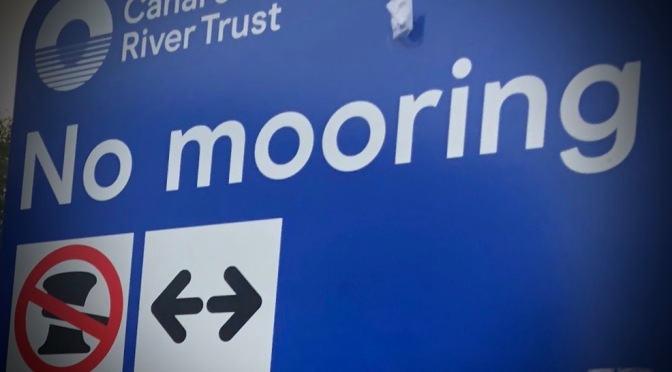
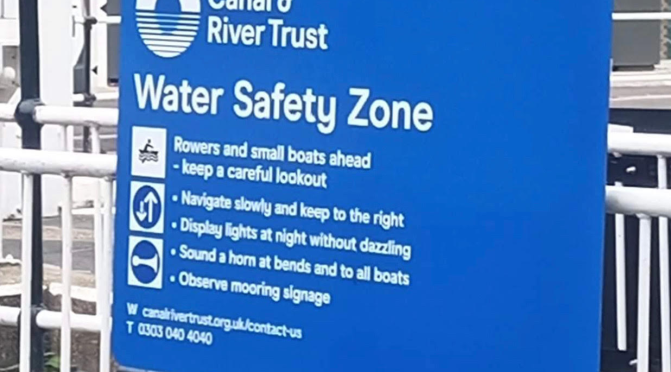
Their increased ‘no mooring’ zones, new chargeable moorings and now a surcharge points toward their deeply concerning intentions for our waterways. They claim they need the income from this surcharge, but it would generate less income per year than their two top earners take in a year. They claim this is about money yet they spend hundreds of thousands enforcing ‘safety zones’.

Before now no waterways authority has ever claimed that we should be charged more to generate income, we assume because it would generate an inconsequential amount, it is no different this time. The CRT is chronically mismanaged, they could generate other much more profitable streams of income if they wanted to. This is not about the money they might make from a surcharge, this is about the gentrification of our waterways, they want to physically restrict our moorings and eventually charge us out of our homes, we are undesirable and not profitable to them.

This decision fundamentally discriminates against our already marginal community. Similarly to the ‘safety’ zones, if we fight we can be a force to be reckoned with. This battle is larger than the ‘safety’ zones, please get involved.


NBTA London needs your support to carry on our work. Please get in touch here if you would like to volunteer with us. Alternatively your donations are vital to us supporting boaters with their legal case work, campaign banners and other printed material as well as events. You can help us with your donations online here
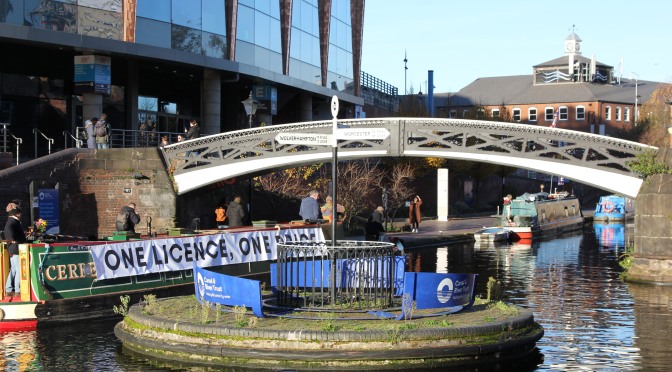

National Demo against the Surcharge in Birmingham

On a crisp winter’s day in November, over one hundred boaters from across UK waterways descended on the Canal and River Trust’s Birmingham office. Boaters from all over, from Macclesfield canal, Birmingham canals, to Kennet and Avon canal, Monmouth and Brecon canal to River Lea and many more waterways unified to protest against CRT’s discriminatory licence fee surcharge. A few boats with banners joined us outside the office, which was really fantastic to see, and we were able to get the story into several press outlets too.

The demo was a great success and showed CRT that we will not stand by and allow them to threaten our way of life. Thank you to everyone who came or supported from afar!


NBTA London needs your support to carry on our work. Please get in touch here if you would like to volunteer with us. Alternatively your donations are vital to us supporting boaters with their legal case work, campaign banners and other printed material as well as events. You can help us with your donations online here


Financial Exclusion of Itinerant boaters in Central London

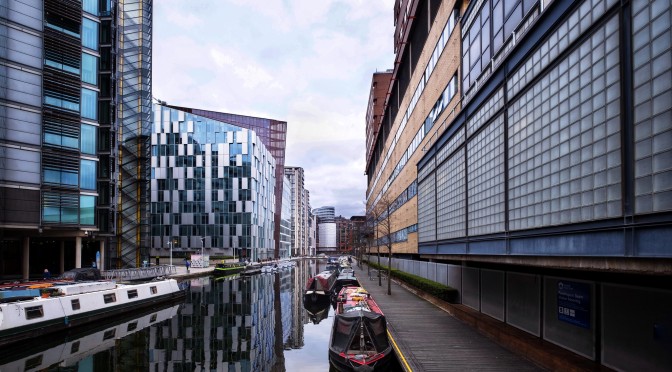
The process of privatisation can be witnessed in various stages on London’s canal network. As visitor moorings become pre-bookable and chargeable moorings become private, the absence of boats on significant lengths of towpath in Central London is testament to the financial exclusion of boaters from these areas.

In 2016 NBTA made it explicitly clear in talks with CRT that public moorings should not be converted to private use.  In August 2023, chargeable moorings at Rembrandt Gardens and Paddington Basin doubled in price overnight from £12 to £25. 80m of previous visitor moorings in Paddington Basin and 160m in Little Venice were converted to chargeable also at £25 a night, effectively £50 for two nights with a midday turnaround. Beyond the financial means of most boaters.

Paddington Basin

A Freedom of Information Request reveals pontoons in Paddington are used at half-capacity 49% of the time, bookings made across 1,200 days generated £16,000 in income. At Rembrandt Gardens 584 days generated £6,350. While there has been high uptake of free pre-bookable mooring in Kings Cross and Angel; new chargeable moorings in Little Venice and Paddington are running at 24% capacity and have since August been underused with a total of only 218 bookings and £5,425 in revenue. These moorings are sighted by three rangers (among other duties) at a cost of £100,000.

CRT claim financial exclusion makes the system ‘fair’ for all boaters, giving everyone an equal opportunity. Significant lengths of pre-bookable space; 200m at Colebrook Row in Angel and 220m at Treaty St in Kings Cross may well be more democratic for the time being, but how long will they remain free? As mooring opportunities are reduced to make chargeable space, overcrowding is experienced on other parts of the network. Travelling boaters, already threatened with surcharges for lack of ownership and place are being further marginalised by the introduction of these zones.

CRT’s vision for London seems to be canals without boats.


NBTA London needs your support to carry on our work. Please get in touch here if you would like to volunteer with us. Alternatively your donations are vital to us supporting boaters with their legal case work, campaign banners and other printed material as well as events. You can help us with your donations online here


Chargeable, Bookable Moorings

In 2016, prior to launching the London Mooring Strategy, which was published in 2018, CRT and NBTA-London had round-the-table discussions about CRT’s thoughts on “pre-bookable” moorings. NBTA made it explicitly clear that if there were any “pre-bookable” moorings to be created, then they should be on the offside, and that tow-path moorings should never be chargeable.

Instead, CRT proceeded to make use of any vacant offside space not yet used for mooring for “long term”, or “residential” moorings, rather than increasing mooring space for visitors who were willing to book ahead, often making deals with third parties who owned the offside land. Two such set of moorings is at Broadway Market on the Regent, which in particular impedes navigation in what was already a very busy part of the London network, whilst overlooking the opportunity to create “pre-bookable” moorings; the other being Matchmakers on the River Lea, where the installation of those moorings meant CRT with their ‘safety’ zones are trying to enforce a ‘no mooring’ site on the towpath.

Yet, this is taken from CRT’s website:

“It’s really important that navigation is maintained and that it’s not impeded by moored boats. The inner London waterways are very busy with many different types of boater: liveaboard, leisure, freight, and business craft as well as increasing numbers of unpowered craft. This measure is intended to ensure that there is clear navigation for everyone in these busy areas.”

Their policy for safe navigation goes into the ether, however when it comes to the possibility of monetising new moorings, such as those on the offside at Broadway Market on the Regent.

Broadway Market, Regents Canal. Pic by Flickr/@scratch_n_sniff

Seven years following CRT’s first discussions with NBTA, CRT have now taken away several “casual”, “visitor” or towpath moorings, making them “pre-bookable”, and furthermore, have started charging extra. Usually, a CRT licence includes the right to moor on any towpath without extra charge, but CRT are turning 1.1km of London’s regular towpath into new ‘Chargeable’ Moorings that would cost an additional £25 extra a day. CRT’s argument for doing so is to make it ‘fairer’ for past-time and full-time liveaboard boaters alike to have a chance of mooring up in popular parts of the canal network. When we checked the facts behind the manipulated CRT survey on how successful the Paddington Basin chargeable moorings are, a Freedom Of Information Request reveals that these moorings have only been used 25% of the time – the rest of the time they remained empty and unused. 

The latest moorings to be eradicated from public, free-for-all use are in Little Venice and Paddington Basin, but this is just the beginning . 

On reading the T&Cs for what CRT call “pre-bookable”, but are actually chargeable moorings, included in these T&Cs are “planned” eco moorings on the Regent at Kings Cross and on Sweetwater in the Olympic Park on the Lee Navigation, strongly implying that these eco moorings may also become chargeable. NBTA also infer from this that the existing eco moorings on the Regent at Angel may become chargeable too, not just “pre-bookable”.

Aside from being financially exclusive and therefore fundamentally unfair in the first place, the quantity of chargeable moorings is not proportionate to the needs of boat owners. Lots of these bookable, chargeable mooring spaces will either be paid for by boaters who can’t find public towpath mooring since CRT have reduced those spaces, or they will remain empty because people a) can’t afford them, and b) don’t want them. If they remain largely empty,  this may then be a great excuse for CRT to turn them into private moorings – as was the case at Here East moorings on the River Lee.

CRT announce itinerant boat dwellers will pay higher licence fees than others

Just before this newsletter went to press, the Canal and River Trust (CRT) announced that it plans to charge boats without home moorings more than boats with home moorings. 

The implications of this are devastating. CRT will now be able to use boat licence fees as a way of removing the travelling boat dweller community from the waterways. It is more important than ever that we join together as a united community to stop CRT in their tracks. We will be sending round a ballot to all members of the NBTA to ask for your input on what action we take next. If you are not already a member, please sign up now to contribute to this vital decision. We have also organised an online meeting to coordinate our fight back. Please join us on Monday 9th October at 7pm. The access details for the meeting can be found on page 3. We hope to see you all there.


NBTA London needs your support to carry on our work. Please get in touch here if you would like to volunteer with us. Alternatively your donations are vital to us supporting boaters with their legal case work, campaign banners and other printed material as well as events. You can help us with your donations online here


Safety zones cost quarter of a million

CRT admits to spending up to £250k on trying to stop boaters from mooring in the ‘Water Safety Zones’ on the River Lea. A Freedom of Information request shows that as of 31 May 2023, the Trust has spent anything up to £249,680.09 in the two WSZs on the Lower Lea at Hackney/Tottenham and at Broxbourne. All the while, trying to up licence fees and divide the boating community. CRT should stop wasting money on preventing people mooring in these so-called ‘Safety Zones’.


NBTA London needs your support to carry on our work. Please get in touch here if you would like to volunteer with us. Alternatively your donations are vital to us supporting boaters with their legal case work, campaign banners and other printed material as well as events. You can help us with your donations online here


River Lea’s ’No Mooring’ zones are ‘not necessary’ finds independent risk assessment.

After CRT ignored repeated requests to provide evidence that boats moored in the ’Safety Zones’ were a danger to navigation, NBTA-L commissioned its own independent assessment. The report, carried out by a qualified and experienced Risk Assessment professional, concluded: ‘Boats moored in this area cannot be considered an additional risk as they comply with national standard practice(…) Mooring restrictions at these sites are not necessary’.

It goes on to suggest that it’s more important for craft – including row boats – to manage their speed effectively to avoid any potential incidents. This upholds NBTA’s long held view that CRT’s ’Safety Zone’ policy has never been about safety, but aims instead to make life difficult for boaters, which could ultimately drive many off the water and out of their homes.


NBTA London needs your support to carry on our work. Please get in touch here if you would like to volunteer with us. Alternatively your donations are vital to us supporting boaters with their legal case work, campaign banners and other printed material as well as events. You can help us with your donations online here


NBTA gets council to put boat cleansing on hold

Elmbridge council on Environmental Agency waterways is re-opening their consultation about imposing a public space protection order on ‘unauthorised’ moorings after NBTA encouraged people to challenge their plans. The PSPO would have allowed the council to issue fines of up to £400 for mooring on the Thames within Elmbridge for longer than 24 hours at a time.


NBTA London needs your support to carry on our work. Please get in touch here if you would like to volunteer with us. Alternatively your donations are vital to us supporting boaters with their legal case work, campaign banners and other printed material as well as events. You can help us with your donations online here


Partial Energy Grant Victory!

After great effort by the NBTA and others, boaters without home moorings on Canal & River Trust waters will now finally receive the £600 winter energy grant. Together, boaters have fought hard for our community and won a victory. However, many people – including itinerant boaters on non Canal & River Trust waters, many live-aboards with a leisure moorings, and those living itinerantly on land – remain excluded, despite the grant being promised to every household in the UK.


NBTA London needs your support to carry on our work. Please get in touch here if you would like to volunteer with us. Alternatively your donations are vital to us supporting boaters with their legal case work, campaign banners and other printed material as well as events. You can help us with your donations online here


NBTA FIGHT BACK AGAINST LICENCE FEE CONSULTATION

In February earlier this year, the Canal and River Trust (CRT) sent out an email announcing their upcoming “Consultation on future boat licence pricing”. The preliminary email stated that the purpose of the consultation was “to gather feedback on boat licence pricing over the next ten years to help support the long-term future of the 2,000 miles of waterways”. Three weeks later, boaters started to receive the invitation to the consultation from a company called DJS Research, who CRT had employed to undertake the process. In our invitation, we were told in no uncertain terms that CRT will be raising the boat licence fee “by more than the rate of inflation for the foreseeable future” and what CRT supposedly wanted from us was to help them find the “fairest way to apply these increases”. 

Reeling from the shock of being told our licence fees will increase yet again, we cautiously opened the survey only to discover an extremely leading, divisive and biased set of questions, heavily aimed at raising the licence fee for boats without a home mooring specifically. Knowing that this consultation went out to all boaters, those with and without home moorings, the consultation felt very much like it was pitting boater against boater. 

In two out the first three questions, it was suggested that the licence fee for boats without home moorings should rise. A third question focused specifically on whether it is more or less reasonable to charge higher fees for “continuous cruisers”, with no option of saying “not reasonable in the slightest”. The questions in this survey were clearly implying that boats without home moorings should be priced differently to boats with home moorings. CRT may as well have asked: “Should we raise the licence fee for: a) continuous cruisers; b) boats without home moorings; or; c) itinerant boat dwellers?”.

As such, the NBTA saw the potential results of this consultation as a direct threat to our community, so we produced a set of suggested answers to all the questions. Our suggestions aimed to provide answers that would not divide boaters and instead encourage every boater to stand together in the face of rising fees, the opposite to what CRT seemed to be driving at with their questions. Our campaign was nationwide; information leaflets detailing the threat of the consultation were distributed across the CRT network, and we had a huge social media outreach drive. We hope that we managed to reach boaters everywhere, and thwart the very biased views CRT were pushing.

This consultation seemed to be yet another part of CRT’s continued assault on the itinerant boat dweller community and their bid to force us off the waterways. and of course there is their history of attempting to raise licence fees for itinerant boaters specifically (you can read about these in detail here). When the numerous aspects of this sustained effort are considered, it is not hard to see a pattern emerge. CRT have taken away facilities, mooring rings and bollards, and mooring spaces (only to replace them with bookable moorings in some cases), and of course there is their history of attempting to raise licence fees for itinerant boaters specifically (see the history article in this newsletter for more details). Itinerant boat dwellers have been targeted by CRT for decades, and if they get away with pricing boats without home moorings differently to those with home moorings, they will be able to price itinerant boaters out of existence.

The results of the consultation are now due to be published in October 2023. If CRT decide to use their survey to justify a decision that has harmful consequences for our community, we will show them that that would be more trouble than it’s worth.

The NBTA would like to thank everyone who filled in CRT’s leading and divisive survey. Thank you to everyone who helped encourage others to fill it in, to the people who put it on social media, to those who chatted to people, and especially to the people who handed out the ‘Don’t let CRT price us off the water’ leaflet across the CRT network. Together, we are a strong community who will not be bullied off the waterways.


NBTA London needs your support to carry on our work. Please get in touch here if you would like to volunteer with us. Alternatively your donations are vital to us supporting boaters with their legal case work, campaign banners and other printed material as well as events. You can help us with your donations online here


CRT ACCOUNTABLE TO WHOM?

Along the waterways, there are signs claiming the Canal & River Trust relies on donations to do its work. A quick look at their annual report shows donations account for a relatively small amount of the Trust’s income, at 3% for 2021/22. Boat licences and moorings, however, make up a fifth of the Trust’s annual income, at £44.5m for the last financial year.  

Income and expenditure are recorded in millions (not thousands or pounds), projects are listed in the abstract without breakdown of costs, charts show vague approximations without quantifying true percentage. In the 176 page report; the word “boater” is mentioned only 8 times, “licence” 6, “mooring” 10. 

The Canal & River Trust (CRT) is known to most if not all boaters who live on or use the waterways through London and beyond. The Trust operates as a charity and as such has charitable objectives, including to “preserve, protect, operate and manage inland waterways for public benefit… [and] improve the conditions of life for socially and economically disadvantaged communities who live nearby”.

The Trust may be best known among boaters for introducing more chargeable moorings, forcing through so-called “Water Safety Zones” that reduce available mooring spaces to boaters without a home mooring, and attempting to hike licence fees for boats without home moorings (again). It comes as no surprise, then, that the “financial strategy of the Trust is to maximise net income from all sources.”

So where exactly does CRT get its funds, and how does it spend the money? 

Despite being a charity, and claiming to rely on donations, charitable giving from the public accounts for only £6.5m (3 percent) of CRT’s income. They spend £41.6m on fundraising. 

£38.8 million came from charities in the form of grants from Historic England, the Active Travel fund, National Lottery, Green Recovery Challenge Fund and local Levelling up funds among others, often directed towards specific projects.  

£300,000 was left to them in peoples’ wills.

Tax exempt on income and profits from investments, a large portion of the Trust’s annual earnings comes from return on its investment portfolio. Value has increased 26% over the past five years, from £800m to over £1.1bn (yes, billion). With “ground rents [being] very resilient holdings over the long term”, last year, returns contributed to a third of CRT’s income. In fact, the submission to the Charity Commission shows an additional £76.7m of investment gains were retained for future use. While the Trust looks around for places to squeeze out a penny, they might also consider digging a little deeper into their own pockets. 

While external contractors are listed for reservoir inspection and property surveys, the cost of outsourced contracts is not. CRT has around 1,700 employees on the payroll and 3,700 volunteers, with 83 of its staff earning over £60k. Of those top earners, 10 earn more than £100k and 2 earn up to £250k… with community, volunteer and corporate groups removing “hundreds of tonnes of environmentally damaging litter and fly-tipping”, perhaps money might be better spent on bins.

A break-down of expenditure by region would be illuminating, as would some acknowledgement in the annual reporting of the fact that the CRT is the de facto local authority for several tens of thousands of people who live on boats as their primary residence.  As they make improvement to reservoirs, water pumps, towpaths, tree clearing, dealing with contamination and pollution, bridges, slipways and aqueducts and are concerned with the upkeep of towpaths for the 9 million reported fortnightly visitors, bins and taps have no mention at all. 

Additionally, NBTA London has recently submitted a Freedom of Information (FOI) request to CRT for the disclosure of spending on “Water Safety Zone” enforcement. With no apparent risk assessment or basis in evidence, could resources and effort be better spent elsewhere? 

Boaters will be most familiar with the Trust’s licencing income stream, which made up £44.5m in the financial year ending 2022. Of this, around half comes from licences, rather than mooring permits and trade. You would expect the Trust to take more of an interest in the wellbeing of liveaboard boaters, given they contribute a fair sum to the Trust’s balance sheet. While an aim of the Trust is the improvement of conditions of life for those in the vicinity of its waterways, its proposed increase in licence fees appears to care less for those who live on them. 

Trawling their high-level corporate finance and accounting jargon, boaters do not seem to figure in their calculations much at all. As their strategy is to “maximise net income” with the promise of being “unrelenting in their efforts to generate funds” it is likely the Trust will find other ways to pass on rising costs to boaters. The Chief Executive reported to the Board earlier this year that boater satisfaction remained on a downward trend. Making life better by water, perhaps, but harder if you live on it.


NBTA London needs your support to carry on our work. Please get in touch here if you would like to volunteer with us. Alternatively your donations are vital to us supporting boaters with their legal case work, campaign banners and other printed material as well as events. You can help us with your donations online here