In the Canal and River Trust’s (CRT) current statements about ‘Managing Boat Numbers’, statistics from 2010 are being used in comparison to today’s boat numbers. However, boat numbers were still considered much too high by the waterway’s authority at that time, British Waterways (BW). BW felt that there were “more boats moored along the Lee than are desirable”.
In 2010/2011 a campaign was launched against boats without home moorings on the River Lea and Stort. BW proposed dividing these rivers into eight zones, six on the Lea and two on the Stort. Regulations stated that boaters needed to move on to the next zone (neighborhoods) after a set time limit (generally seven days), and not to turn round unless at the end of the navigation. If a boater didn’t follow these bizarre rules, they would find themselves under enforcement actions which could eventually lead to eviction.
This outraged boaters, who packed themselves into a BW public meeting where the Head of Boating, Sally Ash, tried to sell the idea. BW’s representatives were met with dismay and anger from boaters. For BW the meeting was a disaster. Many boaters realised that if BW were to get their way, it would have been the beginning of the end of our community as we know it. The meeting was a success, though, for boaters. Boaters’ unity was to prove the key antidote to BW’s plans. Many flocked to the organisation London Boaters (LB) to take on BW plans. A massive public meeting was organised, and was attended by hundreds of boaters, all riled up and ready to take on BW’s plans. Working groups were formed including press, outreach, and direct action, a regular newsletter was published and a boater-run survey of boat dwellers, local land residents, local businesses, joggers, walkers, kayakers and more was carried-out. LB’s own surveys eventually showed clear majorities were against BW’s proposal.
BW eventually buckled under the continuing pressure of LB. BW backed down, their plans discarded in the litter bin of history. However, we now find CRT – all of ten years later – attempting to reimpose kind of idea ‘mooring zones’. Could this indicate that CRT have been rooting around in those bins?
Let’s make sure CRT put these ‘new ideas’ back in the bin!
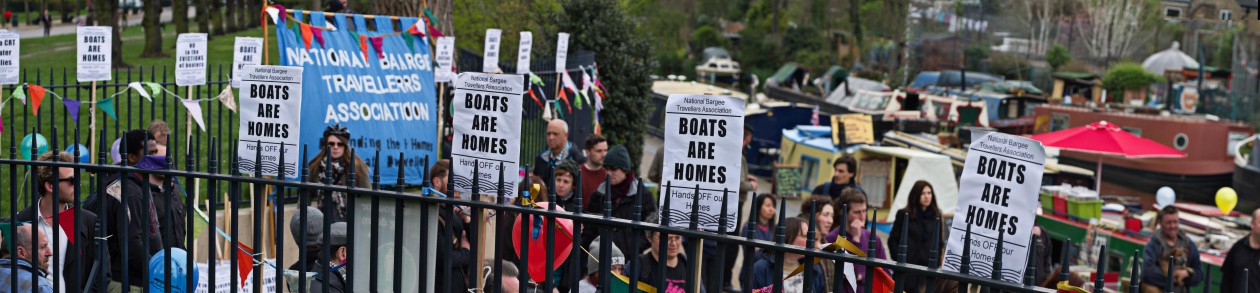
London Boaters action in 2011 against BW’s plans . Picture taken by London Boaters
London’s waterways have received significantly more attention and usage of various forms in more recent years. Following decades of decline, London’s boaters have played a significant role in the reclamation and revitalisation of these spaces. However, this contribution seems increasingly undesirable by the authority that manages the waterways.
Since 2012, the Canal & River Trust (CRT) have assumed guardianship of 2000 miles of the UK’s canals and rivers from the state-owned British Waterways (BW). As a not-for-profit charitable trust, the CRT have placed an increased emphasis on wellbeing in their agenda for their waterways’ users.
There has been a notable increase in and heterogeneous uses of the River Stort, Lee Navigation, Regent’s Canal, Hertford Union Canal, and the lower Grand Union Canal. Cyclists, walkers, joggers, rowers, and kayakers are all user groups that the CRT appear happy to see using the waterways in increased numbers, but not all increases in usage seem to be so welcome.
The general trend of increased usage has brought a range of advantages, including an increased diversification of users of the waterways, yet this has occurred during a period of increased economic and social strain for many living in London. London’s housing crisis has led a relatively small proportion to search for viable living arrangements away from the increasingly unaffordable rental costs ‘offered’ by the housing market, joining the existing communities of liveaboard boaters on the cut.
According to the CRT’s National Boat Count, boat numbers were rising for a period in the London area. However this increase in use appears less welcomed by the CRT when compared to the increase in leisure uses of the estate they manage, despite liveaboard boaters paying licensing fees to the CRT, yielding them a growth in income revenue from boaters.
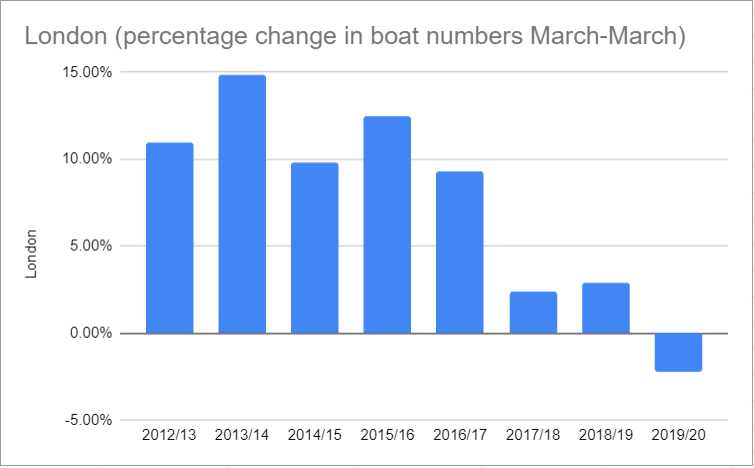
The CRT do not have legal powers to stop or restrict the number of licensed boats on the water, and as such are seeking “creative solutions to help manage growing boat numbers […] to address [the] challenges” this brings them. In lieu of the limited powers the CRT possess, it is difficult to envisage any “creative” solutions that would be equitable across the wide range of boaters that live on London’s waterways, such as introducing surcharges or fees for certain uses of the canals. However, this is occurring in spite of the CRT’s own 2020 data showing a 2.2% reduction of boats in the region.
The apparent need to manage the volume of liveaboard boats in London is not a new struggle for boaters. Back in 2010, BW said that were “more boats moored along the Lee than are desirable” and attempted to zone London’s waterways into “neighbourhoods”. Due to the anger and push back from boater communities, this plan was eventually dropped.
The National Bargee Travellers Association (NBTA) has described the CRT’s 2018 London Mooring Strategy (LMS) as “a strategy to help clear London’s waterways of boat dwellers and turn it into a London waterway leisure and business park. It is the perfect recipe for gentrification of the waterways.” Amongst other issues, the LMS includes a reduction of mooring time available for boaters at 22 sites, with increased surveillance and enforcement on the sites with reduced time limits.
The LMS has not been completed, yet the CRT are currently conducting a new survey to help them strategise new ways to manage the “very high and increasing” boat population. However, the CRT are yet to provide supporting information for the assumed problems caused by the volume of boats, or substantiating data on the apparently negative efficacies of an increased liveaboard population.
The current survey appears flawed in a range of ways, particularly as it is strewn with leading questions. As an example, they ask “In your own words what would you want the Trust to do to manage boat numbers in busy areas?” This assumes that the volume of boats is a problem, but are more boats a problem? More boats means more boaters, and as such a more vibrant and neighbourly community, helping to increase safety for all users of the waterways. Framing an increase in the number of boats as a problem evades other opportunities for the CRT to support thriving liveaboard communities by increasing the facilities offered.
It is also noteworthy that the majority of the survey is collecting qualitative data. This is welcome, as it provides an opportunity for participants to offer detailed, subjective understandings of their experiences of living aboard. However, whilst by no means impossible, such rich data can be difficult to generalise from in the development of an organisational strategy, and can lead accusations of cherry picking data and quote mining.
The global pandemic has created further tensions for the CRT and their wellbeing agenda. The initial lockdown saw posters erected to encourage “local” usage of towpaths, without any clarification of what that meant, causing confusion and anxiety for cyclists, walkers, and boaters alike. As soon as the lockdown was lifted, new posters replaced the old ones, and these actively encouraged the use of the use of towpaths for leisure purposes.
However, much of the towpath is difficult or impossible to navigate whilst staying two metres- or even one metre- from other users and boats. This exposed people to unnecessarily high risks, particularly moored boaters that were enduring the increased risk while remaining aboard their homes.
As with so many other examples of authorities exerting their political agenda in the dehumanising process of managing properties and estates, the lives of those impacted by this ‘management’ are treated with neglect and disdain. As the CRT seeks to offer leisure facilities and develop greater commercial enterprise on the waterways, the lives and rights of liveaboard boaters are treated as an unfortunate hangover of the historic canals of London.
The London branch of the NBTA continues to fight the increasing gentrification of London’s waterways and is planning further action to protect liveaboard boaters and to ensure that the waterways remain for the use of everyone, not just for those with access to resources or for business to expropriate money from a public asset.
So we at NBTA suggest to remedy this the response should be of a positive kind, such as:
Question 1: What would the impact be on you / or those you represent if boat numbers in already busy areas continue to grow significantly? (answer needs to be a choice from 1-10, 0 = no impact; 10 = significant impact)
5
Question 2: In your own words tell us what the impact would be on you/those you represent:
More boats means more neighbours, which particulary in urban areas means more eyes on each others’ boats, leading to significantly less crime.
A proportion of boaters feel anxiety walking home alone, particularly in the winter months, and more neighbours means more people to walk with and call on for support.
More neighbours also means more people to interact and make friends with.
More boats can mean more people to share locks with and travel with, which many boaters feel enhances their experience.
Also, a wider range of varied boats and boat dwellers would increase the diversity, vibrancy and therefore value of the waterways for both boaters and members of the wider community to enjoy these areas.
Question 3: In your own words what would you want the Trust to do to manage boat numbers in busy areas?
(Consider the way this question is framed; this is a leading question. CRT have already decided that more boats is a problem. We suggest you might answer this instead with postive improvements to the waterways, such as:)
The trust should improve facilities, increase the number of facilities, increase mooring rings, dredging the channel and up to the bank, improve the structure of banks which are eroding / falling apart, keep on top of maintenance of things such as locks.
Question 4: How could you help contribute to managing boat numbers in busy areas?
(Here’s another hugely leading question. We suggest this could be turned on its head).
I can contribute by helping implement positive improvements on the waterways including the things mentioned above (facilities and mooring rings outside of ‘busier’ areas).
Question 5: If you have any other comments or suggestions, please write them here:
I would like to see the improvements as mentioned above whether or not numbers of boats increase, decrease or stay the same.
Also I would like to challenge the idea of the survey on the base of these points below:
1. The data provided is too coarse and could be misleading. The narrative of the survey is that the London Mooring Strategy (LMS), “acknowledged that if boat numbers continued to rise [since 2018] then additional measures…would need to be investigated” and states that numbers “show no sign of reducing”. This is supported by a single statistic, which compares boat numbers in 2010 with 2019.
However, the 2020 National Boat Count showed a reduction of 2.2% in boat numbers in the London and SE area. Between 2012 and 2017, boat numbers increased by an average of 11.5% a year, but in the last three years the average has been under 1.5%. This trend (see chart below) tells a very different story to the narrative presented by CRT of unsustainably large increases with no signs of reduction, and so the framing of the whole survey is highly questionable.
2. The first 4 questions in the survey are very particularly framed by CRT, leading down a preordained path, and are therefore likely to lead to unreliable responses. The survey only has a few questions, so each one is very important. The main question looking to gather evidence is question 2: ‘What would be the impact on you/those you represent if boat numbers in already busy areas continue to grow significantly?’ The survey, on the opening page, frames the changes with the point that boat numbers have doubled in the last decade. Without any more detailed data (such as the trends set out above) and with phrases like ‘already busy’, the survey encourages repondants to think that numbers are continuing to rise at the same rate as they have been over the last decade and to imagine an unrealistic and imprecise hypothetical situation and give an assessment of what impact this would have. Responses to this are likely to be alarmist, with respondents imagining the worst (regardless of whether that is likely), and any results from this will be unreliable. The lack of definition around the meaning of ‘busy areas’ or their location is also problematic.
3. The London Mooring Strategy (LMS) proposals have not been implemented or assessed. It is less than two years since CRT completed its comprehensive strategy around London. This took over two years to run, taking in views from a very wide range of stakeholders on the issue of managing London’s waterways. The LMS highlighted potential for 1800m of off-side moorings, the need for new facilities and mooring rings to ‘help spread mooring more evenly across the waterway’ (this more nuanced notion of distribution across London has been replaced with the crude notion of all of London being busy), and creating new short stay visitor moorings and bookable moorings to make London more accessible to visitors. Surely, having spent two years coming up with these proposals which are targeted at the specific issues being considered, it would make sense to complete the implementation of the LMS and assess its impact once completed. It’s great to think outside the box, but only once the good ideas in the box have been fully tested. If those ideas haven’t worked, then there needs to be an explanation of why they haven’t worked published up front to enable a full discussion of what new ideas are needed.
4. The timeline explicitly preempts the outcome of the consultation. While the purpose of this engagement is to generate novel ideas, the timetable published alongside it states ‘July 2021: Implement mooring zone proposals’. It’s a clichéd, hackneyed idea that consultations start with the organisation involved already knowing what the outcome is, but in this case the timeline literally sets out what the conclusion will be. This completely undermines the purpose of the survey, namely reaching out for novel ideas, and deeply erodes trust. This damage is being done right now.
5. The Covid context is missing. Covid is changing everything, as well as creating a huge level of anxiety and insecurity which, as a ‘wellbeing’ charity, CRT should be well aware of. The increase in online working, together with major changes to the job market, could easily lead to a reduction of people moving to London (and increase in people moving away). This is one of the biggest shocks in a generation, one whose impact should be assessed before considering novel, untested ideas for a situation whose form is very likely to change in the future.
Canal and River Trust (CRT) have recently announced that it intends once again to target boaters without a home mooring (also known as continuous cruisers) in London and reduce their numbers. Their latest “survey” of waterways stakeholders is introduced with the implication that there are too many of us, and the leading questions in the survey invite people to imagine the “impact” of having more boaters on the waterways in their area. *
In an attempt to cover up their continuing incompetence in maintaining the waterways in London, the trust is falling back on its most favoured tactic: to divide users of London’s waterways in order to marginalize continuous cruisers
Both CRT and its nationalized predecessor, British Waterways, have always seen boaters without a home mooring as a problem and have made repeated and regular attempts to push them off the London network in particular.
Since rebranding itself in 2018 as a “wellbeing” charity, complete with new waste of money logo, CRT has promoted the canals and rivers it manages as mental wellness spaces. In announcing this new drive to make the lives of boaters more miserable, it revels in its success in making the waterways more popular, while undermining the wellbeing of boaters. The increase in boats in the last 20 years has turned the London network from little more than a ditch no one wanted to go near to a vibrant and colourful space, despite the attempts of the navigation authorities and not because of them This is the wrong kind of popularity it appears; and so boaters, and especially those without a home mooring, will have to pay a price.
This new survey and consultation come only two years after CRT’s last waste of money on this area, The London Mooring Strategy (LMS). This promised new facilities and access to new mooring opportunities. Two years later, and with most of the LMS’s proposals not implemented and consigned to history, CRT are again using the pressure on facilities as a reason to tackle the “boats problem”, with absolutely no reference to the success or otherwise of the LMS. And 2 years later CRT are still pushing out their “unsustainable increase” narrative, despite the fact that the increase in boats is actually slowing.
In these times of Covid 19, where many boaters have feared to leave their boats because the towpath has become a popular exercise space with CRT doing nothing to ensure social distancing, this latest attack on the rights of boaters in London who live on their boats is cruel, if not unusual.
To CRT, the continuous cruisers of London are mere vermin standing in the way of their attempts to gentrify the canals and monetise the towpaths.
NBTA London is opposed to any proposals which would result in an attack on boater’s rights to navigate the London waterways as they could on any part of the national network. If the final part of CRT’s consultation timetable is anything to go by: “July 2021: Implement mooring zone proposals”, the trust has already decided what they shall be.
We encourage boaters without a home mooring to engage with the survey and subsequent virtual meetings to ensure that our voice is heard.
Dave Mendes Da Costa (an NBTA member and an elected member of the CRT council) made this chart above of the percentage change in boat numbers since 2012 using data from CRT Press Notices. Note that for 2018/19 and 2019/20 the data covers London & SE, whereas before it is only London. This is due to the changes in CRT’s regions.
It tells a different story to the one CRT want to tell.
In a landmark judgement issued on 25th June 2020 (AB v London Borough of Camden (HB) [2020] UKUT 158 (AAC)), the Upper Tribunal has confirmed that Housing Benefit is payable for boat licence fees because the boat licence fee if living aboard is rent. Specifically, the boat licence fee is a payment in respect of a licence or permission to occupy a dwelling and thus it qualifies under Regulation 12(1)(b) of the Housing Benefit Regulations. Regulation 12(1)(b) is directly transposed to the Universal Credit Regulations so this judgement also applies to claims for the boat licence fee as housing costs in Universal Credit.
Upper Tribunal Judge Mr E Mitchell found that the boat licence without a permanent mooring qualifies under this regulation because the boat dweller without a permanent mooring is required to make a payment in respect of a licence to occupy the land, including land covered with water, that while moored, comprises part of his houseboat dwelling. Although the decision was made in respect of a boat licensed without a home mooring, it also covers boat licences with a home mooring (Housing Benefit for mooring fees is already within the scope of the regulations in Regulation 12(1)(f) which is also transposed to the Universal Credit regulations).
In paragraph 69 of the judgement, Judge Mitchell said:
“…a ‘dwelling’ is comprised of more than simply the houseboat. It includes the land used for the purposes of mooring it. When a houseboat is moored, the dwelling is comprised for housing benefit purposes of the houseboat itself, the canal or river bank used for mooring and, probably, also the land beneath the vessel (given the Interpretation Act 1978 definition of land, which includes land covered by water). If someone other than the person dwelling in the houseboat owns the land comprised within the houseboat dwelling, the owner in principle is free to licence its use, for mooring purposes, to that person.”
He continued in paragraphs 82 and 83:
“I therefore conclude that payments made by Mr B to the Canal & River Trust were payments in respect of a licence to occupy that part of his houseboat dwelling comprised of land owned or managed by the Trust. It is not disputed that the payments are periodical in nature nor that they are made in respect of a dwelling occupied by Mr B as his home. The payments therefore fall within regulation 12(1)(b) of the 2006 Regulations and constitute ‘rent’ for the purposes of that regulation.
It follows that the local authority, acting on 1 December 2016, did not establish a proper statutory ground for superseding Mr B’s award of housing benefit. The authority’s decision is set aside. For entitlement purposes, the result is that the authority’s actions on 1 December 2016 had no effect on Mr B’s existing housing benefit award. That is the effect of the decision given before the start of the reasons for this decision.”
Unfortunately the judge also decided that the costs of compulsory third party insurance and Boat Safety Scheme examination did not qualify for Housing Benefit under Regulation 12(1)(b) on the grounds that these payments “…were made in respect of services necessary in order for the conditions for grant of a licence to be satisfied” and were not payments in respect of the boat licence itself.
The Judge made it clear that he was not drawing a distinction between a boat licence without a home mooring, a boat licence with a home mooring or a houseboat certificate: the decision covers all three. He also used the word ‘houseboat’ in the everyday sense to mean a boat that is used as a home.
This welcome decision follows a difficult period for boat dwellers due to an adverse judgement in the Upper Tribunal in 2017 (Kirklees MBC v JM [2018] UKUT 219 (AAC)) which was undefended by the boater, and which had reversed a Social Security and Child Support Commissioners’ decision of 2002 (CH 884 2002) that boat licence fees, regardless of whether the boater had a mooring, were eligible for Housing Benefit. From 2017, many boat dwellers both with and without a home mooring saw the Housing Benefit for their boat licence either withdrawn on review or refused with a new claim.
If you have been refused Housing Benefit for the boat licence fee or if your Housing Benefit was stopped, you can now either make a new claim or seek permission to appeal out of time. The same applies to those who claimed Universal Credit for the boat licence fee and were refused.
If your Housing Benefit was refused or stopped and you did not appeal, you may be able to get permission to appeal out of time. If you did appeal, your appeal should have been stayed pending the outcome of this case and you should now contact the Tribunal with the judgement. If you appealed and your appeal was not stayed but was decided against you, then you should contact the Tribunal for permission to appeal out of time.
The boater was represented by barrister Justin Bates, instructed by the NBTA.
CRT and Islington Council’s much vaunted green washing project is not going smoothly…
In the first half of 2018, Canal and River Trust (CRT) and Islington Borough Council (IBC) announced their intention to introduce “eco” moorings either side of the Islington Tunnel on the Regent’s Canal. Despite CRT and IBC both admitting that boaters had a negligible effect on emissions compared with the hundreds of thousands cars, lorries and buses which pass nearby every month, this did not stop them from proposing the banning of generators & engine running and, after a 2 year trial period, the banning of burning even smokeless fuels.
While Paul Convery, a Caledonian ward councillor and mouthpiece for anti boater feeling in the area, saw the scheme as addressing the specific concerns of canalside residents, the council and CRT were soon presenting the scheme as a “pilot”, although for what exactly they seemed unsure or unwilling to say.
In the original plan, the scheme was supposed to start in October 2019. But in two meetings held by CRT in September 2019, one with organisations & interested parties and the other with boaters, it became clear that this was not going to happen, and the CRT PR machine continues to be eerily quiet on the subject even now.
It also became clear that the whole scheme, which sought to solve a problem which doesn’t exist, had been planned on the back of a fag packet.
While the scheme was going to be assessed after 2 years before the solid fuel ban was to be introduced, the success criteria given by IBC spokespeople was nebulous to say the least, despite persistent pushing for clarity; whether the moorings would be bookable or not had not been decided; whether the electricity would be charged through the MeterMac system used on CRT long term moorings or some other system had not been decided; the distance between the electricity bollards was still up for discussion; the requirement for 32A supply, which an effective electrical heating system would need, and the safety implications of this had not even been thought about. But in hindsight most of these points remained moot as the CRT project management team had still not been able to agree an extension of the mains electricity supply to the towpath. At the time of writing – more than 2 months after the scheme was supposed to start – this still hasn’t been agreed.
But these technical matters are a distraction from the real crime of the eco moorings: that they will exclude a large number of boaters from being able to moor here. In the meeting with boaters, the IBC project manager came up with ideas about how they could help boaters upgrade their boats to meet the requirements to moor; but all of these ideas were around the technical advice they could give on how best to spend several thousand pounds. When challenged on what they could do to avoid the social exclusion of boaters, she just gave a blank stare, as did CRT.
The eco moorings are seriously at risk of becoming moorings for single night stays and the increasing number of ghost boats, neither of which need to run their engines to charge batteries or heat water, as well as boaters for whom money is not a serious problem and who are willing to be nudged into changing their boats at huge expense. Despite their sheepishness, this is how CRT see the future of boating in the capital. Unless we challenge their green washing now, gentrification by stealth will begin whenever the scheme finally starts.
This year Canal and River Trust (CRT) is running elections for the CRT council.
CRT council is an advisory board for CRT but also appoints CRT trustees. Liveaboard boaters without a home mooring are seriously under-represented on CRT advisory boards. So we are supporting one liveaboard boaters without a home mooring to be elected onto the council.
When CRT opens the polls, please vote for Dave Mendes da Costa.
With 34 people standing for just 4 posts, it’s more likely Dave will get elected if you just vote for Dave and no one else.
Here is a quote from Dave Mendes da Costa for the CRT council election;
‘I have been living on my narrowboat Stellar for six years and have had the pleasure of exploring many of the UK’s canals. Our waterways offer a unique opportunity to travel and live in a different way and I want to protect this way of life for everyone. I believe this means keeping the navigation open and in good condition, and challenging the reduction of Trust staff with the knowledge and experience needed to maintain the waterways. It means taking steps to reduce crime on the towpath (taking inspiration from London’s Canal Watch initiative) and increasing the quantity and quality of boaters’ facilities. It means cherishing our heritage by keeping the canals a living environment. I’m an active member of the community, chairing the NBTA London branch in 2017 and volunteering as a caseworker. As chair, I helped set up the Lea Boaters Collective, a coalition of local organisations who came together to hold the EA and the Trust to account following their slow response to a large oil spill on the River Lea. If I am elected to the Council I will bring this experience of successful cooperation, representing all boaters and working to improve, renew and restore our waterways.’
Eligible voters will receive an email from the Civica Election Services (CES), the Trust’s elections partner, containing a link to the elections portal and instructions on how to cast your vote.
If you have not received an email from the CES, please check your junk email folder. Alternatively, please contact council@canalrivertrust.org.uk.
Its a great event for itinerant boaters to eat, drink and be ‘merry’ together, socialise and openly talk about defending our homes in a warm and friendly environment.
All boaters are welcome to come and cook with us, as well as bring their own dishes. We will start cooking at 5pm, please join us.
Thursday 5 December at 7pm at London Action Resource Centre 62 Fieldgate St, London E1 1ES
The venue is off a road on Whitechapel Road, between Aldgate East tube and Whitechapel tube
A part of stopping boat dwellers eviction is our community sticking together. We have set up a way of alerting our community to people who want to give their support in stopping evictions.
If you would like to support boaters threatened with eviction, please take a minute to add your number.





 National Bargee Travellers Association - London Branch