The Canal and River Trust (CRT) has introduced a “glide path” with incremental and differential licence pricing through to 2028, which includes a significant surcharge on boats without a home mooring. The previously clear pricing structure has been replaced by online calculators, which obscure the true cost for boaters. Is this deception by design?
Starting in April 2024, these boats will face a 5% surcharge in the first year, on top of planned standard above inflation increases, which have already risen by 18% from 2022 to 2024. For narrowboats without a home mooring, this year’s total increase will be 11%, while widebeams (10ft and 14ft) will see increases of 25% and 39%, respectively.
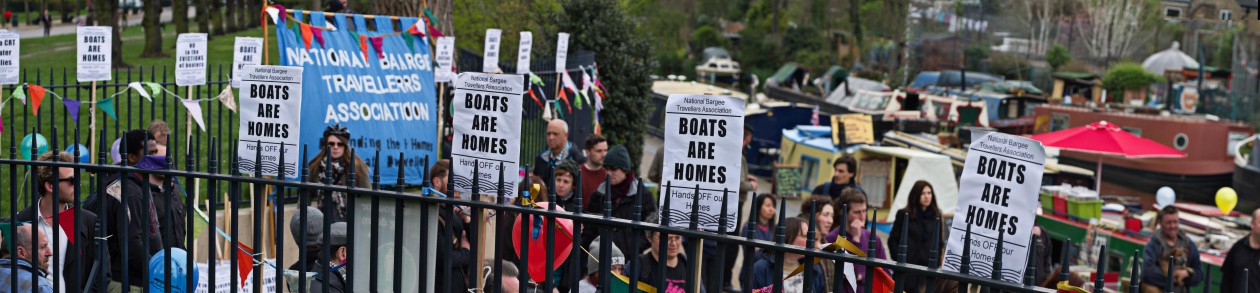
NBTA volunteers attended events across the country and leafletted beside CRT stalls to raise public awareness about the licence fee surcharge.
Looking ahead, CRT expects standard licence fees for narrowboats with home moorings to rise by 31% by 2028, based on a projected consumer price index (CPI) of around 4%, plus an additional 1.5%. That’s before any surcharge. CRT’s aim is to increase revenue by an average of CPI plus 3%, but most of the burden will fall on boats without a home mooring and larger vessels. By 2028, narrowboats without a home mooring could face a total increase of 61%, while 10ft and 14ft widebeams might see rises of 97% and 130%, respectively. These figures are minimum estimates.
Additionally, CRT only provides five-year projections (2023-2028), despite operating under a 10-year financial plan, leaving future price increases uncertain. In 2022, CRT raised licence fees twice, and they may increase them further in the coming years depending on inflation. Current estimates assume 4% CPI plus 1.5% added by CRT for the next five years.
If CRT manages to extort the surcharge on boats without a home mooring this year, the future looks increasingly unpredictable and financially insecure.
NBTA London needs your support to carry on our work. Please get in touch here if you would like to volunteer with us. Alternatively your donations are vital to us supporting boaters with their legal case work, campaign banners and other printed material as well as events. You can help us with your donations online here
Canal and River Trust (CRT) backs down over some of the chargeable moorings.
Following campaigns from the NBTA London, the CRT have scrapped charges to moor on the Camden visitor moorings, and reduced prices over winter across all chargeable moorings in London. High-profile media coverage the other week – including in The Telegraph – reported that the moorings were “punishingly expensive,” privatising the canals and turning once-busy spots into a “ghost town.”
CRT imposed the charges on sites initially meant to be “eco-moorings”, despite all surveyed groups of waterway users responding negatively to the proposal. Freedom of Information requests by the NBTA showed that existing chargeable moorings were only booked 16.5% of the time during the first six months of the year, making once vibrant stretches of the canal deserted and unsafe. Plans for more charges in Victoria Park, Broadway Market and Cowley are now looking unwise for CRT. The NBTA London welcomes the roll-back, but won’t stop pushing for an end to discriminatory policies, including scrapping all chargeable moorings and the surcharge on continuous cruiser licences.
If you want to protect a thriving boat community from being pushed off the waterways, take action now and stop the rest of the chargeable mooring.
NBTA London’s annual boaters’ winter social returns!
Join us for an evening of delicious food and boater chat, as well as watching the amazing video ‘Off the Cut’ together. We will also be having a discussion on the impact increased enforcement has had on our community, and how sticking together is necessary for the survival of our community.
Let’s eat, drink and be boaty!
Tickets will cost £2.50 this year, but includes your first drink!
Time: Saturday 30th November 2024 at 7pm
Location: London Action Resource Centre, 62 Fieldgate St, London E1 1ES
Tickets oftwn sell out well in advance, so don’t delay!
This wonderful film gives a unique insight into a community of boaters living on the Kennet and Avon canal in 2016. Shining a light on the impact the increased enforcement of 2015 had, the film follows a family on their pedal powered boat as they embark on a journey in which their way of life, and that of the whole community, comes under strain.
New daily mooring fees which are now being charged in a number of locations in London have had a devastating impact on London’s boating community in 2024.
Once-busy sections of towpath have emptied, thanks to discriminatory fee policies from the Canal and River Trust (CRT).
A campaign by NBTA saw a small reversal in policy from the CRT. In November 2024 it agreed to drop prices from the ‘punishingly expensive’ daily charge of between £25 and £35 a night to £20 a night over winter. By continuing to charge a nightly fee, the CRT has created a two-tier system, where those with discretionary spending money for whom an extra £140 a week is nothing at all, can moor safely in central London and everyone else is pushed out.
CRT also agreed to stop charging to moor in Camden, but has remained committed to charging boaters to be able to moor in Little Venice, Paddington Basin, Kings Cross and Angel. These moorings spots — all time-limited at 7 days — are generally considered safe places to moor as long as there are other boaters around, as they are close to public transport and other amenities.
However, the fight to protect London’s canals from de facto privatisation and CRT’s stated ambition to “manage the number of boats in Lonon” is not over.
If you DON’T want London’s thriving boat community to be pushed off the waterways, we call on you to take action before it is TOO LATE.
1. Share your thoughts on London’s boating community in an increasingly hostile environment via social media tagging @CanalRiverTrust and @NBTAlondon
2. Write to the Mayor of Londonmayor@london.gov.uk to tell him how London’s canals and boating community benefits you, your family, your friends, your community, or your business — and why you believe he needs to help protect it.
Here is an opinion of a boater about a licence strike:
My boat is my home. Over a five year period CRT want to raise my licence by around £600. That’s an additional half on top of the fee I already pay. I want to make a stand and I want to refuse to pay such an excessive rise but I’m nervous about a participating in the proposed licence strike. I don’t want to jeopardise my home.
I feel a powerful need to do something to stop CRT getting away with this punitive and destructive surcharge, particularly in the face of reduced services and fat salaries at the top of their organisation. What they’re doing with moorings is what was called embourgoisement when old terraced houses in towns got bought up by the middle classes and working people were priced out of those areas. The same when council houses were sold off. The CRT is looking, by design or by default, to price a whole section of society off the water. Where those people go, CRT don’t seem to care. What they’re doing by running services down is impoverishing the lives of all canal users, not just boaters. Their justifications and their figures are, at best, questionable. What’s their motivation?
Over many years, and in completely different situations from this one, I have had involvement in strikes and coordinated actions. The empowering factor in those activities for the people involved has always been numbers. To stand side by side with people seeking to achieve the same aim is powerful, reassuring and, even if the purpose of the action isn’t fully realised, provides future security in knowing you have each other’s interests at heart. The ripple effects create change somewhere else along the way. It changes the people who are involved and it makes those seeking to squash individuals and force them out of, or into compromised positions, realise that they have to rethink , because together, individual voices form a potent mass, a force to be reckoned with.
Organisations hit by strike action have to rethink their strategies. They have to sit down and negotiate with the people their proposals will adversely affect. They have to back down or compromise. I doubt the CRT would be able to continue to press such punitive payment proposals into action if enough people say “no”. The negative publicity of forcing numbers of people out of their homes would likely be counterproductive if they’re publicly shown to be making life worse by water.
I’ve been on strike as a warehouseman and as a teacher. I’ve been on mass demonstrations, squatted empty buildings, blocked machinery from digging roads across peoples beloved landscapes. Those things have had an effect. I can look back and see that some of the efforts haven’t been successful in the long term but have caused a slowing down of the process, a rethink of the necessity of a scheme and have always cost the organisations and corporations money, something they hate not having control over.
I’ve also seen things conclude with some success. A pay rise, better working conditions, an ear bent to listen in a more understanding way, negotiation of future plans with those who will be adversely affected. I’ve rarely been involved in the process of organising. I’m more a person who stands arm in arm with others who are struggling with the same imposition of stringent and ill advised policies. Standing with people is powerful. If we don’t do it, if we give in to the insecurities it raises for us, if we roll over, we don’t stand a chance of being heard or of winning our case.
The CRT isn’t a massive organisation, it’s not a multinational corporation, it’s not government. It’s a trust, a charity. It has a set of principles it ought to be adhering to. It has a broad remit and it needs to fulfil that remit in all aspects of its work. As Ccers, and it now seems, as long term moorers, they have engaged with us offering unfavourable terms. We need to take those terms back to them and say no. If we try that individually, they’ll pick us off and deny the justness of each case, as if to suggest each individual effort was pure wilfulness or criminality. If a mass of boaters coordinate to say a loud and reverberating NO, they’ll be forced to sit up and take note, to look at their strategy, to test it against a mass of adverse opinion.
How we achieve this it’s not my intention to state here. I just want to reassure myself and others that it’s possible to stop this surcharge being imposed or at least to negotiate something far more reasonable. And I want to hear enough other voices say a simple YES to decisive action so that I feel secure in taking that necessary action myself.
If you would like to ask questions about going on licence strike or agree with having a licence strike please contact Licence Strike campaign group. Licence Strike campaign group are planning to organising the licence strike, their email address is here:
It’s been over a year since Canal and River Trust (CRT) started introducing chargeable moorings as part of their plan to bring down boat numbers in London. So far, only part of the plan to bring in 1.1km of chargeable moorings has been implemented and already these have had a great impact on the boaters that use these areas. Added to the chargeable moorings that were bought in with CRT’s London Mooring Strategy, the length of chargeable moorings in London will do up to 1.5km.
The pretence was that these moorings would allow those from other parts of the country to visit the capital more freely, with assured availability in the most popular destinations. CRT supposedly carried out a consultation on whether boaters wanted such moorings in 2022, however they have so far been unable to provide us with the results of this consultation upon request. Meantime in the “Issues & Challenges Report” published as a result of their 2022 survey, the issue of a lack of moorings in central London is nowhere to be seen: unsurprisingly, a lack of facilities and the waterways falling into disrepair are much higher on boaters’ list of concerns.
Anyhow, availability there now certainly is. According to a Freedom Of Information (FOI) request submitted to the Canal and River Trust (CRT) in June this year and NBTA’s calculations, 1,203 one-night paid bookings were made between 31st October 2023 and 31st May 2024, where the total availability would have been 7,224. This demonstrates that pre-bookable moorings are being used at approximately 17% of their full potential. Chargeable moorings have existed since 2019, with a few available for £10-£12 a night. Why the need to double or triple the price and create more, when these already sat empty?
Paddington visitor moorings after they were made chargeable, 2023
In the aforementioned FOI response, CRT declared a total gross income from these booked moorings of £36,532, averaging an income of just over £30 for each night of each booking. To be clear, this is £30 per night to live in your own home, potentially double-moored, with the wonderful view of central London replaced by that of your neighbour’s curtains. Unfortunately, instead of opening up the capital to those living outside it, it has merely priced those of us already living there out. Instead of opening up new moorings and maintaining those available to us now, we find ourselves crammed into smaller spaces, while the most desirable parts of the city sit empty. This leaves the towpaths increasingly susceptible to crime and violence, particularly as the nights draw in earlier, and commuters walk home after dark. These once thriving community mooring spaces have been left empty and abandoned because CRT has made them financially exclusive – a strange no-person’s land throughout central London.
For those of us crossing the capital and unwilling or unable to pay, we now have an obligatory full day’s cruise ahead of us. And what’s to stop CRT extending these expensive moorings further, leaving us no choice but to stop in them and pay a fee or risk a fine? Alternatively, more London boaters will remain on a River Only licence and cruise solely on the Lee and Stort, therefore reducing CRT’s income further. Boaters from outside London will likely do what most Londoners do all year-round: moor up on the outskirts and travel in.
In an FOI request submitted in October 2023, CRT explained that three Mooring Rangers manage the pre-bookable moorings alongside other tasks, at a cost to them of £104k a year. This doesn’t cover software, IT, admin support, management of that team, or any other associated costs. Considering the gross income from these moorings of £36,532 over six months, so approximately £73k a year, it’s hard to see how CRT could be making much profit, if any. It is in fact more likely they would be making a loss.
So here we are again. Another scheme started by CRT under false pretences, which is not only detrimental to London boaters, but those all along the network, who aren’t seeing any of the supposed income reinvested into CRT waterways and facilities to meet boaters’ day to day needs.
Boats moored in protest against chargeable moorings at Little Venice, late 2023
It has been 3 years since CRT installed a new set of ‘No Mooring Zones’ on the River Lee. These ‘No Mooring Zones’ were exclusionary and unpopular at their outset – leaving the boating and wider community confused why it was so necessary to push boaters out of such a vital community area – without any evidence of a safety issue in the first place.
For 3 years boaters have continued to moor in protest at these ‘No Mooring Zones’ – yet the river has remained safe, with no significant, or even noticeable spike in safety incidents. The Itinerant Boating Community is full of diversity. Boat dwellers are also canoeists, paddle boarders and rowers, and NBTA are keen to encourage and celebrate this diversity, so we have approached CRT to suggest a different approach. An approach based on mutual initiatives – rather than exclusionary ‘No Mooring Zones’ – where different aspects of the boating community work together to ensure the river is accessible to all.
It is early days yet, and we hope that discussion will have began in earnest by the end of July – but early signs are good, with CRT and key boating orgs along the River Lee showing interest in a different and more collaborative approach.
A further benefit to this collaborative approach is it can be ‘grassroots’, growing within the community – saving CRT the cost of needless and ineffective micro-management and policing during this time of financial need.
CRT have introduced their discriminatory surcharge against boats without a home moorings. As every day passes, more boaters realise that their licences are spiralling upwards while services continue to degrade. As more boaters realise that they are been priced off the water, urgent action is required. CRT claim it’s about money. But is it really?
There is no money to be made by the surcharge. Rather it is about making an alternative way of life impossible.
The surcharge has been justified by CRT following a consultation that they presented to their board of trustees. CRT claimed that the consultation revealed that boaters were overall in favour of a surcharge. However multiple FOI’s have shown that CRT doctored the consultation, removing the slides that demonstrate that 97% of boats without a home mooring and 60% of all boaters were against the surcharge. The doctored consultation was used to mislead the board of trustees and push through this discriminatory surcharge. Recent contact with Richard Parry by NBTA members has shown that CRT has no interest in discussing how the surcharge will negatively impact our way of life. He has stated that there will be no reopening of negotiations regarding the surcharge. But CRT once claimed similar regarding the ‘saftey zones’ and following community pressure, they have been forced back to the table.
So what does pressure look like this time around? A licence strike: Strikers will refuse to pay CRT’s new class of licence fee in protest against the ever increasing additional charges for boaters who do not want, cannot afford, or cannot find a home mooring. Currently the Stop the Surcharge Campaign are looking to sign up 500 boaters to go on a full licence strike. They are rapidly approaching that threshold and strike action is imminent. Why do they need to wait until 500 are ready to go on strike before acting? First, we are stronger as a collective in the face of CRT’s enforcement. Such a number would overwhelm CRT’s enforcement capabilities thereby minimising the risk to you and your home. Secondly, it would deny CRT over half a million pounds (the same amount as the combined salaries of Richard Parry, Chief Executive, and Stuart Mills, Chief Investment Officer). Such amounts would begin to exert the pressure require from CRT to reopen discussions.
To sign up to the strike go to tinyurl.com/licencestrike . We are also looking for volunteers to deliver leaflets and picket CRT stalls, thereby damaging their public image. If you feel that you would be able to please email: CRTlicencestrike@gmail.com .
In March, the Canal and River Trust (CRT) announced that they will be introducing 800 meters of new pre-bookable moorings at 6 sites across London: Kings Cross, Camden, Victoria Park, Broadway Market, Kensal Green and Cowley North. This is in addition to existing chargeable moorings at Islington, Little Venice and Paddington.
Since then, members of NBTA London have been working together to campaign against the loss of these free mooring spaces, and to tackle the CRT’s assertions that boaters struggle to find somewhere to moor in London and therefore these pre-bookable moorings are justifiable.
These pre-bookable moorings are now live but if you have been anywhere near these moorings, you’ll be wondering who are the boaters that so desperately want to moor in these spots, because they’re not in London. These moorings, which used to be full of bustling boater life, are now empty and quiet. Locals have already started to comment that they do not feel safe walking these strips of towpath at night again. In response to this, an outreach program targeted at locals and boaters, called “Where have all the boats gone?”, is about to be launched to find out how the lack of boats in these areas is negatively impacting their use of the canal and towpath.
To make matters worse, more chargeable moorings now seem to be popping up, almost over night, with little or no warning. Embarrassingly for CRT, these pre-bookable moorings are clearly already failing. Based on the lack of uptake, the CRT have been sent several FOIs regarding the use of these moorings, but unfortunately they have not been very forthcoming with their responses so far.
Chargeable Mooring Sign in London, subverted by local boaters to read, “No Charges apply”
As many of you know, the main reason CRT has given for charging more for boaters that don’t have a home mooring is that they need more money. CRT says this is due to two things; 1) inflation, and 2) cuts to the funding they get from the government.
However, inflation increases are accounted for with an increase in the standard boat licence. In 2022, a CRT standard boat licence was increased by 8%, while inflation that year was 9%. Then CRT increased the standard boat licence once again in 2023 by 9%, while the inflation the same year was just 7%. In 2024, they continued to increase the standard boat licence by another 6% at a time that inflation has decreased to 2%. So as you can see, with boat licences CRT more than compensated for inflation. Therefore, CRT can’t seriously argue that they need to increase licences on boats without home moorings due to inflation.
Now onto the cuts to funding from the government that CRT receives. It is possible to counter this argument with the following argument:
When CRT was set up in 2012 the plan set out by the government was always to cut CRT funding over time until CRT no longer received government funding, and CRT’s job was to find other ways to fund the waterways they managed. For some years, CRT got more funding from the government than British Waterways before them. However, instead of succeeding in the plan to fund the waterways without the government, CRT spent the time wasting money on things like new logos and the ‘safety zones’, plus selling off assets such as most of the marinas, dredging equipment and most other things necessary for managing the waterways; it subsequently costs them much more to hire the equipment back. So either CRT leadership is to blame for mismanagement, or the CRT project was set to fail from the beginning. Or a bit of both. Therefore, it can easily be argued that we as boaters shouldn’t foot the bill for the failure of CRT.
However, the real question should be – can the extra money raised by the surcharge on boats without home moorings cover the decreases in funding from the government?
We worked out that CRT would raise roughly an extra £4.27 million with the surcharge on boats without home moorings over the next 5 years. Which is a drop in the ocean compared to more £320m CRT claims will be cut from its government funding. Also CRT hasn’t put forward any serious plans to raise the hundreds of millions needed to cover the loss of government grants, and charging boaters more will never fill that gap. Therefore, we maintain that CRT isn’t charging a surcharge because they need the money, it is simply a way to make our way of life harder, in an effort to rid the waterways of our community.
A volunteer organisation formed in 2009 campaigning and providing advice for itinerant boat dwellers on Britain’s inland and coastal waterways


 National Bargee Travellers Association - London Branch