The campaign against the surcharge (the charge for not having a home mooring) started with a massive influx of people joining, and the campaign set up many working groups to facilitate the large range of strategies and tactics people put forward. After a while, it became obvious to most that there were too many strategies and tactics compared to the number of people actively doing things. Therefore, the campaign decided to agree on a set of strategies and tactics.
After much discussion, we, inside the campaign, have decided on a strategy to stop the surcharge. The strategy is twofold: while we are trying to make inroads with finding allies within Parliament (lobbying MPs, Lords etc) to be against the surcharge; we will also be using our leverage to take on CRT’s public image by protest leafleting at the very events and places CRT is trying to improve its image.
The reason why leafleting at CRT stalls works is that it undermines CRT’s public image. The whole premise of CRT’s existence is based on its “charity doing charitable work” public image, and of course, its donations are linked to how people view it. This is why it spends millions of pounds on PR events and social media, etc. CRT has written to NBTA twice now asking, then demanding, we stop leafleting at their stalls. It has obviously been having a serious effect on CRT, and there is no way CRT can stop us. Leafleting at CRT stalls will stop when CRT stops the surcharge; it is our leverage, its the reason CRT will stop the surcharge because CRT needs their public image more than it needs it charge the surcharge. Get involved to be part of the actions that will stop the surcharge. Email stopboatlicencediscrimination@gmail.com to be involved.
With strategy of lobbying MPs, if successful, rather than fighting CRT time and time again over never-ending iterations of their attrition of our community, we might just possibly see government seeking to regulate CRT excesses on our behalf. Long shot. But if it works it will save us many, many more battles.
Our first ‘Drop in Session’ back in November was just a start. Our second session was planned for February 11th but has morphed to a meeting with Andrew Cooper MP, who we met at the first session, so that he might understand our case more fully, then to advise our next parliamentary steps.
It’s been over a year since Canal and River Trust (CRT) started introducing chargeable moorings as part of their plan to bring down boat numbers in London.
So far only part of the plan to bring in 1.1km of chargeable moorings to London has been implemented but already these changes have had a great impact on boaters who move through these areas of London.
In the CRT’s London Mooring Strategy, the length of chargeable moorings in London could go up to 1.5km in the next year.
CRT claimed to have consulted boaters in 2022 on the need for such moorings but it has not provided the results of this consultation. Notably, their 2022 “Issues & Challenges Report” did not mention a shortage of moorings, instead it highlighted boaters concerns about disrepair and lack of facilities.
Little Venice chargeable moorings in August 2024. Once brimming with life, now desolate.
Chargeable moorings were first introduced here in 2019, but they were priced at £10 to £12 a night. Despite low demand at that price, CRT has significantly raised the price, leading to even more space in central London being wasted, empty of boaters.
According to a Freedom of Information (FOI) request submitted in June 2024, only 1,203 bookings were made between October 2023 and May 2024 (out of a possible 7,224 bookings), indicating that the moorings were used at just 17% capacity.
The FOI revealed that CRT earned a gross income of £36,532 from these bookings on an average of just over £30 per night. We believe this is barely enough to cover the cost of administering prebookable moorings.
The rationale for them is to enable people to book a berth without having to find somewhere to moor on their own in central London. However, the data tells us that the demand is simply not there: only 16.5% of the availability has been utilised.
Rather than improving access to the capital, the charges have effectively priced many existing boaters out of central London, leaving prime locations empty. As a result, many boaters must now cruise for a full day to find a mooring, or risk being fined.
There is a knock-on effect of leaving these locations empty too: those who cannot afford to pay are forced to moor in now even more crowded areas, making a trip through London even more precarious for boaters with or without a home mooring.
Vandalised chargeable mooring sign in London
The situation has also worsened safety concerns for boaters and local residents, as these once-bustling sections of towpath have been deserted, leaving them more vulnerable to crime.
Others may opt for a River Only license, staying on the Lee and Stort as London’s main canal network becomes too expensive, a move that will reduce CRT’s revenue further.
The decimation of London’s boating community and the safety that it brings to the canal here means those boaters from outside London whom CRT are trying to entice with their pricey prebookable moorings are likely to avoid the capital altogether.
A subsequent FOI in October 2024 revealed that three Mooring Rangers, tasked with managing these moorings, cost CRT £104k annually, far exceeding the (assumed) £73k annual income from the moorings. This suggests CRT may even be operating this policy at a loss. It is an illogical policy that is costing boaters and CRT, with no clear benefit to either.
In November 2024, CRT decided to reduce the price of these chargeable moorings – from between £25 and £35 per night to £20 per night – as a result of NBTA London’s campaigning.
We look forward to seeing whether the reduced price has any positive uptick in the number of bookings made, or if there is in fact NO case for charging per night for mooring on the public towpath at all.
Due NBTA London campaigning CRT has also agreed to stop charging to moor in Camden and says they no longer plans to roll out more chargable moorings across London including Uxbridge, Kensal, Broadway Market and Victoria Park. However, CRT has remained committed to charging boaters to be able to moor in Little Venice, Paddington Basin, Kings Cross and Angel.
NBTA believe these mooring spots should be open for anyone boating through London, as is the norm across the entire canal network, and that the privatisation of public spaces should continue to be resisted.
NBTA London needs your support to carry on our work. Please get in touch here if you would like to volunteer with us. Alternatively your donations are vital to us supporting boaters with their legal case work, campaign banners and other printed material as well as events. You can help us with your donations online here
It’s been over a year since Canal and River Trust (CRT) started introducing chargeable moorings as part of their plan to bring down boat numbers in London. So far, only part of the plan to bring in 1.1km of chargeable moorings has been implemented and already these have had a great impact on the boaters that use these areas. Added to the chargeable moorings that were bought in with CRT’s London Mooring Strategy, the length of chargeable moorings in London will do up to 1.5km.
The pretence was that these moorings would allow those from other parts of the country to visit the capital more freely, with assured availability in the most popular destinations. CRT supposedly carried out a consultation on whether boaters wanted such moorings in 2022, however they have so far been unable to provide us with the results of this consultation upon request. Meantime in the “Issues & Challenges Report” published as a result of their 2022 survey, the issue of a lack of moorings in central London is nowhere to be seen: unsurprisingly, a lack of facilities and the waterways falling into disrepair are much higher on boaters’ list of concerns.
Anyhow, availability there now certainly is. According to a Freedom Of Information (FOI) request submitted to the Canal and River Trust (CRT) in June this year and NBTA’s calculations, 1,203 one-night paid bookings were made between 31st October 2023 and 31st May 2024, where the total availability would have been 7,224. This demonstrates that pre-bookable moorings are being used at approximately 17% of their full potential. Chargeable moorings have existed since 2019, with a few available for £10-£12 a night. Why the need to double or triple the price and create more, when these already sat empty?
Paddington visitor moorings after they were made chargeable, 2023
In the aforementioned FOI response, CRT declared a total gross income from these booked moorings of £36,532, averaging an income of just over £30 for each night of each booking. To be clear, this is £30 per night to live in your own home, potentially double-moored, with the wonderful view of central London replaced by that of your neighbour’s curtains. Unfortunately, instead of opening up the capital to those living outside it, it has merely priced those of us already living there out. Instead of opening up new moorings and maintaining those available to us now, we find ourselves crammed into smaller spaces, while the most desirable parts of the city sit empty. This leaves the towpaths increasingly susceptible to crime and violence, particularly as the nights draw in earlier, and commuters walk home after dark. These once thriving community mooring spaces have been left empty and abandoned because CRT has made them financially exclusive – a strange no-person’s land throughout central London.
For those of us crossing the capital and unwilling or unable to pay, we now have an obligatory full day’s cruise ahead of us. And what’s to stop CRT extending these expensive moorings further, leaving us no choice but to stop in them and pay a fee or risk a fine? Alternatively, more London boaters will remain on a River Only licence and cruise solely on the Lee and Stort, therefore reducing CRT’s income further. Boaters from outside London will likely do what most Londoners do all year-round: moor up on the outskirts and travel in.
In an FOI request submitted in October 2023, CRT explained that three Mooring Rangers manage the pre-bookable moorings alongside other tasks, at a cost to them of £104k a year. This doesn’t cover software, IT, admin support, management of that team, or any other associated costs. Considering the gross income from these moorings of £36,532 over six months, so approximately £73k a year, it’s hard to see how CRT could be making much profit, if any. It is in fact more likely they would be making a loss.
So here we are again. Another scheme started by CRT under false pretences, which is not only detrimental to London boaters, but those all along the network, who aren’t seeing any of the supposed income reinvested into CRT waterways and facilities to meet boaters’ day to day needs.
Boats moored in protest against chargeable moorings at Little Venice, late 2023
So this year CRT pulled out of their bag of tricks, one of the favourite waterways authorities questions: ‘Should people without a home mooring pay more than those with?’ And without much warning they actioned this into their new surprise survey. It’s not the first time CRT or their predecessor British Waterways (BW) brought this question out. Within the last 21 years they have bought it out four times.
In the Bill that became the British Waterways Act 1995, BW wanted it to be a criminal offence to keep a boat on BW waterways without a home mooring. However, with an almighty pushback we instead got an Act which gave us the legal right to exist on BW waterways. This was quite a setback for BW, it had for the 20-30 previous years been making life on the water harder. Now it was law that they had to licence our boats as long as we followed three basic criteria. Therefore, BW and following them CRT had to come up with some inventive ideas to deal with their persistent pest – the travelling boater.
They tried a few different tactics in their attempts to eliminate our community from the waterways, from reducing mooring stay times to taking away moorable banks to outlandish enforcement strategies such as 2003’s plan to make our travelling boaters travel 120 different lock-miles every 3 months without turning back. Some plans were beaten back, others weren’t. So far each time BW and CRT have proposed that boats without home moorings should pay more; it has been successfully resisted.
In early 2002, BW stated that they believed the licensing system was “felt by many to be unduly complicated”, in a document entitled ‘A fresh look at BWs craft licensing structure:
Consultation Paper for Boaters May 2002′. They proposed a more complicated tiered licensing system where they would increase the licence fee for a boat without a home mooring to 2.5 times that of the normal licence fee. In their document they even argued, ‘there is a compelling argument for a ‘pay as you go’ system’.
Later that year, after doing a bit a consultation they published ‘A fresh look at BW’s craft licensing structure: Consultation update’. Here BW put boats without home moorings into four categories: genuine continuous cruisers, bridge-hoppers or short range cruisers, static “live aboard” boats and boats awaiting a mooring. Just for clarification, BW considered bridge-hoppers or short range cruisers were people who “moved less than 50 km in any three month period”. They were concerned that if they charged boats without home moorings more then they would harm the “genuine continuous cruisers” as well as the other types of categories they’d coined without home moorings. Therefore, they proposed that boats without home moorings who moved within a range in one region “pay a district mooring fee equivalent to the lowest priced BW permanent mooring in the area where your craft is normally kept or used”. Under pressure, this idea was also discarded.
In a 2005 document entitled ‘Licence Fee Consultation June 2005’ BW proposed to increase the licence fee for boats without a home mooring by 147%. It was identified in a report by BW entitled ‘Fee Structures for Boat Licences in England and Wales White Paper’ in the same year, that if implemented it would have raised £1million from only 1,360 boat licence holders.
A group called the Continuous Cruiser Action Group was set up to coordinate boaters responses to the consultation.
A section of boaters organised themselves against it and set up a campaign mobile phone group. Some of the organised boaters travelled across the nation and painted the phone number on locks asking people to get involved. The phoneline became inundated with texts of people wanting to do something. If BW didn’t back down the plan was to send text messages for people to meet at a list of different lock pinch points and do a go slow flotilla to cause disruption. BW backed down so the resistance plan didn’t need to implemented. At the time in 2006, the Continuous Cruiser Action Group made a statement saying, “just because all has gone quiet, it isn’t over”. They weren’t wrong.
In early 2008, hire boat company Wyvern Shipping circulated a petition calling on BW to make continuous cruisers pay a higher licence fee. In January 2008, Sally Ash BW’s then Head of Boating had received a letter from the Association of Pleasure Craft Operators (APCO), the hire boat companies’ trade body, threatening a drop in BW’s licence income if BW increased the cost of hire boat licences.
In September 2008, BW issued a consultation document to the User Groups entitled ‘Boat Licence Fees – For information and comment on by Waterway User Groups’. This document included a proposal to increase the licence fee for boats without home moorings by £150 in comparison to the published tariff. BW also proposed to introduce higher licence fees for widebeam boats. However, once again boaters organised and beat these plans back.
Then in 2017, CRT announced that the licence fees system was “outdated” with the ridiculous lie that licence fees have never been reviewed. They argued that licence fees were “complex”, “unfair”, “outdated” and that their consultation into the fees would be “cost neutral”. This so called cost neutral consultation had three stages and had to change research company for the third stage.
We in the NBTA were involved in each part of the consultation. All the way through this process, CRT attempted to divide boaters, putting forward the question again about charging boats without home moorings more than those with. Therefore, we spent this time preparing to be ready to ballot our members for a licence fee strike if we had to. We weren’t going to let CRT price us off the water!
Again, it didn’t come to that. CRT decided not to take us on at that time. So they decided to halve the early payment discount, pick on wider boats and further made a statement saying they would think about how to deal with the London waterways problem; separately. This thinking has led CRT to plan to implement chargeable moorings on 1.1km of London’s regular towpath. In a meeting between NBTA and CRT this year, CRT revealed that they still haven’t implemented this plan because they haven’t been able to hire someone suitable to manage the project. While that plan is still apparently to be implemented, CRT has reached back into the bag of tricks and found the same old question, once again hoping for different reply.
As in the past, we must show the waterways authorities we aren’t a community that they can push around and do whatever they want with. We aren’t a social problem that needs culling, our way of life is worth defending and together we can beat them back! Please get involved. If you think the lifestyle of travelling without a fixed address should continue to be defended, then join us here: https://nbtalondon.co.uk/about/welcome-to-the-nbta/ or email nbtalondon@gmail.com.
Featured image by David Mould on Flickr
NBTA London needs your support to carry on our work. Please get in touch here if you would like to volunteer with us. Alternatively your donations are vital to us supporting boaters with their legal case work, campaign banners and other printed material as well as events. You can help us with your donations online here
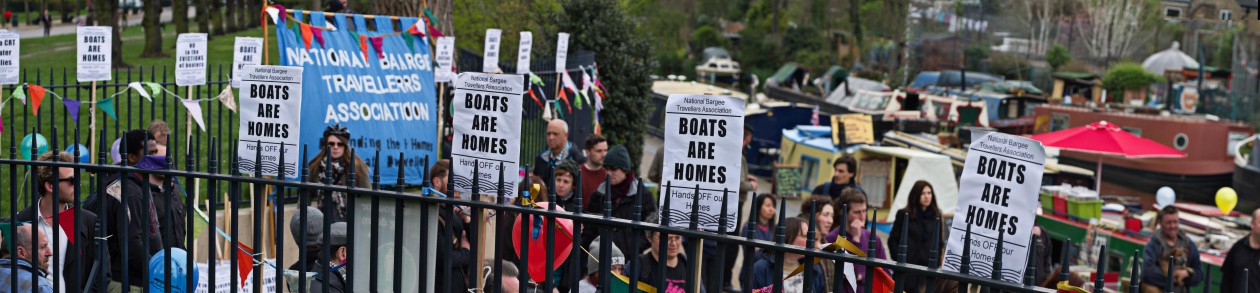
Hundreds of boaters, local residents and land-based supporters turned out on Sunday 26th of June to attend the National Bargee Travellers Association’s (NBTA) Hackney Protest Picnic in a continued show of resistance to the Canal & River Trust’s (CRT) ongoing attacks on the capital’s liveaboard boating community.
The picnic, which began at midday and ran into the late afternoon, was held on Walthamstow Marshes opposite the Anchor and Hope pub. On a day lit by glorious summer sun, the capital’s boating community came together in a joyous show of solidarity and celebrated their life on the water with conversation, live music, mural painting, refreshments and a vegan BBQ. With hundreds in attendance, the event was a chance for local, land-based residents to learn more about boaters, and to hear from the NBTA about the attacks that their community has sustained from CRT over the past few years, as well as the lively and ongoing campaigns to preserve their way of life that have grown up in response.
Picture by Amy DyduchPicture by Amy DyduchPicture by Marcus Trower
Marcus Trower, NBTA London branch secretary and one of the event’s organisers said: “London’s boater community has endured years of attacks on their way of life from the CRT – everything from unlawful attempts to evict boaters from their homes to the current Water ‘Safety’ Zones that will drastically restrict boaters ability to live and work around the River Lea. This Protest Picnic is an opportunity to not only draw attention to the issues that boaters are facing from the CRT, but to also celebrate our unique community, way of life and contribution to Hackney’s own rich public life. Those of us that have moored in Hackney consider spending time here to be an essential part of London’s boating culture, and one of the joys of making our lives on water; we’re looking forward to welcoming as many people as possible to Walthamstow Marshes to celebrate that fact with good food, music, conversation and continued solidarity for our fight against CRT’s boat cull.”
With the CRT recently rowing back on commitments to consult with boaters about the removal of moorings in so-called ‘Water Safety Zones’ on the River Lee, the Protest Picnic comes at a time of uncertainty for many boaters, many of whom have been harassed with enforcement notices and threatened with eviction from their homes. Sunday’s celebration of boater life was the latest in a series of events which protest against the CRT’s plans to drastically cull the number of casual moorings across London, and demonstrate the strength and vibrancy of the liveaboard community whose lives these plans will negatively impact. In April 2021, a flotilla of boaters made its way through Broxbourne to raise awareness of CRT’s attacks in the local community and in June 2021 a similar flotilla protest through Hackney drew thousands of boaters and supporters alike. In March of this year, hundreds of boaters and supporters marched on the CRT’s main office in Little Venice to explain how these discriminatory policy changes are threatening people’s livelihoods and intentionally pricing boaters out of their homes.
Ian McDowell, chair of the London branch of NBTA explained some of the reasons behind boaters continuing resistance to the CRT’s plans: “This continued disregard for the people who live and work in these new ‘no mooring’ and proposed paid-for mooring areas drives boaters away from their livelihoods, and out of their homes. By ignoring its responsibility to preserve the waterways for all communities, CRT is crossing a dangerous line that could see London Waterways and other waterways become usable only by those who can afford any extra costs CRT chooses to introduce in addition to the licence fee. Their actions only serve to show that while CRT markets themselves as a charity that promotes wellbeing, they repeatedly try to introduce policies which attack boaters’ wellbeing and way of life.”
London’s waterways have received significantly more attention and usage of various forms in more recent years. Following decades of decline, London’s boaters have played a significant role in the reclamation and revitalisation of these spaces. However, this contribution seems increasingly undesirable by the authority that manages the waterways.
Since 2012, the Canal & River Trust (CRT) have assumed guardianship of 2000 miles of the UK’s canals and rivers from the state-owned British Waterways (BW). As a not-for-profit charitable trust, the CRT have placed an increased emphasis on wellbeing in their agenda for their waterways’ users.
There has been a notable increase in and heterogeneous uses of the River Stort, Lee Navigation, Regent’s Canal, Hertford Union Canal, and the lower Grand Union Canal. Cyclists, walkers, joggers, rowers, and kayakers are all user groups that the CRT appear happy to see using the waterways in increased numbers, but not all increases in usage seem to be so welcome.
The general trend of increased usage has brought a range of advantages, including an increased diversification of users of the waterways, yet this has occurred during a period of increased economic and social strain for many living in London. London’s housing crisis has led a relatively small proportion to search for viable living arrangements away from the increasingly unaffordable rental costs ‘offered’ by the housing market, joining the existing communities of liveaboard boaters on the cut.
According to the CRT’s National Boat Count, boat numbers were rising for a period in the London area. However this increase in use appears less welcomed by the CRT when compared to the increase in leisure uses of the estate they manage, despite liveaboard boaters paying licensing fees to the CRT, yielding them a growth in income revenue from boaters.
The CRT do not have legal powers to stop or restrict the number of licensed boats on the water, and as such are seeking “creative solutions to help manage growing boat numbers […] to address [the] challenges” this brings them. In lieu of the limited powers the CRT possess, it is difficult to envisage any “creative” solutions that would be equitable across the wide range of boaters that live on London’s waterways, such as introducing surcharges or fees for certain uses of the canals. However, this is occurring in spite of the CRT’s own 2020 data showing a 2.2% reduction of boats in the region.
The apparent need to manage the volume of liveaboard boats in London is not a new struggle for boaters. Back in 2010, BW said that were “more boats moored along the Lee than are desirable” and attempted to zone London’s waterways into “neighbourhoods”. Due to the anger and push back from boater communities, this plan was eventually dropped.
The National Bargee Travellers Association (NBTA) has described the CRT’s 2018 London Mooring Strategy (LMS) as “a strategy to help clear London’s waterways of boat dwellers and turn it into a London waterway leisure and business park. It is the perfect recipe for gentrification of the waterways.” Amongst other issues, the LMS includes a reduction of mooring time available for boaters at 22 sites, with increased surveillance and enforcement on the sites with reduced time limits.
The LMS has not been completed, yet the CRT are currently conducting a new survey to help them strategise new ways to manage the “very high and increasing” boat population. However, the CRT are yet to provide supporting information for the assumed problems caused by the volume of boats, or substantiating data on the apparently negative efficacies of an increased liveaboard population.
The current survey appears flawed in a range of ways, particularly as it is strewn with leading questions. As an example, they ask “In your own words what would you want the Trust to do to manage boat numbers in busy areas?” This assumes that the volume of boats is a problem, but are more boats a problem? More boats means more boaters, and as such a more vibrant and neighbourly community, helping to increase safety for all users of the waterways. Framing an increase in the number of boats as a problem evades other opportunities for the CRT to support thriving liveaboard communities by increasing the facilities offered.
It is also noteworthy that the majority of the survey is collecting qualitative data. This is welcome, as it provides an opportunity for participants to offer detailed, subjective understandings of their experiences of living aboard. However, whilst by no means impossible, such rich data can be difficult to generalise from in the development of an organisational strategy, and can lead accusations of cherry picking data and quote mining.
The global pandemic has created further tensions for the CRT and their wellbeing agenda. The initial lockdown saw posters erected to encourage “local” usage of towpaths, without any clarification of what that meant, causing confusion and anxiety for cyclists, walkers, and boaters alike. As soon as the lockdown was lifted, new posters replaced the old ones, and these actively encouraged the use of the use of towpaths for leisure purposes.
However, much of the towpath is difficult or impossible to navigate whilst staying two metres- or even one metre- from other users and boats. This exposed people to unnecessarily high risks, particularly moored boaters that were enduring the increased risk while remaining aboard their homes.
As with so many other examples of authorities exerting their political agenda in the dehumanising process of managing properties and estates, the lives of those impacted by this ‘management’ are treated with neglect and disdain. As the CRT seeks to offer leisure facilities and develop greater commercial enterprise on the waterways, the lives and rights of liveaboard boaters are treated as an unfortunate hangover of the historic canals of London.
The London branch of the NBTA continues to fight the increasing gentrification of London’s waterways and is planning further action to protect liveaboard boaters and to ensure that the waterways remain for the use of everyone, not just for those with access to resources or for business to expropriate money from a public asset.
#stoptheboatcull
A volunteer organisation formed in 2009 campaigning and providing advice for itinerant boat dwellers on Britain’s inland and coastal waterways


 National Bargee Travellers Association - London Branch