Tag Archives: Chargable Moorings

The chargeable moorings, the backstory

It’s been over a year since Canal and River Trust (CRT) started introducing chargeable moorings as part of their plan to bring down boat numbers in London. So far, only part of the plan to bring in 1.1km of chargeable moorings has been implemented and already these have had a great impact on the boaters that use these areas. Added to the chargeable moorings that were bought in with CRT’s London Mooring Strategy, the length of chargeable moorings in London will do up to 1.5km.

The pretence was that these moorings would allow those from other parts of the country to visit the capital more freely, with assured availability in the most popular destinations. CRT supposedly carried out a consultation on whether boaters wanted such moorings in 2022, however they have so far been unable to provide us with the results of this consultation upon request. Meantime in the “Issues & Challenges Report” published as a result of their 2022 survey, the issue of a lack of moorings in central London is nowhere to be seen: unsurprisingly, a lack of facilities and the waterways falling into disrepair are much higher on boaters’ list of concerns.

Anyhow, availability there now certainly is. According to a Freedom Of Information (FOI) request submitted to the Canal and River Trust (CRT) in June this year and NBTA’s calculations, 1,203 one-night paid bookings were made between 31st October 2023 and 31st May 2024, where the total availability would have been 7,224. This demonstrates that pre-bookable moorings are being used at approximately 17% of their full potential. Chargeable moorings have existed since 2019, with a few available for £10-£12 a night. Why the need to double or triple the price and create more, when these already sat empty?

In the aforementioned FOI response, CRT declared a total gross income from these booked moorings of £36,532, averaging an income of just over £30 for each night of each booking. To be clear, this is £30 per night to live in your own home, potentially double-moored, with the wonderful view of central London replaced by that of your neighbour’s curtains. Unfortunately, instead of opening up the capital to those living outside it, it has merely priced those of us already living there out. Instead of opening up new moorings and maintaining those available to us now, we find ourselves crammed into smaller spaces, while the most desirable parts of the city sit empty. This leaves the towpaths increasingly susceptible to crime and violence, particularly as the nights draw in earlier, and commuters walk home after dark. These once thriving community mooring spaces have been left empty and abandoned because CRT has made them financially exclusive – a strange no-person’s land throughout central London.

For those of us crossing the capital and unwilling  or unable to pay, we now have an obligatory full day’s cruise ahead of us. And what’s to stop CRT extending these expensive moorings further, leaving us no choice but to stop in them and pay a fee or risk a fine? Alternatively, more London boaters will remain on a River Only licence and cruise solely on the Lee and Stort, therefore reducing CRT’s income further. Boaters from outside London will likely do what most Londoners do all year-round: moor up on the outskirts and travel in.

In an FOI request submitted in October 2023, CRT explained that three Mooring Rangers manage the pre-bookable moorings alongside other tasks, at a cost to them of £104k a year. This doesn’t cover software, IT, admin support, management of that team, or any other associated costs. Considering the gross income from these moorings of £36,532 over six months, so approximately £73k a year, it’s hard to see how CRT could be making much profit, if any. It is in fact more likely they would be making a loss.

So here we are again. Another scheme started by CRT under false pretences, which is not only detrimental to London boaters, but those all along the network, who aren’t seeing any of the supposed income reinvested into CRT waterways and facilities to meet boaters’ day to day needs.

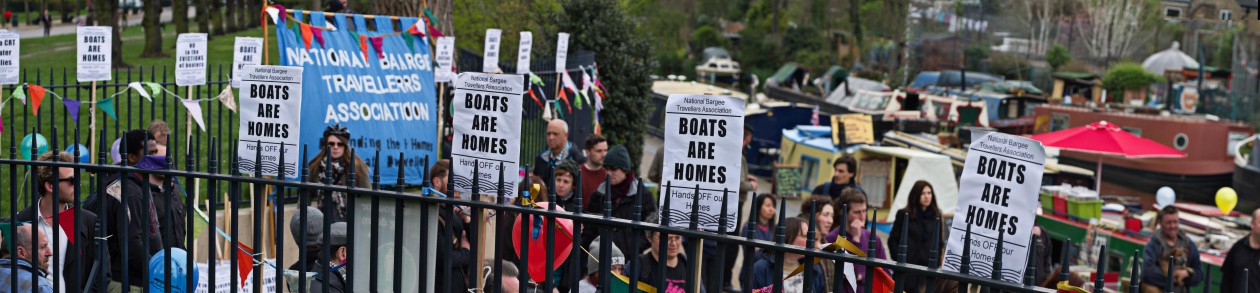
Boats moored in protest against chargeable moorings at Little Venice, late 2023

Should I moor on the payable moorings? Some brief guidance and advice.

This guidance is to help you to decide whether to moor on the chargeable moorings or not. If CRT charge you for mooring without booking, contact NBTA Caseworkers for help. 

For more detailed guidance, including case law and foot notes, see here

I’ve already decided to moor – what are the basics I need to remember? Brief Information

CRT’s ability to issue charges is untested. They state that they will charge double the nightly cost for any boat that stays without paying. It isn’t known if they can uphold this (see [link] for more info). 

Stick to the British Waterways Act 1995: do not overstay the 14 day limit unless reasonable, use your boat for bona fide navigation, have a valid BSS, have insurance. 

Check that mooring is available on CRT’s website before mooring on the chargeable mooring. If it is fully booked, don’t moor there. Be respectful to other boaters who may have paid.

If you say that you are mooring there in protest or there are clear signs which state the charges, then then CRT could argue that you have agreed to the terms and conditions of mooring there. This may make it easier to charge you. 

Hiding index numbers is against the 1975 BW byelaw. However, CRT do not have the power to refuse you a licence for not displaying your index number. If someone doesn’t display an index number, it is harder for CRT to know who is moored on the chargeable mooring and therefore to send emails to them.

Do not engage in conversation with mooring rangers. 

If CRT move beyond threats and do issue a charge, contact the NBTA London caseworkers: https://nbtalondon.co.uk/resources/contact-nbta-caseworkers/

Should I moor on the payable moorings? More detailed guidance

This detailed guidance is to help you to decide whether to moor on the chargeable moorings or not. If CRT charge you for mooring without booking, contact NBTA Caseworkers for help. 

For less detailed guidance, see here.

I don’t know whether to moor there – what do I need to consider?  Detailed Guidance 

Can CRT Charge me?

CRT claims it could charge a fee for breaking the T&Cs and ignoring their signs. They haven’t issued any extra charges to boaters for ignoring their signs. 

CRT are claiming that they can charge double for mooring on chargeable moorings without booking. This has not been tested. We believe it to be unlikely and as far as we are aware, no charges have been issued for overstaying before. However, mooring will be at your own risk.

If no signs are visible clearly saying what the restrictions are, CRT will not be able to charge boaters for staying there. If signs are visible, it can be argued that the boater is entering into a contract with CRT by mooring there. In ‘Parkingeye Ltd v Beavis (2015), a motorist’s appeal against a charge was rejected because there were plenty of signs stipulating the length of stay and the penalty1.

Similarly, if a mooring ranger tells you to move, it can be argued that by remaining there the boater is entering into a contract with CRT. If you were to tell a CRT employee that you are moored in protest, you would be acknowledging that you know about the chargeable mooring and so also be entering into the contract. However, you should only feel compelled to move if safe and able to do so. 

If you mooring on a chargeable mooring doesn’t stop another boater who has paid, then CRT can not issue a large fine. In the Parkingeye Ltd v Beavis 2015 court case, the judges ruled that a charge collected needs to be in line with the loss incurred. This suggests that if you cause CRT to lose money by mooring in a spot someone else has paid for, they will be able to charge more than if you had not caused them a loss2. Take a screenshot of the available booking online and of the empty spaces so that you have proof of this. 

The booking website will show you if there is limited or no availability on the chargeable moorings (amber or red). If it is red, we do not advise that you moor there. If it is amber, make your own judgement about whether to moor there. 

CRT cannot legally issue fines which automatically take money from your bank account. They might be able to send a penalty charge notice to your address. 

Can CRT take away my licence if I get a charge and don’t pay it? 

Mooring on chargeable moorings without paying should not affect your licence. It is a breach of your licence Terms and Conditions.

Legal advice states that CRT that cannot refuse to relicense your boat so long as you satisfy all the conditions of section 17 of British Waterways Act 19953 (Not staying more than 14 days, the boat is used for bona fide navigation, has insurance, and valid BSS). Whether you breach the Terms and Conditions or refuse to pay the charge, it is not relevant and should not affect your renewing your licence.

CRT cannot evict a boater only for running up charges that they say are owed to them. In Ravenscroft Vs Canal and River Trust court case (2018), the judge ruled that CRT cannot recover ‘outstanding cost’ from boat owners using Section 8 of British Waterways Act 1983 (one of the eviction notices that CRT issues to boaters)4.

If I decide to moor there, how do I go about it?

  • untickedCheck that mooring is available on CRT’s website before mooring on the chargeable mooring.
  • untickedStick to British Waterways Act 1995: do not overstay the 14 day limit, use for bona fide navigation, have a valid BSS, have insurance. 
  • untickedHiding index numbers is against the 1975 BW byelaw5. If someone doesn’t display an index number, it is harder for CRT to know who is more on the chargeable mooring.
  • untickedYou do not have to engage in conversation with mooring rangers. 

If CRT move beyond threats and do issue a charge, contact the NBTA London caseworkers: https://nbtalondon.co.uk/resources/contact-nbta-caseworkers/

Footnotes

 1 Parkingeye Ltd v Beavis [2015] EWCA Civ 402: “[28] …charges of the kind now under consideration should be recoverable, provided that they had been brought clearly to the attention of the motorist at the time he made use of the car park.”

2Parkingeye Ltd v Beavis [2015] EWCA Civ 402: “ [12] It will be held to be a penalty if the sum stipulated for is is extravagant and unconscionable in amount in comparison with the greatest loss that could conceivably be proved to have followed from the breach.”

3 https://www.legislation.gov.uk/ukla/1995/1/section/17/enacted

4  https://www.casemine.com/judgement/uk/5b2897fa2c94e06b9e19e90e

5  “No person shall knowingly cause or permit to be concealed a pleasure boat licencce or commercial vessel license required to be displayed on a pleasure boat or commercial vessel in accordance with this Bye-law”,