Tag Archives: law

Meet the boaters defying the new no mooring signs

Ali pictured on her boat

Ali was moored at Daubeney Fields. She works for a food and farming charity which advocates for land redistribution and community grow projects. Ali has been on the water for three years. “I’ve been involved in the protest movement against the new CRT restrictions for about a year and a half now, since the safety zones campaign started. I consciously seek out places where the new no mooring locations are. I speak to my neighbours about the restrictions, so that everyone in the community knows about them. And I think it’s important to show up physically against CRT’s attempts to gentrify the waterways even more. These are perfectly great moorings and the idea that they could become paid for or private moorings is really shocking. It’s been a hard year for everyone and the fact that space and land access is going to be restricted is really disgusting.”

“We must take a stand to protect our way of life or they will do everything they can to get rid of it.”

Marcus

Dee, Michelle and their son Io were moored offside at Daubeney fields. They have been on the water for just over a year. Mychelle is a baker. Dee is a gardener and has been clearing up the bankside where they are moored to make a lovely space for their son and other children to play.  “It is a good spot to moor and it doesn’t cause any obstruction to anybody; there’s no reason for it not to be moored on. It’s a good spot to be.  “The fact that it is a no mooring spot hasn’t really changed our minds about mooring here to be honest. If there was a real reason, like if it felt dangerous, then we wouldn’t moor here, obviously. But there’s no reason. Usually, families moor along here and our son will hopefully start school locally too.”

Lud by his boat

Lud “I work in a cleaning and maintenance job on a dock restoration site by the river. I’ve been on the water since 2016 and I fell in love with boating life and its people. I’m resisting the ‘no mooring zones’ because I think they are not fair to boaters who live on their boats and there’s nothing to justify them.”

Ben and Pru were moored at Matchmaker’s Wharf. They have been on the water for about three years. “We got a notice from the enforcement guy saying that we are wrongfully moored – there are no signs to tell us that we shouldn’t moor here and we haven’t received an email updating us about where we can and can’t moor. “CRT tried to put a load of water safety zones in and then realised that they hadn’t consulted anyone apart from the rowing groups.  In a few years it will be impossible to moor in London and it will become just a rich city for rich people. It’s a subtle cultural genocide. They want to take us away.”

Jade and Ted were moored by the Green Bridge (Mandeville St).

Jade & Ted “There is no logic to what CRT are trying to implement. What they say it is about and what it is actually about are two different things. Safety is important, but this is nothing to do with safety”

Matthew was moored on the bend just above the Princess of Wales. He is a musician and he fits out sailaways to sell on. “I love the river and I love the people on it. I think (the safety zones) are absolutely ridiculous really. Boaters made the canal and rivers habitable again, haven’t we? We have a lot to do with the regeneration of the canals in London. The rowers don’t own the river . This is our life, for them it’s just a hobby.  It’s really backward thinking and there’s a definite disconnect between us and CRT.”

Jay was moored near a bridge on the Filter Beds. Jay works in theatre, but has just quit his job and is going to cruise to Bristol at some point soon. “I didn’t realise that I was on a no mooring section. I’ve not heard anything, and I’ve been here a week. I think its just CRT saying that boaters are creating a problem, but we’re not. It’s kind of bullshit isn’t it? I don’t think mooring here makes any difference compared to mooring there, or mooring there (pointing to mooring spaces nearby).”

“In a few years it will be impossible to moor in London and it will become just a rich city for rich people. It’s a subtle cultural genocide. They want to take us away.”

Ben & Pru

Amy was moored near a bridge on the filter beds. “I don’t think (the safety zones) are needed. I think it is an unnecessary crackdown on numbers of boats in some of the widest parts of the river. The restrictions are unnecessary and I plan to ignore them for as long as possible.”

Marcus and his son aboard their boat

Marcus was moored by the electricity bridge on the offside. He is home schooler and plumber and has lived on the water for 10 years. “Over the years Canal and River Trust has been taking places where it has been possible to moor away. We must take a stand to protect our way of life or they will do everything they can to get rid of it.”

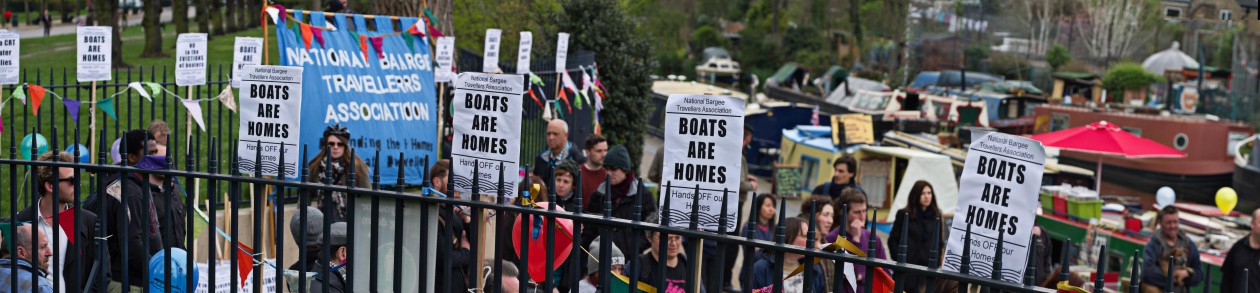
MARCH ON CRT OFFICES! on Saturday 26th March at 1pm Park Square in Regents Park NW1 4LH, nearby tube stations are Great Portland Street and Regent’s Park.

More info here: March on CRT offices

Facebook event here: https://bit.ly/boatshomes26

The screws continue to be tightened on our community 

Canal River and Trust (CRT) is trying to further marginalise us by bringing in more reduced mooring times on the Grand Union, attempting to ban boats from 295 no mooring spaces in ‘safety’ zones on the River Lee, and introducing more mooring restrictions and a total of 1.1 kilometres of new chargeable moorings in Central London. 

With the Clean Air Act putting boats under the same clean air zone restrictions as houses, the Government has made it harder for many of us to heat our homes and has opened us up to more harassment from land based NIMBYs. 

We must stand together and continue to defend our nomadic way of life. A  way of life that has been on the firing line for some time. Some older members of the community will still remember when British Waterways (BW) put forward their Bill to government in 1989, they tried to make it a criminal offence to have a boat without a home mooring on most UK waterways.

Due to action by some great individuals that particular attack was defeated and the Bill was made into the British Waterways Act 1995, where the right for us to have a boat without a home mooring, as long as we use them for navigation and not stay continuously longer than 14 days in one place, unless reasonable, was enshrined in law.

We are in a different time from then and we need more than great individuals; we need collective action. The resistance to ‘safety’ zones on the River Lea is great example of how we can defend our way life.

Let’s come together to march on CRT Little Venice office on Saturday 26th March and using the press, make it heard that Boats are Homes!

More information here:

https://nbtalondon.wordpress.com/2022/02/04/we-must-march-on-crt-offices/

Facebook event here: https://bit.ly/boatshomes26

NBTA press release: distance not important in continuous cruising

NATIONAL BARGEE TRAVELLERS ASSOCIATION

PRESS RELEASE

8th December 2014

DISTANCE NOT IMPORTANT IN CONTINUOUS CRUISING: THE COURT JUDGEMENT CRT TRIED TO HIDE

A recent judgement in a Section 8 case confirms that it would be unlawful for Canal & River Trust (CRT) to set a minimum distance that continuous cruisers must travel to comply with the law.

The judgement in the case of CRT v Mayers states that repeated journeys between the same two places would be “bona fide navigation” if the boater had specific reason for making repeated journeys over the same stretch of canal. HHJ Halbert also stated that any requirement by CRT to use a substantial part of the canal network was not justified by Section 17(3)(c)(ii) of the British Waterways Act 1995 because the requirement to use the boat bona fide for navigation is “temporal not geographical”.

In addition, Judge Halbert determined that a boat with a permanent mooring is not required ever to use its mooring. Indeed, during the course of argument CRT conceded that if Mr Mayers acquired a home mooring, he would be left undisturbed even if he did not use the mooring, provided that he did not exceed the limit of 14 days in one place.

The judgement was handed down in November 2013 but CRT has not published it, unlike other judgements in Section 8 cases. Yet despite knowing about this judgement for a year, CRT is currently attempting to set a minimum distance that continuous cruisers must travel in order to comply with the law.

CRT held two meetings with boating user groups on 22nd September and 3rd November 2014 in which it tried to persuade the groups to agree a minimum distance that boaters without home moorings must travel every three months and over their licence year to avoid enforcement action. CRT did not disclose this judgement at either meeting.

In 2011, BW re-wrote the Mooring Guidance for Continuous Cruisers to remove the words “the law requires a genuine progressive journey (a cruise) around the network or a significant part of it” as a result of the judgement in British Waterways (BW) v Davies. The guidance was renamed Guidance for Boaters Without a Home Mooring.

In 2003, British Waterways tried to introduce the Draft Moorings Code or Lock Miles Rules, which would have required continuous cruisers to travel at least 120 different lock-miles every three months without using the same stretch twice. This draconian proposal was dropped by British Waterways following the threat of legal action by a boating user group and in 2004 the Mooring Guidance for Continuous Cruisers was published instead.

In spite of this judgement CRT started court action in early 2014 against a boat dweller who did not use his home mooring. It has now dropped the Section 8 claim against liveaboard Tony Dunkley.

The relevant paragraphs of the CRT v Mayers judgement are reproduced below.

7.22.3
I consider the requirement imposed by CRT that a substantial part of the network is used cannot be justified by relying solely on section 17(3). That section requires “bona fide navigation throughout the period of the licence” not “bona fide navigation throughout the canal network”. The requirement is temporal not geographical. In my view it does NOT follow from:

“Such journey or cruise must take place “throughout the period of the licence”

that it

“therefore requires progression round the network or at least a significant part of it”

7.22.4
If a person who lived permanently on his or her boat had specific reason for making repeated journeys over the same stretch of canal between two points sufficiently far apart to be regarded as different places, it would in my view be purposeful movement by water from one place to another and hence “bona fide navigation”. In the course of argument I used the example of someone who lived on his boat but was also using the vessel commercially to move coal from a mine to an iron foundry only a few miles away and then returning empty for another load.

7.22.5
To take an extreme example, in its heyday, the Mersey Ferry operated continuously to and fro over the same stretch of water which is less than a mile wide. No one would ever have accepted the suggestion that the ferry boats were not bona fide used  for navigation throughout the period of their operations.

6.3
There are clear anomalies in both positions. CRT clearly regard the occupation of moorings by permanently resident boat owners who do not move very much as a significant problem (see paragraphs 3.5 and 3.6 above). However, neither the statutory regime in subsection 17(3) nor the guidelines can deal with this problem. A boat which has a home mooring is not required to be “bona fide used for navigation throughout the period of the licence” but neither is it required ever to use its home mooring. The Act requires the mooring to be available, it does not say it must be used. The guidelines also have this effect. The boat is still subject to the restriction that it must not stay in the same place for more than 14 days but there is nothing whatever to stop it being shuffled between two locations quite close together provided they are far enough apart to constitute different places. If those who are causing the overcrowding at popular spots have home moorings anywhere in the country the present regime cannot control their overuse of the popular spots. Such an owner could cruise to and fro along the Kennet and Avon canal near Bristol and the home mooring could be in Birmingham and totally unused.

You can download the judgement here http://www.bargee-traveller.org.uk/?page_id=23

NOTES FOR EDITORS

1. For more information contact the National Bargee Travellers Association, press@bargee-traveller.org.uk or 0118 321 4128

2. The National Bargee Travellers Association (NBTA) is a volunteer organisation that campaigns and provides advice for itinerant boat dwellers on the UK’s inland and coastal waters.

3. Boats can be licensed to use Canal & River Trust’s waterways without a permanent mooring under Section 17(3)(c)(ii) of the British Waterways Act 1995. This section states:

(ii) the applicant for the relevant consent satisfies the Board that the vessel to which the application relates will be used bona fide for navigation throughout the period for which the consent is valid without remaining continuously in any one place for more than 14 days or such longer period as is reasonable in the circumstances.

4. The Court granted a Section 8 order to CRT on the grounds that Mr Mayers had deliberately not navigated at all, in breach of the 14-day rule, and had therefore not complied with Section 17(3)(c)(ii).

5. The CRT v Mayers and BW v Davies judgements are County Court judgements. The County Court is not a Court of Record and therefore its judgements do not form case law or create legal precedents. However, County Court judgements can be persuasive to other judges. The Practice Direction on the Citation of Authorities [2001] 1 WLR 1001 states that County Court judgements may be cited in a County Court “in order to demonstrate current authority at that level on an issue in respect of which no decision at a higher level of authority is available”. No other decisions apart from these exist at a higher level regarding the issue of the interpretation of Section 17(3)(c)(ii) of the British Waterways Act 1995.

6. Normally when CRT wins a Section 8 case against a boater it publishes the judgement (where there is one) and the order herehttps://canalrivertrust.org.uk/publication-scheme/publication-scheme/court-action-to-remove-boats-from-our-waterways

National Bargee Travellers Association
30, Silver St, Reading, Berkshire, RG1 2ST

0118 321 4128


secretariat@bargee-traveller.org.uk
www.bargee-traveller.org.uk

The 14 Day Rule

Boaters may have received two letters from CRT recently, posted direct to their boats. One, dated 8 August 2014, states “The canals and rivers in London have seen a 36% rise in boat numbers over the last five years to 2,964 boats in March 2014. In the past year alone, overall numbers have increased by 14%, while numbers of continuous cruisers in East London has [sic] increased by 85%.”

Continue reading The 14 Day Rule