Tag Archives: Licence Strike

Why I will be licence striking as part of a coordinated boater mass action

Here is an opinion of a boater about a licence strike:

My boat is my home. Over a five year period CRT want to raise my licence by around £600. That’s an additional half on top of the fee I already pay. I want to make a stand and I want to refuse to pay such an excessive rise but I’m nervous about a participating in the proposed licence strike. I don’t want to jeopardise my home.

I feel a powerful need to do something to stop CRT getting away with this punitive and destructive surcharge, particularly in the face of reduced services and fat salaries at the top of their organisation. What they’re doing with moorings is what was called embourgoisement when old terraced houses in towns got bought up by the middle classes and working people were priced out of those areas. The same when council houses were sold off. The CRT is looking, by design or by default, to price a whole section of society off the water. Where those people go, CRT don’t seem to care. What they’re doing by running services down is impoverishing the lives of all canal users, not just boaters. Their justifications and their figures are, at best, questionable. What’s their motivation?

Over many years, and in completely different situations from this one, I have had involvement in strikes and coordinated actions. The empowering factor in those activities for the people involved has always been numbers. To stand side by side with people seeking to achieve the same aim is powerful, reassuring and, even if the purpose of the action isn’t fully realised, provides future security in knowing you have each other’s interests at heart. The ripple effects create change somewhere else along the way. It changes the people who are involved and it makes those seeking to squash individuals and force them out of, or into compromised positions, realise that they have to rethink , because together, individual voices form a potent mass, a force to be reckoned with.

Organisations hit by strike action have to rethink their strategies. They have to sit down and negotiate with the people their proposals will adversely affect. They have to back down or compromise. I doubt the CRT would be able to continue to press such punitive payment proposals into action if enough people say “no”. The negative publicity of forcing numbers of people out of their homes would likely be counterproductive if they’re publicly shown to be making life worse by water.

I’ve been on strike as a warehouseman and as a teacher. I’ve been on mass demonstrations, squatted empty buildings, blocked machinery from digging roads across peoples beloved landscapes. Those things have had an effect. I can look back and see that some of the efforts haven’t been successful in the long term but have caused a slowing down of the process, a rethink of the necessity of a scheme and have always cost  the organisations and corporations money, something they hate not having control over.

I’ve also seen things conclude with some success. A pay rise, better working conditions, an ear bent to listen in a more understanding way, negotiation of future plans with those who will be adversely affected. I’ve rarely been involved in the process of organising. I’m more a person who stands arm in arm with others who are struggling with the same imposition of stringent and ill advised policies. Standing with people is powerful. If we don’t do it, if we give in to the insecurities it raises for us, if we roll over, we don’t stand a chance of being heard or of winning our case.

The CRT isn’t a massive organisation, it’s not a multinational corporation, it’s not government. It’s a trust, a charity. It has a set of principles it ought to be adhering to. It has a broad remit and it needs to fulfil that remit in all aspects of its work. As Ccers, and it now seems, as long term moorers, they have engaged with us offering unfavourable terms. We need to take those terms back to them and say no. If we try that individually, they’ll pick us off and deny the justness of each case, as if to suggest each individual effort was pure wilfulness or criminality. If a mass of boaters coordinate to say a loud and reverberating NO, they’ll be forced to sit up and take note, to look at their strategy, to test it against a mass of adverse opinion.

How we achieve this it’s not my intention to state here. I just want to reassure myself and others that it’s possible to stop this surcharge being imposed or at least to negotiate something far more reasonable. And I want to hear enough other voices say a simple YES to decisive action so that I feel secure in taking that necessary action myself.

If you would like to ask questions about going on licence strike or agree with having a licence strike please contact Licence Strike campaign group. Licence Strike campaign group are planning to organising the licence strike, their email address is here:

crtlicencestrike@gmail.com

To register your interest in striking by filling out their signup formtinyurl.com/licencestrike

The campaign has produced a Q&A about the Licence Strike here:

Licence Strike Imminent


CRT have introduced their discriminatory surcharge against boats without a home moorings.  As every day passes, more boaters realise that their licences are spiralling upwards while services continue to degrade.  As more boaters realise that they are been priced off the water, urgent action is required.   CRT claim it’s about money.  But is it really? 

There is no money to be made by the surcharge.  Rather it is about making an alternative way of life impossible.


The surcharge has been justified by CRT following a consultation that they presented to their board of trustees.  CRT claimed that the consultation revealed that boaters were overall in favour of a surcharge.  However multiple FOI’s have shown that CRT doctored the consultation, removing the slides that demonstrate that 97% of boats without a home mooring and 60% of all boaters were against the surcharge.  The doctored consultation was used to mislead the board of trustees and push through this discriminatory surcharge.
Recent contact with Richard Parry by NBTA members has shown that CRT has no interest in discussing how the surcharge will negatively impact our way of life.  He has stated that there will be no reopening of negotiations regarding the surcharge.  But CRT once claimed similar regarding the ‘saftey zones’ and following community pressure, they have been forced back to the table. 

So what does pressure look like this time around? A licence strike: Strikers will refuse to pay CRT’s new class of licence fee in protest against the ever increasing additional charges for boaters who
do not want, cannot afford, or cannot find a home mooring.
Currently the Stop the Surcharge Campaign are looking to sign up 500 boaters to go on a full licence strike.  They are rapidly approaching that threshold and strike action is imminent.  Why do they need to wait until 500 are ready to go on strike before acting? First, we are stronger as a collective in the face of CRT’s enforcement.  Such a number would overwhelm CRT’s enforcement capabilities thereby minimising the risk to you and your home.  Secondly, it would deny CRT over half a million pounds (the same amount as the combined salaries of Richard Parry, Chief Executive, and Stuart Mills, Chief Investment Officer).  Such amounts would begin to exert the pressure require from CRT to reopen discussions.  

To sign up to the strike go to  tinyurl.com/licencestrike . We are also looking for volunteers to deliver leaflets and picket CRT stalls, thereby damaging their public image.  If you feel that you would be able to please email:  CRTlicencestrike@gmail.com .

Resisting CRT’s controversial Surcharge with a Licence Strike

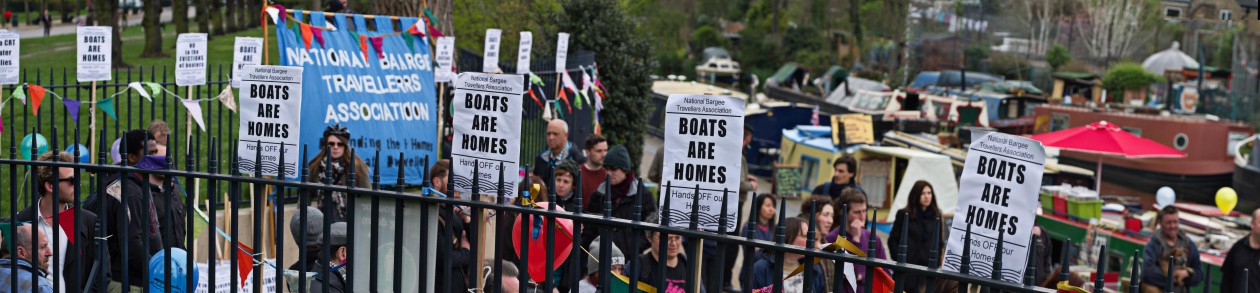
Stop The Surcharge Campaign members are organising ahead of a Licence Strike. They are asking anyone interested in striking to sign up to the Licence Strike Group – tinyurl.com/licencestrike. Strikers will refuse to pay CRT’s new class of licence fee in protest against an ever-increasing additional charge for boaters who do not want, or cannot afford or find a home mooring.

The strength of this protest action is it has real leverage – a real financial and administrational impact on CRT. The new ‘Continuous Cruiser’ fee is perceived within the community as an attempt to incrementally price itinerant boaters off the waterways. Once enough people sign up to the Licence Strike, if CRT doesn’t back down a strike will be called. A coordinated Licence Strike will have a significant impact on CRT, overloading their enforcement team and costing them dearly.

Early signs are strong. Leafleting and promotion has only begun and already over 300 boaters have signed up. Strike organisers have indicated that the number of strikers are growing of their own accord:

“Boaters can see how divisive and unfair the Surcharge is and they want to strike – some are striking already. The intent is already there in the community – all we’ve had to do is facilitate it as a viable protest action. Our job is to make the strike effective and safe for boaters. There are legal protections we can incorporate. There is protection in numbers. Already more than 300 hundred boaters have signed up, and there’s an entire community behind them.”

“Boaters are being charged unfairly every time they renew a licence. CRT almost certainly aim to increase the surcharge beyond what they have stated so far and destroy our community, and boaters know this. The number of strikers will only grow. Once we have enough interest we will call a ballot and strike. CRT have left us with little choice – take action or they will end our community. We must take collective action to stop the ‘surcharge’. “

Stop the ‘surcharge’ by signing up to the License Strike Group – go to tinyurl.com/licencestrike and complete the signup form. There will be a full description of the strike action and a full ballot to members and boaters before any strike action is taken.


NBTA London needs your support to carry on our work. Please get in touch here if you would like to volunteer with us. Alternatively your donations are vital to us supporting boaters with their legal case work, campaign banners and other printed material as well as events. You can help us with your donations online here


A history of the collective fight for our homes

The fight to defend our homes is far from new. For as long as land and water are privatised and our right to live on those lands and waters are restricted by private, often for-profit landlordism, people have always fought for our right to live.

In UK’s modern history, we saw this over a century ago when in 1915 the women of Glasgow resisted increases in rent prices. They formed a women’s housing association and in May 1915 some 25,000 Glaswegians joined a rent strike that eventually pressured the government to pass the Rent Restriction Act. 

Statue of 1915 Govan Rent Strike Organiser, Mary Barbour, in Glascow

Unfortunately, the rent controls were reversed and another major wave of rent strikes came in the 1930s, when the working classes of London, Birmingham, Huddersfield, Liverpool, Aberdeen, Sunderland, Oxford and Sheffield seized power into their own hands and took strike action, demanding rent reductions as well as overdue repairs. Some tenants fought against intimidation, evictions and violence from bailiffs and police for months. Rent controls were reintroduced with the outbreak of the Second World War, followed by the Rent Act of 1957.

But as the government began inflicting vicious austerity programmes and privatised public housing over the past few decades, the UK has further plunged into increasingly acute housing crises.

This may not be surprising to us, as many boaters may have chosen to live aboard because living on land simply became too expensive. But with much of our waterways remaining under the control of the Canal and River Trust who have unilateral power to set license fees, we are again seeing what happens when the cost to literally live in our homes become unbearable.

Govan 1915 Rent Strike, Glasgow

But if history tells us anything, it is that we the people have power. More recently, in 2022 we saw this in action with the #DontPay campaign where families across the country pledged to withhold paying unjustly high costs for energy, which contributed to the government’s decision to offer some – if still inadequate – controls and support for households.

While too many decisions impacting our lives are made by just a handful of individuals, we have the power to resist and push for change. Affordable living should be the bare minimum, and beyond that we must continue fighting towards a commons where we all have the voice and power over our homes, our lives and futures.


NBTA London needs your support to carry on our work. Please get in touch here if you would like to volunteer with us. Alternatively your donations are vital to us supporting boaters with their legal case work, campaign banners and other printed material as well as events. You can help us with your donations online here