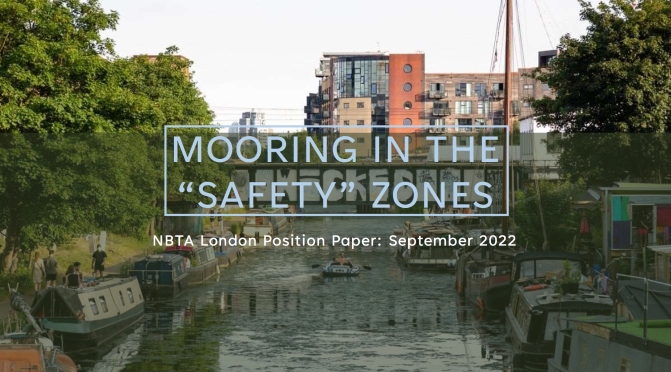
Have you ever wondered what the ‘no mooring’ sites in the ‘safety’ zones” are all about?
What are CRT trying to say to justify them, and which sites are NBTA London challenging and why?
In this document we answer these questions *and more*.
As well as hashing out the main arguments, we have throughly, concisely and clearly laid out each area which CRT are trying to ban boats from in the ‘safety’ zones.
The document states CRT’s position and shows NBTA London’s counter argument to each of the sites which we are challenging.
It’s very useful to help understand the ‘safety’ zones better. It’s not only very pretty, but also a must read!’ —> view pdf
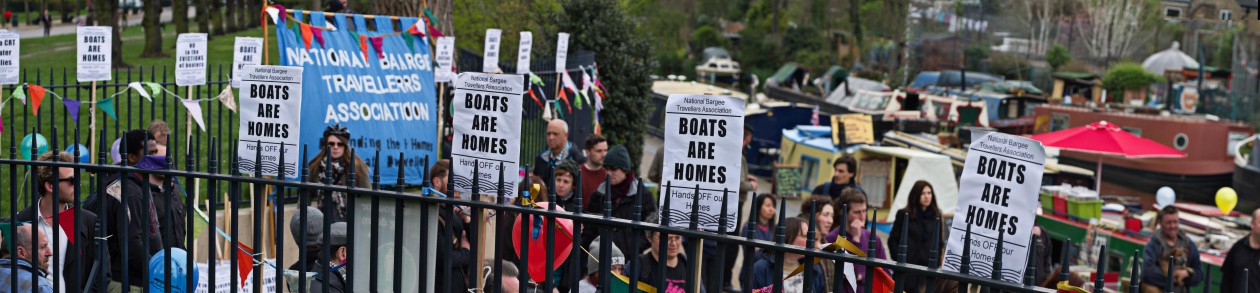
NBTA Boats are homes protest outside CRT’s London offices
NBTA London needs your support to carry on our work. Please get in touch here if you would like to volunteer with us. Alternatively your donations are vital to us supporting boaters with their legal case work, campaign banners and other printed material as well as events. You can help us with your donations online here
Hundreds of boaters, local residents and land-based supporters turned out on Sunday 26th of June to attend the National Bargee Travellers Association’s (NBTA) Hackney Protest Picnic in a continued show of resistance to the Canal & River Trust’s (CRT) ongoing attacks on the capital’s liveaboard boating community.
The picnic, which began at midday and ran into the late afternoon, was held on Walthamstow Marshes opposite the Anchor and Hope pub. On a day lit by glorious summer sun, the capital’s boating community came together in a joyous show of solidarity and celebrated their life on the water with conversation, live music, mural painting, refreshments and a vegan BBQ. With hundreds in attendance, the event was a chance for local, land-based residents to learn more about boaters, and to hear from the NBTA about the attacks that their community has sustained from CRT over the past few years, as well as the lively and ongoing campaigns to preserve their way of life that have grown up in response.
Picture by Amy DyduchPicture by Amy DyduchPicture by Marcus Trower
Marcus Trower, NBTA London branch secretary and one of the event’s organisers said: “London’s boater community has endured years of attacks on their way of life from the CRT – everything from unlawful attempts to evict boaters from their homes to the current Water ‘Safety’ Zones that will drastically restrict boaters ability to live and work around the River Lea. This Protest Picnic is an opportunity to not only draw attention to the issues that boaters are facing from the CRT, but to also celebrate our unique community, way of life and contribution to Hackney’s own rich public life. Those of us that have moored in Hackney consider spending time here to be an essential part of London’s boating culture, and one of the joys of making our lives on water; we’re looking forward to welcoming as many people as possible to Walthamstow Marshes to celebrate that fact with good food, music, conversation and continued solidarity for our fight against CRT’s boat cull.”
With the CRT recently rowing back on commitments to consult with boaters about the removal of moorings in so-called ‘Water Safety Zones’ on the River Lee, the Protest Picnic comes at a time of uncertainty for many boaters, many of whom have been harassed with enforcement notices and threatened with eviction from their homes. Sunday’s celebration of boater life was the latest in a series of events which protest against the CRT’s plans to drastically cull the number of casual moorings across London, and demonstrate the strength and vibrancy of the liveaboard community whose lives these plans will negatively impact. In April 2021, a flotilla of boaters made its way through Broxbourne to raise awareness of CRT’s attacks in the local community and in June 2021 a similar flotilla protest through Hackney drew thousands of boaters and supporters alike. In March of this year, hundreds of boaters and supporters marched on the CRT’s main office in Little Venice to explain how these discriminatory policy changes are threatening people’s livelihoods and intentionally pricing boaters out of their homes.
Ian McDowell, chair of the London branch of NBTA explained some of the reasons behind boaters continuing resistance to the CRT’s plans: “This continued disregard for the people who live and work in these new ‘no mooring’ and proposed paid-for mooring areas drives boaters away from their livelihoods, and out of their homes. By ignoring its responsibility to preserve the waterways for all communities, CRT is crossing a dangerous line that could see London Waterways and other waterways become usable only by those who can afford any extra costs CRT chooses to introduce in addition to the licence fee. Their actions only serve to show that while CRT markets themselves as a charity that promotes wellbeing, they repeatedly try to introduce policies which attack boaters’ wellbeing and way of life.”
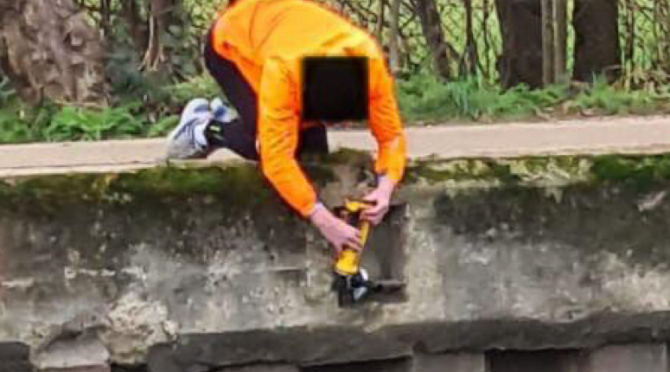
Oh look, an (allegedly senior) member of Lea Rowing Club (LRC) taking an angle grinder to the grab bars which can help people who have fallen into the river get out safely.
LRC has been unapologetic in pushing for CRT’s implementation of the “safety zones” – in fact they were the ones who came up with the deranged scheme in the first place.
But actually useful pieces of safety infrastructure there to help everyone don’t seem to matter to these overly entitled hypocrites. Could it be that their interest in “safety” has more to do with their desire to not share the river with other users?
The Canal and River Trust (CRT) is preparing to launch an assault on the rights of boaters. Specifically, their rights to moor on large stretches of the historic River Lea, a river which has been populated by boat owners of all flavours dating back to the Bronze Age.
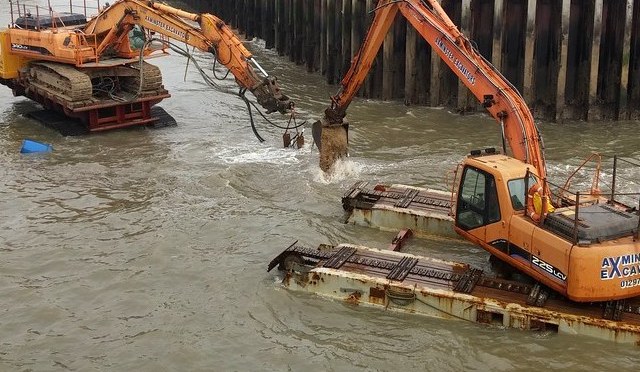
They are pursuing this strategy in the name of safety: they claim moored boats are a hazard to the users of the waterway. We do not agree. In fact, it is CRT themselves who are allowing the River Lea to become a dangerous place. They are allowing it to become dangerous through a lack of care, a lack of investment and a lack of sense. There are too many places which are too shallow, which make it impossible to moor close to the bank or even moor at all, in some places it even makes it hard to navigate.
The Lea has not been properly dredged for many years, 11 to be precise – and that was just the Lower Lea. Waltham Town Lock to Kings Weir hasn’t been done since 2009 and doesn’t even have a record of when above Waltham Town Lock has been done last.
And why, 11 years ago was the cost of dredging the Lower Lea deemed acceptable? The answer is simple, the City of London and by extension British Waterways did not want important, international visitors to the Olympic park to have to contend with the putrid smells and depressing sights of the nearby river which had been neglected. At the time, Simon Bamford, General Manager of British Waterways (BW) in London, is quoted as saying ‘[water] quality on the River Lee Navigation has been an issue of concern for many years, affecting local residents, wildlife, boaters and other waterway users’.
The reason for the poor quality? To put it quite simply, a deluge of raw sewage overflows brought down from Deephams Sewage Works in north London. 11 years later and that issue has not gone away! Together with the 2018 Lower Lea river oil spill, the Lower Lea is fast becoming a toxic mess that is hazardous not only to the humans that spend time within its proximity, but also the animals that call it home.
If safety was a real issue for CRT, rather than removing places where we can moor, they should be looking at positive actions which would get wide support, like dredging.
Canal and River Trust (CRT) are planning to change visitor moorings in central London into paid, pre-bookable moorings.
They are proposing ten locations, totalling 1.1 kilometres of towpath between Kensal and Viccy Park, where moorings that are currently free 7 or 14 day moorings will become 7 day moorings costing £10 to £12 per night. The fees that are being asked for would equal between £70 and £84 per week with no mention of how CRT will manage late arrivals, cancelled bookings, or over-stayers.
The proposals would mean for many boaters who cannot afford these significant fees a very long run from Kings Cross to Willesden that may well cause a lot of stress. It is another attempt by CRT to push out poorer boaters from central London. This is nothing less than social cleansing of the waterways.
CRT are also planning to make it an ‘improper mooring’ offence to moor a widebeam and a narrowbeam next to each other, no matter how wide the river or canal is. While we understand that this may be sensible where the waterway is narrow, such a blanket rule is unnecessary and unfair, especially given their plans to further reduce free mooring spaces in London.
On Saturday 26 March 2022, hundreds of boaters marched on Canal & River Trust’s (CRT) main London office to protest the Trust’s continued attack on the capital’s liveaboard boating community.
Starting in Regents Park, the protest marched to CRT’s offices in Little Venice where they were addressed by speakers from the boating community and land based supporters and engaged with the public to explain how these discriminatory policy changes are threatening people’s livelihoods.
The protest was hailed as a great success by Ian McDowell, Chair of the London branch of the National Bargee Travellers Association, which has helped organize boaters’ opposition to CRT’s attacks.
Since London’s boaters forced CRT into a consultation on their plan to remove up to 550 mooring places on the River Lea in 2021, the Trust has doubled down on their plans to cull boats from London’s waterways including:
• Bringing in more reduced mooring times on the Grand Union; • Implementing banning boats from 295 ‘no mooring’ spaces in ‘safety zones’ despite indicating they wouldn’t; • Turning a blind eye to criminal damage of safety features of the River Lea inside a so-called ‘safety zone’; • Proposing 1.1km of new chargeable moorings and further mooring restrictions in Central London; • Revealing that the Trust no longer takes complaints about their policies.
The National Bargee Travellers Association (NBTA) believe this is further evidence of CRT’s plans to prioritise leisure over living on Britain’s waterways. Early in 2021, CRT announced that they would be restricting moorings along 10km of the river Lea, claiming that mooring in these ‘Water Safety Zones’ was unsafe. The NBTA, together with the London boating community, fought back by organising two flotillas involving over 70 boats and 1000+ people. CRT was forced to engage boaters in consultation, the result of which showed boaters are concerned about safety, but the ‘Water Safety Zones’ would not make the river safer. The ‘River Lea Forum’ was established with representatives from all interested user groups to discuss what would make the waterways safer. However, CRT ignored boaters’ voices by imposing many of the ‘Safety Zones’ before the first Forum even took place.
In October 2021, ‘no mooring’ signs started appearing on the River Lea and boaters moored in these areas were told they would have enforcement action taken against them under the new ‘Improper Mooring Process’. CRT claims that these sites come under its existing rules on where boats are permitted to moor, but these are the exact same stretches that they’d planned to designate as no mooring as part of their ‘Water Safety Zones’, making these new rules for areas where boaters have lawfully moored without any penalty for many years.
On 10 January 2022, enforcement started on the ‘no mooring’ sites and since then, CRT has continued to try and intimidate boaters by giving notices threatening to terminate licences and thereby forcing boaters out of their homes. CRT has also employed a third party car parking ‘enforcement’ agency at huge cost to hand out these notices.
Tyrone Halligan, Amelia Friend and their two year old son Isaac.
London houseboat dwellers stage a protest against what they believe is a drive by the Canal & River Trust to force them out, as part of a gentrification process of the UK (particularly London’s) waterways.
Amelia and Tyrone have lived on a boat travelling the London waterways for seven years. Together with their two-year-old son, they spend up to 6 months a year staying in one place to the next along the stretch of the River Lea from Tottenham to Stratford where the ‘no mooring’ signs have gone up. They are currently expecting their second child and worry that they may have to leave the water, and perhaps London, altogether. “This area is our home. My son attends a nursery here and we’re registered with doctors, dentists, and my midwife appointments are in Homerton Hospital. We have built a life within this area and not being able to moor here truly feels as if we are being forced out,” Amelia says. “The stress of receiving abrupt emails, notices and knocks at the door, about where we are moored, in areas we have allowed to be for years previous, is causing us a great deal of stress at a time when, as a young and growing family, we already have a lot going on. No consideration is being given for people who have set up their lives, careers and families in these areas.”
Days before Christmas 2021, CRT made a fresh attempt at trying to take away mooring spaces in the capital by sneaking out another consultation with proposals for paid-for bookable short term moorings of less than 14 days. This, despite their own figures showing that the two ‘test sites’ for these new chargeable moorings have had less than 25% occupancy – most of the year they were wasted moorings. They’re also proposing further areas of restrictions on triple mooring and narrowboat to widebeam mooring – regardless of how wide the navigation is. “This continued disregard for the people who live and work in these new ‘no mooring’ and proposed paid-for mooring areas drives boaters away from their livelihoods, and out of their homes,” argues Ian McDowell, chair of the London branch of NBTA. “By ignoring its responsibility to preserve the waterways for all communities, CRT is crossing a dangerous line that could see London Waterways and other waterways become usable only by those who can afford any extra costs CRT chooses to introduce in addition to the licence fee. Their actions only serve to show that while CRT markets themselves as a charity that promotes wellbeing, they repeatedly try to introduce policies which attack boaters’ wellbeing and way of life.”
NBTA London demands that CRT concentrates on its mandate to maintain the navigation with things like dredging, rather than persecuting boaters who moor on some of the widest waterways in the country. The Trust must stop destroying boating communities by favouring one kind of boater over another.
NBTA and London Boaters have fought and prevented unfair and destructive attempts like these before, and we will do so again. National Bargee Travellers Association London branch (NBTAL) is supporting boaters in their direct action to disobey the ‘no mooring’ signs through providing a template complaint letter if they do receive a notice and posters to display in windows declaring the boat is moored in protest. Hundreds of boaters have defied CRT’s unfair and unjustified restrictions so far and since we are unable to complain online, now we are marching on CRT’s offices to resist the displacement of boaters and to protect our homes.
Ali was moored at Daubeney Fields. She works for a food and farming charity which advocates for land redistribution and community grow projects. Ali has been on the water for three years. “I’ve been involved in the protest movement against the new CRT restrictions for about a year and a half now, since the safety zones campaign started. I consciously seek out places where the new no mooring locations are. I speak to my neighbours about the restrictions, so that everyone in the community knows about them. And I think it’s important to show up physically against CRT’s attempts to gentrify the waterways even more. These are perfectly great moorings and the idea that they could become paid for or private moorings is really shocking. It’s been a hard year for everyone and the fact that space and land access is going to be restricted is really disgusting.”
“We must take a stand to protect our way of life or they will do everything they can to get rid of it.”
Marcus
Dee, Michelle and their son Io were moored offside at Daubeney fields. They have been on the water for just over a year. Mychelle is a baker. Dee is a gardener and has been clearing up the bankside where they are moored to make a lovely space for their son and other children to play. “It is a good spot to moor and it doesn’t cause any obstruction to anybody; there’s no reason for it not to be moored on. It’s a good spot to be. “The fact that it is a no mooring spot hasn’t really changed our minds about mooring here to be honest. If there was a real reason, like if it felt dangerous, then we wouldn’t moor here, obviously. But there’s no reason. Usually, families moor along here and our son will hopefully start school locally too.”
Lud by his boat
Lud “I work in a cleaning and maintenance job on a dock restoration site by the river. I’ve been on the water since 2016 and I fell in love with boating life and its people. I’m resisting the ‘no mooring zones’ because I think they are not fair to boaters who live on their boats and there’s nothing to justify them.”
Ben and Pru were moored at Matchmaker’s Wharf. They have been on the water for about three years. “We got a notice from the enforcement guy saying that we are wrongfully moored – there are no signs to tell us that we shouldn’t moor here and we haven’t received an email updating us about where we can and can’t moor. “CRT tried to put a load of water safety zones in and then realised that they hadn’t consulted anyone apart from the rowing groups. In a few years it will be impossible to moor in London and it will become just a rich city for rich people. It’s a subtle cultural genocide. They want to take us away.”
Jade and Ted were moored by the Green Bridge (Mandeville St).
Jade & Ted “There is no logic to what CRT are trying to implement. What they say it is about and what it is actually about are two different things. Safety is important, but this is nothing to do with safety”
Matthew was moored on the bend just above the Princess of Wales. He is a musician and he fits out sailaways to sell on. “I love the river and I love the people on it. I think (the safety zones) are absolutely ridiculous really. Boaters made the canal and rivers habitable again, haven’t we? We have a lot to do with the regeneration of the canals in London. The rowers don’t own the river . This is our life, for them it’s just a hobby. It’s really backward thinking and there’s a definite disconnect between us and CRT.”
Jay was moored near a bridge on the Filter Beds. Jay works in theatre, but has just quit his job and is going to cruise to Bristol at some point soon. “I didn’t realise that I was on a no mooring section. I’ve not heard anything, and I’ve been here a week. I think its just CRT saying that boaters are creating a problem, but we’re not. It’s kind of bullshit isn’t it? I don’t think mooring here makes any difference compared to mooring there, or mooring there (pointing to mooring spaces nearby).”
“In a few years it will be impossible to moor in London and it will become just a rich city for rich people. It’s a subtle cultural genocide. They want to take us away.”
Ben & Pru
Amy was moored near a bridge on the filter beds. “I don’t think (the safety zones) are needed. I think it is an unnecessary crackdown on numbers of boats in some of the widest parts of the river. The restrictions are unnecessary and I plan to ignore them for as long as possible.”
Marcus and his son aboard their boat
Marcus was moored by the electricity bridge on the offside. He is home schooler and plumber and has lived on the water for 10 years. “Over the years Canal and River Trust has been taking places where it has been possible to moor away. We must take a stand to protect our way of life or they will do everything they can to get rid of it.”
Canal River and Trust (CRT) is trying to further marginalise us by bringing in more reduced mooring times on the Grand Union, attempting to ban boats from 295 no mooring spaces in ‘safety’ zones on the River Lee, and introducing more mooring restrictions and a total of 1.1 kilometres of new chargeable moorings in Central London.
With the Clean Air Act putting boats under the same clean air zone restrictions as houses, the Government has made it harder for many of us to heat our homes and has opened us up to more harassment from land based NIMBYs.
We must stand together and continue to defend our nomadic way of life. A way of life that has been on the firing line for some time. Some older members of the community will still remember when British Waterways (BW) put forward their Bill to government in 1989, they tried to make it a criminal offence to have a boat without a home mooring on most UK waterways.
Due to action by some great individuals that particular attack was defeated and the Bill was made into the British Waterways Act 1995, where the right for us to have a boat without a home mooring, as long as we use them for navigation and not stay continuously longer than 14 days in one place, unless reasonable, was enshrined in law.
We are in a different time from then and we need more than great individuals; we need collective action. The resistance to ‘safety’ zones on the River Lea is great example of how we can defend our way life.
Let’s come together to march on CRT Little Venice office on Saturday 26th March and using the press, make it heard that Boats are Homes!
London’s waterways have received significantly more attention and usage of various forms in more recent years. Following decades of decline, London’s boaters have played a significant role in the reclamation and revitalisation of these spaces. However, this contribution seems increasingly undesirable by the authority that manages the waterways.
Since 2012, the Canal & River Trust (CRT) have assumed guardianship of 2000 miles of the UK’s canals and rivers from the state-owned British Waterways (BW). As a not-for-profit charitable trust, the CRT have placed an increased emphasis on wellbeing in their agenda for their waterways’ users.
There has been a notable increase in and heterogeneous uses of the River Stort, Lee Navigation, Regent’s Canal, Hertford Union Canal, and the lower Grand Union Canal. Cyclists, walkers, joggers, rowers, and kayakers are all user groups that the CRT appear happy to see using the waterways in increased numbers, but not all increases in usage seem to be so welcome.
The general trend of increased usage has brought a range of advantages, including an increased diversification of users of the waterways, yet this has occurred during a period of increased economic and social strain for many living in London. London’s housing crisis has led a relatively small proportion to search for viable living arrangements away from the increasingly unaffordable rental costs ‘offered’ by the housing market, joining the existing communities of liveaboard boaters on the cut.
According to the CRT’s National Boat Count, boat numbers were rising for a period in the London area. However this increase in use appears less welcomed by the CRT when compared to the increase in leisure uses of the estate they manage, despite liveaboard boaters paying licensing fees to the CRT, yielding them a growth in income revenue from boaters.
The CRT do not have legal powers to stop or restrict the number of licensed boats on the water, and as such are seeking “creative solutions to help manage growing boat numbers […] to address [the] challenges” this brings them. In lieu of the limited powers the CRT possess, it is difficult to envisage any “creative” solutions that would be equitable across the wide range of boaters that live on London’s waterways, such as introducing surcharges or fees for certain uses of the canals. However, this is occurring in spite of the CRT’s own 2020 data showing a 2.2% reduction of boats in the region.
The apparent need to manage the volume of liveaboard boats in London is not a new struggle for boaters. Back in 2010, BW said that were “more boats moored along the Lee than are desirable” and attempted to zone London’s waterways into “neighbourhoods”. Due to the anger and push back from boater communities, this plan was eventually dropped.
The National Bargee Travellers Association (NBTA) has described the CRT’s 2018 London Mooring Strategy (LMS) as “a strategy to help clear London’s waterways of boat dwellers and turn it into a London waterway leisure and business park. It is the perfect recipe for gentrification of the waterways.” Amongst other issues, the LMS includes a reduction of mooring time available for boaters at 22 sites, with increased surveillance and enforcement on the sites with reduced time limits.
The LMS has not been completed, yet the CRT are currently conducting a new survey to help them strategise new ways to manage the “very high and increasing” boat population. However, the CRT are yet to provide supporting information for the assumed problems caused by the volume of boats, or substantiating data on the apparently negative efficacies of an increased liveaboard population.
The current survey appears flawed in a range of ways, particularly as it is strewn with leading questions. As an example, they ask “In your own words what would you want the Trust to do to manage boat numbers in busy areas?” This assumes that the volume of boats is a problem, but are more boats a problem? More boats means more boaters, and as such a more vibrant and neighbourly community, helping to increase safety for all users of the waterways. Framing an increase in the number of boats as a problem evades other opportunities for the CRT to support thriving liveaboard communities by increasing the facilities offered.
It is also noteworthy that the majority of the survey is collecting qualitative data. This is welcome, as it provides an opportunity for participants to offer detailed, subjective understandings of their experiences of living aboard. However, whilst by no means impossible, such rich data can be difficult to generalise from in the development of an organisational strategy, and can lead accusations of cherry picking data and quote mining.
The global pandemic has created further tensions for the CRT and their wellbeing agenda. The initial lockdown saw posters erected to encourage “local” usage of towpaths, without any clarification of what that meant, causing confusion and anxiety for cyclists, walkers, and boaters alike. As soon as the lockdown was lifted, new posters replaced the old ones, and these actively encouraged the use of the use of towpaths for leisure purposes.
However, much of the towpath is difficult or impossible to navigate whilst staying two metres- or even one metre- from other users and boats. This exposed people to unnecessarily high risks, particularly moored boaters that were enduring the increased risk while remaining aboard their homes.
As with so many other examples of authorities exerting their political agenda in the dehumanising process of managing properties and estates, the lives of those impacted by this ‘management’ are treated with neglect and disdain. As the CRT seeks to offer leisure facilities and develop greater commercial enterprise on the waterways, the lives and rights of liveaboard boaters are treated as an unfortunate hangover of the historic canals of London.
The London branch of the NBTA continues to fight the increasing gentrification of London’s waterways and is planning further action to protect liveaboard boaters and to ensure that the waterways remain for the use of everyone, not just for those with access to resources or for business to expropriate money from a public asset.
If you are pregnant, on maternity, have a mental or physical disability, or are older you are entitled to have adjustments made to enable you to continue to live and own a boat on Britain’s waterways.
This is thanks to the Equality Act 2010 which means that the Canal and River Trust (or any other authority) cannot expect of you to meet their policies and procedures, including guidance in the same way that they would expect someone who did not fit into these characteristics.
For example, this means CRT shouldn’t tell you that you should not be living on a boat because you are disabled, “too old” or pregnant. These rights are in addition to the rights of all boaters without home moorings on CRT waterways to stay in one place longer than 14 days if it is “reasonable in the circumstances”. As a result of campaigning by the National Bargee Travellers Association (NBTA) and other groups, CRT has now adopted a standard procedure for assessing and agreeing adjustments to its enforcement procedure for boaters with disabilities.
Your boat license shouldn’t be terminated following enforcement action as your characteristic puts you at a substantial disadvantage. Don’t panic, you shouldn’t be made homeless if you follow our advice and keep the Canal and River Trust informed in writing.
Direct, combined and indirect discrimination defined by the Equality Act 2010
According to Equality Act 2010, direct discrimination occurs if a person is treated less favourably than others because of one or more of the protected characteristics defined in the Equality Act 2010.
If you are finding it difficult to keep in line with the conditions of your license due to a characteristic outlined in the Equality Act 2010 then this is the help sheet for you.
First off make sure you keep up good written communication and contact your local Boat License Officer (Enforcement Officer) via email.
If you are unable to do this get in touch with our caseworkers and we can speak on your behalf.
The Canal and River Trust should ask if you require an adjustment however we suggest you do inform them yourself.
The Canal should ask if you require an adjustment however we suggest you do inform them yourself.
What is reasonable in the circumstances cannot be defined in advance but if an adjustment is recommended from a GP, physical or psychological assessment, ATOS or supporting benefits document or other such Professional Authority then this should be taken as reasonable.
For example:
Pregnancy might mean you need to be near an area before, during and after birth for trips to visit the midwife. You may also request a period of non-movement after you have given birth.
Chronic illness (which must be on going over a period 12 months or longer) may require treatment, in which case a reduced range can be agreed upon.
Your disability may mean that you are only able to access specific areas, for instance if you find it difficult to open locks due to a physical ailment then a cruising pattern with minimal locks can be agreed upon.
If you are older and require adjustments such as use of a mobility scooter and would need to moor in areas which can accommodate access to you boat such as visitor moorings where you will be entitled to stay for the full 14 days or longer where reasonable in the circumstances.
If you need additional help people can support you in this process.
If you feel you are unable to manage your adjustment request someone can speak or organise emails on your behalf this can be a relative, friend or a caseworker. You will need to let the Boat Licensing Support team know whom will be representing you and provide signed form of authority;
FORM OF AUTHORITY
I, ____________________________________
of Boat Name:_________________________________________,
Boat Number:___________________,
hereby give authority for members of the National Bargee Travellers Association (NBTA) caseworkers to represent me and act on my behalf with regards to my dealings with the Canal and River Trust (CRT). In regards to these dealings, I hereby give consent for the NBTA Caseworkers Group to the disclosure of my records with CRT.
Signed:
____________________________
Dated: ______________________
Once you have started the process of requesting a reasonable adjustment you will receive the following email:
To enable us to consider your request, I would be grateful if you could provide in writing, within 28 days of this letter:-
i) Evidence of your disability in the form of a letter from your GP;
Medical evidence should not just state the condition that you currently have, but give some indication about how this might affect mobility or ability to move your boat.
ii) A written description from you of how your disability makes it more difficult for you to comply with our Guidance for Boats without a Home Mooring;
Provide a description of your condition and how this limits your ability to have a movement pattern that we would normally expect of a continuous cruiser, as well as detailing how the adjustment you are requesting would improve your situation/ or how it would help.
iii) Confirmation of the adjustment that you are requesting the Trust to make.
Be specific about the adjustment you are looking for.
For example you may want us to consider an adjustment to your cruising pattern to enable you to attend treatment at a particular hospital. It would also be useful if you could give an indication of how long you believe that you would need the adjustment for.
The team will then review your requests for adjustment and reply with their conclusions regarding your requested adjustments.
Remember you know yourself and your capability best and should you be unhappy with the adjustments the Boat Licensing Support are prepared to make then you will need to raise a complaint and which point be sure to copy the Welfare Officer in.
Please refer to CRT complaints procedure help sheet for further advice and guidance which is to be found on our website:






 National Bargee Travellers Association - London Branch