Tag Archives: news

Selling us up the Swanee

While CRT complains about the reduction in government funding and uses it as an excuse to increase our licence fees, we must remind ourselves that the reason given by the Tory government for the creation of CRT was so that the waterways could eventually be self-sustaining and not need any government funding. Putting aside the fact that the only way the waterways can continue is at least in part via government funding, the question is: how could the waterways be self-funded?

The only way that the waterways could be self-sustaining is by the waterways authority managing its profitable assets properly. However, CRT, which got the government contract in the first place on the proviso that it would eventually be self-sustaining, has been selling off its profitable assets. Back in 2018, for example, CRT put up for sale its marina subsidiary, BWML. Why did they do this? Was it because the marinas were unprofitable? No. In the words of Stuart Mills, Chief Investment Officer at CRT at the time, “BWML is performing well and we believe its prospects for future growth are good.” In 2018, the turnover at BWML was £8,502,000. This level of turnover continued to grow even after BWML became Aquavista. In 2021, turnover was £10,064,021. But unlike when it was BWML, CRT doesn’t receive that profit from Aquavista.

Limehouse Waterside and Marina is also part of Aquavista owned by BWML

Now that CRT has sold off BWML, who gets that profit? While there are many strands to this, simply put, the profits go primarily to the private equity company Lloyds Development Capital (LDC), which is part of Lloyds Bank. In 2018, CRT sold all its shares in BWML for £2,116 (yes! We found it difficult to believe too, but this is what the financial reports suggest) to a limited company called Project Belize Limited. You would think that the 18 marinas, including the Crick Marina, caravan sites, etc., would sell for millions, but the amount isn’t reported in the press, nor is it in the financial reports of CRT, Project Belize, or Aquavista. So, BWML became Aquavista, and Project Belize borrowed roughly £35 million from Lloyds Development Capital for infrastructure (no more detail is given than that). Aquavista now has 29 marinas in its growing portfolio. A lot of the profits from the marinas go to paying off the debt and, of course, paying shareholders.

CRT sold off this whole road (Dock Road) in 2024

So why did CRT sell off these very profitable assets like marinas, particularly when they weren’t facing a large funding shortfall from the government? There appears to be no good business reason. Even if they sold them off for £35 million, with the level of profit the assets were making, they would get that back in a few years. What better way to bring in money for a water authority than moorings? As well as profits from moorings, BWML generated income from caravan sites, boat brokerage, property rents, and other sources. Now that profit is being gobbled up by shareholders and bankers rather than going back into reinvestment in the waterways, which serve the wider public good.

Sadly, this is not an isolated case. CRT and British Waterways before them have been selling off anything bolted down or otherwise. From lock houses and dredging equipment to even towpaths, assets have been sold off and are being sold off, and this isn’t to the benefit of the waterways. It’s only to the benefit of the people and businesses that own them now. So it is CRT’s remarkable mismanagement (read: selling off) of its assets that has led to huge holes in its funding. We shouldn’t allow CRT to lump us with the bill for this with ever increasing licence fees. We say to CRT: fund our waterways and stop selling our assets!


NBTA London needs your support to carry on our work. Please get in touch here if you would like to volunteer with us. Alternatively your donations are vital to us supporting boaters with their legal case work, campaign banners and other printed material as well as events. You can help us with your donations online here

Licence Review Survey Results: What the Data Really Shows

The other week CRT’s Licence Review Commission published the results of their ‘engagement survey of Canal and River Trust waterway users’, carried out between March and April of this year by independent consultants Campbell Tickell. The survey – which many respondents have reported as being ill-conceived and biased – has nevertheless returned results that will make difficult reading for CRT.

Results showed that more than 8 in 10 are frustrated with the day-to-day management of CRT waterways in the UK. Over 60% of respondents were frustrated about maintenance – including of towpaths and banks, management of water supply and a lack of investment in infrastructure – making this the biggest issue raised in the report. Despite CRT scapegoating the rise in itinerant boat dwellers, only 1 in 20 surveyed saw overcrowding on the waterways as an issue. 9 in 10 did not support legislative change, despite CRT’s recent emphasis on this possibility.

Scapegoating itinerant boaters

The survey forms part of CRT’s ongoing ‘Future of Boat Licensing Commission’ which caused outrage earlier this year when it described the itinerant boating community as an ‘operational, financial and reputational challenge’ and lamented how legislation like the Human Rights Act 1998 and Equality Act 2010 were limiting the charity’s ability to take enforcement action against boaters, which includes forcing people into homelessness via eviction proceedings.

The total amount of itinerant boats is only around 7000 across CRT waterways. Yet CRT continues to target this small community with a controversial fee surcharge, a decline in services, punitive enforcement including of families, pensioners and disabled boaters, and multiple attempts to remove historic mooring spaces altogether.

Questions about the survey data 

The National Bargee Travellers Association, requested the raw data of the survey in a meeting with CRT, but to date has received nothing, shedding doubt on the Commission’s promises of “clarity” and “fairness”.

A Freedom of Information Act request has now been lodged, but CRT continues to deny the boating community its own data.

Failing on the basics

Despite CRT’s continued scapegoating of boaters, the numbers show a convincing rejection of legislative changes that could have decimated England’s boating community. 

More worryingly for CRT, they also indicate a range of stakeholders’ overwhelming level of frustration with its day-to-day management of the waterways, including financial mismanagement, a decline in facilities and anger over the inflating wages of CRT executives

The surcharge campaign has a strategy!

The campaign against the surcharge (the charge for not having a home mooring) started with a massive influx of people joining, and the campaign set up many working groups to facilitate the large range of strategies and tactics people put forward. After a while, it became obvious to most that there were too many strategies and tactics compared to the number of people actively doing things. Therefore, the campaign decided to agree on a set of strategies and tactics.

After much discussion, we, inside the campaign, have decided on a strategy to stop the surcharge. The strategy is twofold: while we are trying to make inroads with finding allies within Parliament (lobbying MPs, Lords etc) to be against the surcharge; we will also be using our leverage to take on CRT’s public image by protest leafleting at the very events and places CRT is trying to improve its image.

The reason why leafleting at CRT stalls works is that it undermines CRT’s public image. The whole premise of CRT’s existence is based on its “charity doing charitable work” public image, and of course, its donations are linked to how people view it. This is why it spends millions of pounds on PR events and social media, etc. CRT has written to NBTA twice now asking, then demanding, we stop leafleting at their stalls. It has obviously been having a serious effect on CRT, and there is no way CRT can stop us. Leafleting at CRT stalls will stop when CRT stops the surcharge; it is our leverage, its the reason CRT will stop the surcharge because CRT needs their public image more than it needs it charge the surcharge. Get involved to be part of the actions that will stop the surcharge. Email stopboatlicencediscrimination@gmail.com to be involved. 

With strategy of lobbying MPs, if successful, rather than fighting CRT time and time again over never-ending iterations of their attrition of our community, we might just possibly see government seeking to regulate CRT excesses on our behalf. Long shot. But if it works it will save us many, many more battles.

Our first ‘Drop in Session’ back in November was just a start. Our second session was planned for February 11th but has morphed to a meeting with Andrew Cooper MP, who we met at the first session, so that he might understand our case more fully, then to advise our next parliamentary steps.

2010-Present: BW and CRT’s local mooring strategies for London and the K&A

As itinerant boaters face the double threat of license surcharges and extortionate ‘pre-bookable paid towpath moorings’, it is worth reminding ourselves that when we faced similar challenges in the past, our protests were successful. 

In 2010, British Waterways (who were later succeeded by CRT), introduced ‘local mooring strategies’ in London and the West end of the Kennet and Avon. They claimed that ‘more boats are moored along the river Lea than desirable’ and tried to implement a set of rules that would make it near impossible for most itinerant boaters to live in these areas. 

British Waterways, in an attempt to make the river Lea less popular for boaters, tried to define the word ‘place’ in the following statute: the vessel ‘will be used bona fide for navigation throughout the [license period] without remaining continuously in any one place for more than 14 days or such longer period as is reasonable in the circumstances.’ (BW Act 1995, Section 17)

They claimed that a ‘place’ is the same as a neighbourhood and then defined enormous stretches of the waterways as one neighbourhood. In London, the entire length of the river Stort became two ‘neighbourhoods’ (and almost entirely seven day mooring only); all waterways in London south of the North Circular became one neighbourhood, including Limehouse cut and the Hertford Union; the Lea north of the north circular was split into three neighbourhoods. 

Having redefined the meaning of the word ‘place’, British Waterways declared that itinerant boaters had to move to a new neighbourhood each 14 days and would have to spend an equal amount of time in each neighbourhood across the licence period. 

Against this unfair attempt to cleanse the river Lea of itinerant boaters, hundreds of boaters protested. It was at this time that London Boaters, originally a protest group, formed. They got information about the changes out to residents, rowers, canoers, cyclists and surveyed boaters and towpath users. They encouraged responses to the consultation and demonstrated that, far from being unwanted on the Lea, itinerant boats were welcome. 

London Boaters also challenged the legality of BW’s proposals  and worked with other boating organisations such as NABO (National Association of Boat Owners) and RBOA (Residential Boat Owners’ Association). They conducted their own research which challenged BW’s unsupported claims about congestion and examined the likely impact of the proposals, which would increase homelessness and put pressure on local housing waiting lists. They showed that the changes would prevent boaters accessing education, employment and health care.

Eventually, in September 2011, British Waterways realised the game was up and announced that it was dropping its plans for London. But, they were implemented by the newly formed Canal and River Trust in a 12 month trial in 2014 on the K&A.

On the K&A, similar to the ‘neighbourhoods’ idea, they set a maximum length of time that could be stayed on each stretch of the canal. They also planned to implement a charge of £25 a day for staying longer than stated on a less-than-14 day visitor mooring and introduced a 20 mile minimum distance. If boaters couldn’t abide by these draconian rules,  CRT offered ‘roving mooring permits’ (£800 a year for a 60ft boat) which enabled the boater to move every 14 or 28 days. While CRT eventually conceded that the ‘roving mooring permits’ were illegal , many of these requirements will be familiar to itinerant boaters across the country as they have since been rolled out in guidance to all boaters. The parallels between the new ‘constant-cruiser’ surcharge and the ‘roving mooring permits’ might also be noted. BW backed down in London because boaters dedicated a huge amount of time and energy to fighting their cause, but CRT re-used the same ideas on the K&A some years later and are re-using them again now in the introduction of the itinerant boater surcharge and the pre-payable visitor moorings in London. We must stick together and stay united in our opposition to their incessant attacks on our way of life – attacks which have been defended against before and can be defended against again.


    NBTA London needs your support to carry on our work. Please get in touch here if you would like to volunteer with us. Alternatively your donations are vital to us supporting boaters with their legal case work, campaign banners and other printed material as well as events. You can help us with your donations online here

    Why I will be licence striking as part of a coordinated boater mass action

    Here is an opinion of a boater about a licence strike:

    My boat is my home. Over a five year period CRT want to raise my licence by around £600. That’s an additional half on top of the fee I already pay. I want to make a stand and I want to refuse to pay such an excessive rise but I’m nervous about a participating in the proposed licence strike. I don’t want to jeopardise my home.

    I feel a powerful need to do something to stop CRT getting away with this punitive and destructive surcharge, particularly in the face of reduced services and fat salaries at the top of their organisation. What they’re doing with moorings is what was called embourgoisement when old terraced houses in towns got bought up by the middle classes and working people were priced out of those areas. The same when council houses were sold off. The CRT is looking, by design or by default, to price a whole section of society off the water. Where those people go, CRT don’t seem to care. What they’re doing by running services down is impoverishing the lives of all canal users, not just boaters. Their justifications and their figures are, at best, questionable. What’s their motivation?

    Over many years, and in completely different situations from this one, I have had involvement in strikes and coordinated actions. The empowering factor in those activities for the people involved has always been numbers. To stand side by side with people seeking to achieve the same aim is powerful, reassuring and, even if the purpose of the action isn’t fully realised, provides future security in knowing you have each other’s interests at heart. The ripple effects create change somewhere else along the way. It changes the people who are involved and it makes those seeking to squash individuals and force them out of, or into compromised positions, realise that they have to rethink , because together, individual voices form a potent mass, a force to be reckoned with.

    Organisations hit by strike action have to rethink their strategies. They have to sit down and negotiate with the people their proposals will adversely affect. They have to back down or compromise. I doubt the CRT would be able to continue to press such punitive payment proposals into action if enough people say “no”. The negative publicity of forcing numbers of people out of their homes would likely be counterproductive if they’re publicly shown to be making life worse by water.

    I’ve been on strike as a warehouseman and as a teacher. I’ve been on mass demonstrations, squatted empty buildings, blocked machinery from digging roads across peoples beloved landscapes. Those things have had an effect. I can look back and see that some of the efforts haven’t been successful in the long term but have caused a slowing down of the process, a rethink of the necessity of a scheme and have always cost  the organisations and corporations money, something they hate not having control over.

    I’ve also seen things conclude with some success. A pay rise, better working conditions, an ear bent to listen in a more understanding way, negotiation of future plans with those who will be adversely affected. I’ve rarely been involved in the process of organising. I’m more a person who stands arm in arm with others who are struggling with the same imposition of stringent and ill advised policies. Standing with people is powerful. If we don’t do it, if we give in to the insecurities it raises for us, if we roll over, we don’t stand a chance of being heard or of winning our case.

    The CRT isn’t a massive organisation, it’s not a multinational corporation, it’s not government. It’s a trust, a charity. It has a set of principles it ought to be adhering to. It has a broad remit and it needs to fulfil that remit in all aspects of its work. As Ccers, and it now seems, as long term moorers, they have engaged with us offering unfavourable terms. We need to take those terms back to them and say no. If we try that individually, they’ll pick us off and deny the justness of each case, as if to suggest each individual effort was pure wilfulness or criminality. If a mass of boaters coordinate to say a loud and reverberating NO, they’ll be forced to sit up and take note, to look at their strategy, to test it against a mass of adverse opinion.

    How we achieve this it’s not my intention to state here. I just want to reassure myself and others that it’s possible to stop this surcharge being imposed or at least to negotiate something far more reasonable. And I want to hear enough other voices say a simple YES to decisive action so that I feel secure in taking that necessary action myself.

    If you would like to ask questions about going on licence strike or agree with having a licence strike please contact Licence Strike campaign group. Licence Strike campaign group are planning to organising the licence strike, their email address is here:

    crtlicencestrike@gmail.com

    To register your interest in striking by filling out their signup formtinyurl.com/licencestrike

    The campaign has produced a Q&A about the Licence Strike here:

    ‘Safety Zones’ Update

    It has been 3 years since CRT installed a new set of ‘No Mooring Zones’ on the River Lee. These ‘No Mooring Zones’ were exclusionary and unpopular at their outset – leaving the boating and wider community confused why it was so necessary to push boaters out of such a vital community area – without any evidence of a safety issue in the first place.

    For 3 years boaters have continued to moor in protest at these ‘No Mooring Zones’ – yet the river has remained safe, with no significant, or even noticeable spike in safety incidents. The Itinerant Boating Community is full of diversity. Boat dwellers are also canoeists, paddle boarders and rowers, and NBTA are keen to encourage and celebrate this diversity, so we have approached CRT to suggest a different approach. An approach based on mutual initiatives – rather than exclusionary ‘No Mooring Zones’ – where different aspects of the boating community work together to ensure the river is accessible to all. 

    It is early days yet, and we hope that discussion will have began in earnest by the end of July – but early signs are good, with CRT and key boating orgs along the River Lee showing interest in a different and more collaborative approach.

    A further benefit to this collaborative approach is it can be ‘grassroots’, growing within the community – saving CRT the cost of needless and ineffective micro-management and policing during this time of financial need.

    National Demo against the Surcharge in Birmingham

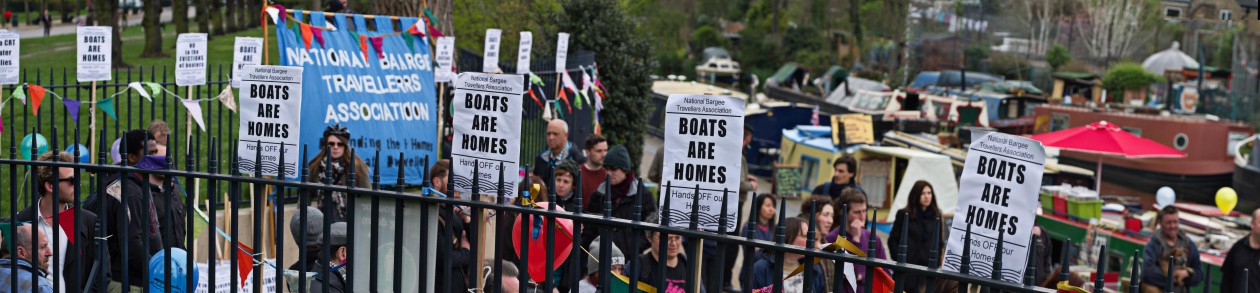
    On a crisp winter’s day in November, over one hundred boaters from across UK waterways descended on the Canal and River Trust’s Birmingham office. Boaters from all over, from Macclesfield canal, Birmingham canals, to Kennet and Avon canal, Monmouth and Brecon canal to River Lea and many more waterways unified to protest against CRT’s discriminatory licence fee surcharge. A few boats with banners joined us outside the office, which was really fantastic to see, and we were able to get the story into several press outlets too.

    The demo was a great success and showed CRT that we will not stand by and allow them to threaten our way of life. Thank you to everyone who came or supported from afar!


    NBTA London needs your support to carry on our work. Please get in touch here if you would like to volunteer with us. Alternatively your donations are vital to us supporting boaters with their legal case work, campaign banners and other printed material as well as events. You can help us with your donations online here

    NBTA gets council to put boat cleansing on hold

    Elmbridge council on Environmental Agency waterways is re-opening their consultation about imposing a public space protection order on ‘unauthorised’ moorings after NBTA encouraged people to challenge their plans. The PSPO would have allowed the council to issue fines of up to £400 for mooring on the Thames within Elmbridge for longer than 24 hours at a time.


    NBTA London needs your support to carry on our work. Please get in touch here if you would like to volunteer with us. Alternatively your donations are vital to us supporting boaters with their legal case work, campaign banners and other printed material as well as events. You can help us with your donations online here


    Partial Energy Grant Victory!

    After great effort by the NBTA and others, boaters without home moorings on Canal & River Trust waters will now finally receive the £600 winter energy grant. Together, boaters have fought hard for our community and won a victory. However, many people – including itinerant boaters on non Canal & River Trust waters, many live-aboards with a leisure moorings, and those living itinerantly on land – remain excluded, despite the grant being promised to every household in the UK.


    NBTA London needs your support to carry on our work. Please get in touch here if you would like to volunteer with us. Alternatively your donations are vital to us supporting boaters with their legal case work, campaign banners and other printed material as well as events. You can help us with your donations online here


    CRT SELLING OFF ASSETS…

    Ever wondered where to go to buy second hand industrial grade machinery? No, not just Stanstead Abbots summer bootsale, you could try Industry Asset Services Ltd (iaservices.co.uk). And were you to visit this industrial equipment auction site, you’d quite quickly find plenty of recognisable CRT equipment sold or on sale. Mainly boats; Piling Workboats, craning boats (and the cranes), rubbish barges, even the CRT patrol boat usually moored at Enfield Lock. But the CRT own much more than just boats, and it seems that if it can be sold, it IS being sold. There’s been diggers, trailers, even replacement beams for lock gates sold off through this site.

    CRT advertisement on iaservices.co.uk

    Well why would CRT sell this stuff? The only explanation CRT gave when questioned was

    that it: “would usually be the case that these boats and items are surplus to the Trust’s requirements or are no longer required in general.”

    As seen on iaservices.co.uk

    Which sounds more like, to make/ save some money. Seems fairly reasonable. Any organisation responsible for physical work and upkeep is going to need specialist machinery, tools and vehicles, and those assets will need maintenance themselves, and in some cases re- placing from time to time. So CRT are selling these things because they’re buying new ones right? Well, no. They are simply out- sourcing work in many cases. No need to have a patrol boat if you just pay more money out to a 3rd party company to do your patrols for you…

    As seen on iaservices.co.uk

    NBTA London needs your support to carry on our work. Please get in touch here if you would like to volunteer with us. Alternatively your donations are vital to us supporting boaters with their legal case work, campaign banners and other printed material as well as events. You can help us with your donations online here